


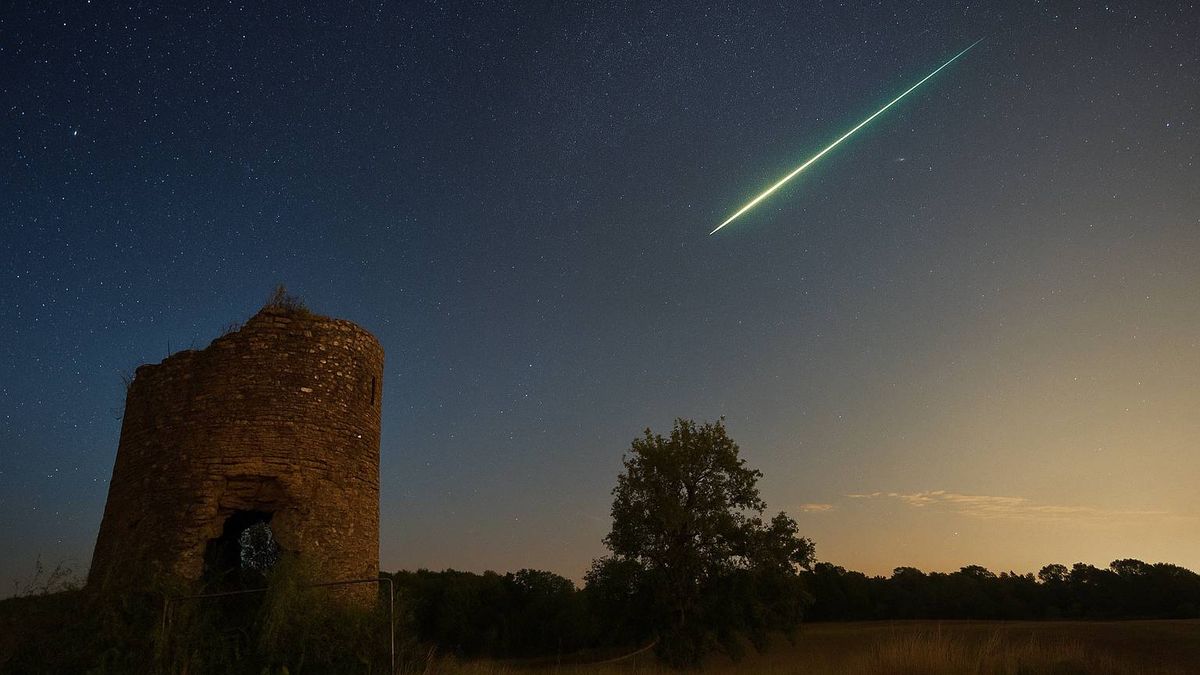
Stargazers across the Scotland are in for a rare treat this August as the annual Perseid meteor shower reaches its peak just hours after a partial solar eclipse.
The timing means astronomy enthusiasts could witness two major celestial events on the same day, with the eclipse occurring during the evening before the meteor shower produces a spectacular display overnight.
The Perseids will reach their peak on the night of Wednesday, August 12, into the early hours of Thursday, August 13.
The optimal time to observe the most meteors will be after midnight and before dawn, when the radiant – the point in the sky from which the meteors appear to originate – sits higher above the horizon.
During the peak, observers in locations with dark skies could witness dozens of meteors every hour, with the shower capable of generating up to around 100 meteors per hour under ideal conditions.
 View 3 Images
(Image: Getty Images/iStockphoto)
The Perseids are amongst the most renowned meteor showers of the year and occur when Earth passes through a trail of dust and debris left behind by Comet Swift-Tuttle.
As tiny fragments of space rock enter Earth’s atmosphere at tremendous speeds, they burn up, producing bright streaks of light across the night sky.
The meteors are known for being particularly striking because they are often bright, fast and can leave glowing trails in their wake.
The partial solar eclipse will occur earlier on August 12, with the Moon passing across the face of the Sun during the evening hours.
The eclipse will not affect the Perseids later that night, and the timing could actually improve conditions for viewing the meteor shower.
The eclipse will begin shortly before 6pm in parts of Scotland, with the maximum eclipse taking place at around 7pm before the event ends at around 8pm. Exact timings will vary depending on location.
- Eclipse begins: 6.08pm
- Maximum eclipse: 7.05pm
- Eclipse ends: 8.00pm
- Maximum coverage: Around 91% of the Sun
- Eclipse begins: 6.08pm
- Maximum eclipse: 7.06pm
- Eclipse ends: 8.00pm
- Maximum coverage: Around 91% of the Sun
- Eclipse begins: 6.05pm
- Maximum eclipse: 7.03pm
- Eclipse ends: 7.57pm
- Maximum coverage: Around 91% of the Sun
- Eclipse begins: 6.06pm
- Maximum eclipse: 7.04pm
- Eclipse ends: 7.59pm
- Maximum coverage: Around 92% of the Sun
- Eclipse begins: 6.01pm
- Maximum eclipse: 6.58pm
- Eclipse ends: 7.52pm
- Maximum coverage: Around 88% of the Sun
A new moon means there will be very little natural light in the sky, making it easier to spot fainter meteors once darkness descends.
For the greatest chance of seeing shooting stars, experts advise seeking out a location well away from streetlights and built-up areas.
Open countryside, beaches, parks and other spots with wide, unobstructed views of the sky offer the most favourable conditions.
 View 3 Images
(Image: AFP via Getty Images)
Allow your eyes time to adjust to the darkness beforehand, and avoid looking at your phone as the bright screen can hamper night vision.
No specialist equipment is required, with the meteors best observed with the naked eye as they can appear anywhere across the sky.
Clear skies will be absolutely vital for anyone hoping to catch the Perseids at their spectacular best. Cloud cover may obscure visibility, however the meteor shower remains active from mid-July through to late August, meaning there should still be plenty of opportunities to catch shooting stars around the peak period.
Article continues below
With a partial solar eclipse followed by one of the year’s most popular meteor showers, August 12 could become one of the biggest dates in the 2026 astronomy calendar.