


Osun’s toxic election buildup
August 7, 2026 12:39 am

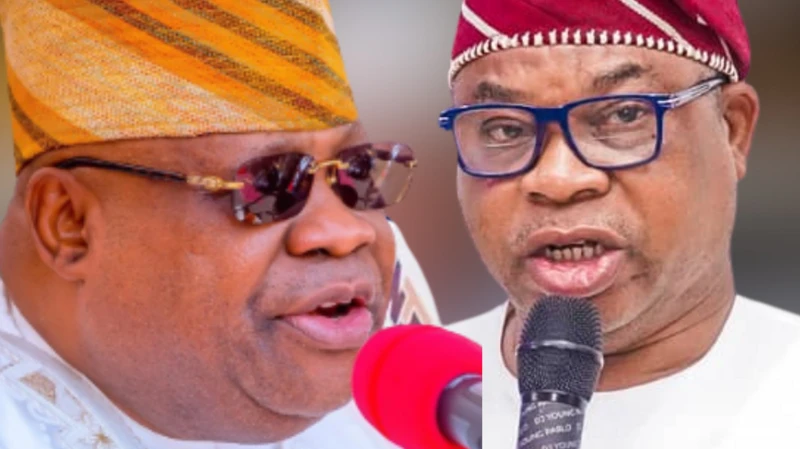
FILE: Governor Ademola Adeleke and APC governorship candidate, Bola Oyebamiji
OSUN State stands on edge. As its people prepare to elect a governor on August 15, the state is gripped by fear and uncertainty. The political temperature has risen to a frightening level. This is disturbing because an election is not supposed to be war.
Yet, the state is increasingly becoming a theatre of violence, intimidation and institutional warfare. Unless reason prevails, Osun’s toxic politics could end in a tragedy. That must not happen.
The state has remained in turmoil for four years. What began as a dispute over local government control has snowballed into one of the most dangerous political crises in the country.
Governance has been crippled. Local councils have become battlefields. Federal allocations have been trapped in legal and political disputes. The people have become unwilling spectators in a vicious power struggle.
The roots of the crisis are well known. The LG election at the tail end of former Governor Gboyega Oyetola’s administration was challenged in court and later nullified by a Federal High Court.
Governor Ademola Adeleke organised another council election under the Osun State Independent Electoral Commission. Thereafter came conflicting judicial pronouncements, with both the All Progressives Congress and the Peoples Democratic Party claiming legitimacy and the right to occupy council secretariats.
The inevitable happened.
When sacked APC chairmen sought to resume office, resistance followed. Political supporters clashed across several LGAs. Bullets replaced ballots. Former Irewole LGA chairman Remi Abbas was shot dead on February 17, 2025. About six other persons died with him.
Last month, the Nigeria Police Force confirmed it was investigating about 30 politically motivated killings ahead of the August 15 governorship election. Thirty deaths over politics. Thirty families shattered because politicians prefer conquest to service.
That is a national disgrace.
Even in the final days before the election, fresh controversies have only heightened public anxiety. The arrest and subsequent release of the Secretary to the State Government generated another round of political recriminations.
The freezing of Osun State’s accounts by the Economic and Financial Crimes Commission has further fuelled suspicion in an already combustible environment. Claiming ignorance, President Bola Tinubu called off the EFCC intransigence on Thursday, but the damage had been long done.
This is no longer healthy democratic competition. It is a desperate struggle for the soul of Osun.
No genuine desire to serve the people produces this level of bloodshed. Public office is not worth a single human life, let alone dozens. Yet politicians continue to inflame passions while innocent citizens live in fear. Businesses suffer. Investors stay away. Governance stalls.
The people whose welfare should be the central objective of politics become its greatest victims.
Osun’s toxic politics is becoming a metaphor for the degeneration of democratic values in Nigeria.
History offers a frightening warning.
The political class should revisit the events that followed the disputed Western Region election of October 11, 1965. Allegations of widespread vote rigging and manipulation sparked an explosion of violence that rapidly consumed much of the old Western Region.
What became known as ‘Operation Wetie’ was one of the darkest chapters in Nigeria’s political history.
Political opponents were hunted down. Houses and vehicles were soaked with petrol and set ablaze. In many cases, human beings suffered the same horrifying fate.
There were shootings, lynchings, assassinations, mob attacks, revenge killings, destruction of party offices, burning of homes and businesses, attacks on police formations and unrestrained reprisals between rival political camps.
The violence spread across Ibadan, Abeokuta, Ijebu, Oyo and many other towns.
Civil administration virtually collapsed in several districts. Commerce and transportation were disrupted. Thousands fled their homes. Heavy police deployments often resulted in even bloodier confrontations.
By late 1965, the South-West had earned the infamous label of the “Wild-Wild West” because law and order had all but disappeared.
Operation Wetie destroyed public confidence in civilian government, deepened political and regional mistrust and created conditions that culminated in the military coup of January 15, 1966, bringing Nigeria’s First Republic to an abrupt end.
A similar crisis erupted in 1983 in the old Ondo and Oyo states, from which today’s Osun State was carved, over disputed election outcomes. People died, homes burned, and communities were displaced.
Nigeria cannot afford another such descent into anarchy.
Yet the echoes are unmistakable. Osun’s toxic politics is steadily normalising hatred, violence and the weaponisation of state institutions.
Political rivals increasingly behave as though elections are wars to be won at all costs rather than constitutional contests whose outcomes should reflect the freely expressed will of the people.
That road leads only to disaster.
The Independent National Electoral Commission has assured Osun residents that every vote will count. The commission must now prove that promise.
Every ballot must count and be protected.
The police also carry an enormous responsibility. The visit by the Inspector-General of Police, Tunji Disu, and his appeal for calm are welcome. But appeals alone will not stop violence. Professional, impartial and proactive policing will. The police owe allegiance only to the Constitution, not to politicians.
Every troublemaker, regardless of party affiliation, must be restrained. Every voter must be protected.
Tinubu bears an even greater responsibility.
There is a widespread perception that he shares close political and family ties with former governor, Gboyega Oyetola, now Minister of Marine and Blue Economy. That perception imposes upon the President an even higher obligation to ensure that no federal institution is used, or seen to be used, to influence the outcome of this election.
This is the moment for statesmanship.
The President’s words carry enormous weight. His directives command attention throughout the federal establishment. He should deploy that authority to guarantee that security agencies, anti-graft bodies and every other federal institution operate with neutrality. He must not give room for insinuations that “federal might” decided the Osun governorship election.
Osun people alone must choose their governor.
If the election is free, fair and credible, whoever emerges victorious will enjoy legitimacy. If it is manipulated or tainted by violence, intimidation or abuse of state power, the consequences may haunt not only Osun but the entire federation.
Enough blood has been shed.
Enough families have buried loved ones.
Enough fear has enveloped Osun.
Politicians have too often been the arsonists of Nigeria’s democracy, lighting fires they later pretend to extinguish. They must not set Osun ablaze.
The ghosts of Operation Wetie must not become the headlines again. Osun’s toxic politics must not ignite another Wild-Wild West. It must not trigger a chain of events capable of plunging the country into another avoidable national catastrophe.
All rights reserved. This material, and other digital content on this website, may not be reproduced, published, broadcast, rewritten or redistributed in whole or in part without prior express written permission from PUNCH.
Contact: [email protected]