


Why Nigeria’s economic progress is still failing the ordinary citizen
August 7, 2026 12:36 am

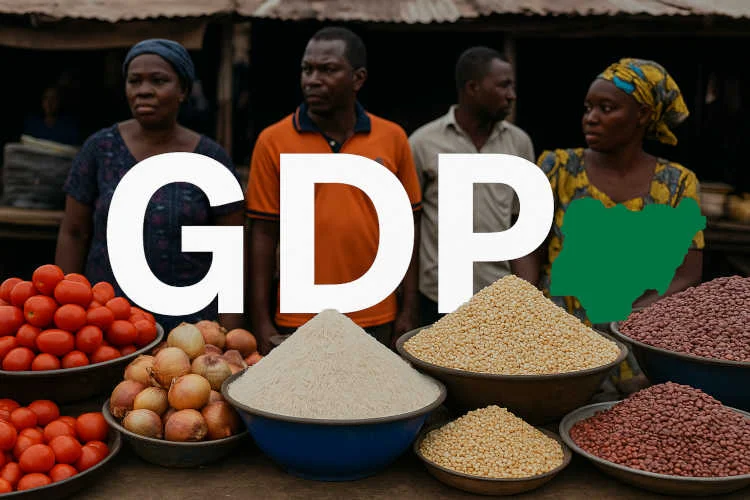
Illustrative picture of GDP and market. CREDIT: developmentdiaries. | Web
Wahab Abiona
Nigeria’s economy appears to be showing signs of recovery. Government officials frequently point to rising Gross Domestic Product, stronger foreign exchange reserves, improved tax revenues, renewed investor confidence, and far-reaching fiscal reforms as evidence that the country is on the path to sustainable growth. These indicators are important and suggest that difficult policy decisions may be yielding results.
However, for millions of Nigerians, this recovery remains largely invisible.
Across the country, households continue to grapple with rising food prices, expensive transportation, high electricity tariffs, increasing healthcare costs, and unaffordable school fees. This disconnect between encouraging macroeconomic indicators and the daily realities of citizens raises a critical question: Can an economy truly be said to be growing when the majority of its people are becoming poorer?
The answer lies in understanding that economic growth does not automatically translate into shared prosperity. GDP measures the size of an economy but does not show how wealth is distributed. Growth concentrated in sectors such as oil and gas, banking, or telecommunications may improve national output without significantly benefiting farmers, artisans, traders, manufacturers, and small businesses that employ most Nigerians. Economic growth that enriches only a few while leaving the majority behind cannot be considered inclusive.
Inflation has further weakened the impact of whatever gains have been made. Even where incomes have remained stable, their purchasing power has declined sharply. Families now spend a larger share of their earnings on basic necessities, leaving little room for savings or investment. Consequently, the cost-of-living crisis has overshadowed many of the government’s positive economic statistics.
Improved government revenues have also failed to inspire widespread public confidence. Citizens judge economic progress not by higher tax collections but by better public services. Yet poor roads, unreliable electricity, inadequate healthcare, underfunded schools, and limited access to clean water remain common challenges. Without visible improvements in public infrastructure and service delivery, higher revenues mean little to ordinary Nigerians.
Equally concerning is the labour market. Despite signs of economic expansion, unemployment and underemployment remain high, especially among young people. Many skilled professionals continue to leave the country in search of better opportunities, while countless others depend on low-income informal jobs. An economy that does not create productive employment cannot deliver lasting prosperity.
The depreciation of the naira has compounded these difficulties. Nigeria’s dependence on imported machinery, medicines, industrial inputs, and consumer goods means that exchange-rate instability quickly translates into higher production costs and increased prices. Businesses pass these costs on to consumers, placing additional pressure on already strained household budgets.
There is little doubt that reforms such as fuel subsidy removal, exchange-rate liberalisation, and fiscal consolidation may strengthen the economy over time. Yet reforms must produce benefits that citizens can see and feel. Without effective social protection programmes to cushion vulnerable households, the immediate costs of reform risk outweighing its long-term promise in the eyes of the public.
International experience shows that successful economies combine sound macroeconomic management with deliberate investments in agriculture, manufacturing, education, healthcare, infrastructure, and job creation. Countries that achieved inclusive growth ensured that national prosperity translated into rising incomes and better living standards for ordinary citizens.
Nigeria should pursue the same path. Economic reforms must be complemented by policies that expand opportunities, support small and medium-sized enterprises, strengthen productive sectors, improve public services, and promote transparent governance.
Ultimately, the true measure of economic success is not stronger GDP figures or higher government revenues but whether citizens can afford nutritious food, secure decent jobs, educate their children, access quality healthcare, and live with dignity and hope. Until macroeconomic gains are reflected in higher real incomes and improved living standards, economic growth will remain a success recorded in official reports rather than one experienced in Nigerian homes.
Wahab Abiona, finance, tax expert and public analyst, writes via [email protected]
All rights reserved. This material, and other digital content on this website, may not be reproduced, published, broadcast, rewritten or redistributed in whole or in part without prior express written permission from PUNCH.
Contact: [email protected]