


Gazelle refinancing frees crude, extends Nigeria’s repayment schedule
August 7, 2026 12:33 am

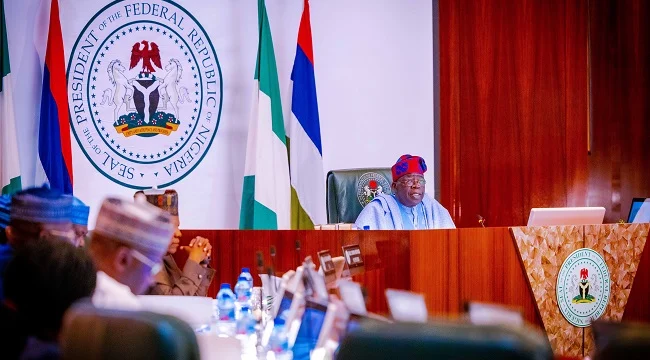
President Bola Tinubu during a National Economic Council meeting at the Council Chamber of the Presidential Villa on Thursday, June 15, 2023. Photo: State House/Nosa Asemota
The National Economic Council’s decision to reduce the volume of crude oil committed to servicing the government’s $3.3bn Project Gazelle oil-backed financing arrangement could lengthen the repayment timeline by about six months, potentially shifting the completion date from December 2029 to around June 2030, an analysis by The PUNCH has shown.
The projection is based on the revised daily crude allocation approved as part of the facility refinancing, which lowered Nigeria’s pledged crude from 90,000 barrels per day to 78,750 barrels per day, a reduction of 11,250 barrels per day.
The refinancing was approved by the National Economic Council at its meeting chaired by Vice President Kashim Shettima on Monday after the Federal Government sought to restructure the oil-backed financing to ease pressure on crude oil allocations while maintaining the country’s debt obligations.
But the Managing Partner of The Energy Consulting Practice, Kelvin Emmanuel, has faulted the Federal Government’s proposed Project Gazelle II crude-backed financing arrangement, describing it as unnecessary, opaque and financially disadvantageous to Nigeria.
He argued that the structure would impose fresh costs on the country despite existing oil-backed repayment mechanisms and questioned the transparency surrounding the transaction.
On August 17, 2023, The PUNCH reported that the NNPC announced it had secured a $3.3bn emergency loan to repay crude oil obligations from Afreximbank. It explained that the loan would be used by the oil company to support the Federal Government in stabilising Nigeria’s exchange rate.
“The NNPC Ltd. and AFREXIM Bank have jointly signed a commitment letter and Termsheet for an emergency $3bn crude oil repayment loan,” NNPC said in a statement.
“The signing, which took place today at the bank’s headquarters in Cairo, Egypt, will provide some immediate disbursement that will enable the NNPC Ltd. to support the Federal Government in its ongoing fiscal and monetary policy reforms aimed at stabilising the exchange rate market,” it added.
Under the deal, NNPC committed to deliver 90,000 barrels of crude oil per day from Production Sharing Contract assets to back a funding facility, with repayment beginning in June 2024.
However, the refinanced arrangement has been structured on significantly more favourable terms than the original facility, including a substantial reduction in the volume of crude oil pledged as security for the loan.
According to the council’s briefing, the refinancing reduced the volume of crude pledged under the facility from 90,000 barrels per day to about 78,750 barrels per day, a move expected to improve Nigeria’s fiscal flexibility and increase the volume of crude available for domestic use and export.
The approval allows the Nigerian National Petroleum Company Limited to refinance the outstanding balance of approximately $1.5bn under the original 2023 facility while unlocking an additional $3bn in liquidity to strengthen Nigeria’s external reserves and support ongoing fiscal and infrastructure priorities.
“The National Economic Council has approved the refinancing of the US$3.3 billion Project Gazelle Pre-Export Finance Facility through a new US$4.5 billion facility named ‘Project Gazelle 2’,” a statement issued read.
An analysis of the revised structure, however, indicates that if the overall crude repayment obligation remains unchanged, lowering the daily crude commitment would inevitably require a longer repayment period to deliver the same total volume of oil.
Based on the original repayment schedule, approximately 40 months remain between August 2026 and the projected initial December 2029 maturity, equivalent to about 1,218 days.
At the original commitment of 90,000 barrels per day, Nigeria would have allocated approximately 109.62 million barrels of crude oil over the remaining repayment period.
The calculation is derived by multiplying 90,000 barrels per day by 1,218 days, resulting in an estimated outstanding crude repayment obligation of 109,620,000 barrels.
Applying the revised repayment rate of 78,750 barrels per day, The PUNCH estimates that delivering the same 109.62 million barrels would require approximately 1,392 days, equivalent to about 45 months and 21 days.
This represents an extension of about 174 days, or roughly five months and 24 days, beyond the original repayment schedule, effectively moving the projected completion date from December 2029 to around June 2030.
The revised arrangement also means Nigeria will commit 11,250 fewer barrels of crude every day throughout the original repayment period. Over the remaining 40 months, the lower daily commitment translates into approximately 13.7 million barrels of crude oil that would no longer be tied to servicing the facility.
Specifically, the reduction amounts to 337,500 barrels each month, about 4.1 million barrels annually, and approximately 13,702,500 barrels over the remaining repayment period.
The additional crude volumes could strengthen Nigeria’s export capacity, improve domestic crude availability, and provide greater flexibility for meeting supply obligations to local refineries, including the Dangote Petroleum Refinery and other domestic processing plants, while potentially boosting foreign exchange earnings from crude exports.
However, the projected extension to June 2030 is not an officially announced maturity date. Rather, it is a projection based on the assumption that the total crude repayment obligation under the refinanced Project Gazelle facility remains unchanged, the refinancing commences in August 2026, and the reduction in daily pledged crude is the only material adjustment to the repayment structure.
If the refinancing agreement also changes other key parameters, such as the tenor of the facility, principal repayment schedule, interest obligations, cash repayment components or total repayment volume, the final maturity date could differ from the estimate.
The National Economic Council did not announce a revised repayment deadline during its briefing, focusing instead on the reduction in daily crude commitments and the expected fiscal benefits of the refinancing.
According to the NEC briefing, the restructuring was designed to optimise Nigeria’s crude oil commitments, improve fiscal sustainability and create more room for the country to utilise its crude production for budgetary and economic priorities while continuing to meet its obligations under the financing arrangement.
The PUNCH reports that Project Gazelle was introduced as a pre-export finance facility backed by future crude oil production to provide immediate funding for government obligations. Under the structure, specified volumes of Nigeria’s crude production are committed daily to service the financing over an agreed period.
According to the NNPC 2024 financial statement report, the company has serviced part of its $3bn forward-sale loan from the African Export-Import Bank with crude oil worth N991bn in 2024.
The drawdown on the facility had reached N4.9tn out of a total available N5.1tn, while N991bn worth of crude oil had been lifted in repayment, leaving an outstanding balance of N3.8tn at the end of 2024.
Oil-backed financing has become an important source of liquidity for the Federal Government in recent years, but economists have repeatedly warned that large crude commitments under such facilities can reduce the volume of oil available for direct exports and domestic refining, particularly at a time when Nigeria is seeking to raise crude production, expand local refining capacity and increase foreign exchange earnings.
The refinancing of Project Gazelle therefore represents a trade-off. While the lower daily crude allocation immediately frees more barrels for the government’s use, maintaining the same overall repayment obligation could require Nigeria to remain under the facility for a longer period unless the revised agreement also reduces the total amount to be repaid or introduces alternative repayment mechanisms.
Consequently, the projected June 2030 completion date should be regarded as an analytical estimate based on the available information rather than a confirmed maturity date, pending the release of the full refinancing agreement and its detailed repayment terms.
Reacting in an interview, Emmanuel criticised the proposed refinancing arrangement in strong terms, saying it failed to protect Nigeria’s financial interests and lacked sufficient public disclosure.
He said, “The Project Gazelle II forward sale agreement is so disrespectful to the collective intelligence of Nigerians, given that in Gazelle II, 160 million barrels of crude oil was pledged for a $3.4bn loan that 45 million barrels of crude oil should have repaid in full with interest.”
The energy consultant further alleged that the structure of the offshore debt service reserve account raised accountability concerns, insisting that key details had not been disclosed to the Nigerian public or the Federation.
According to him, “The offshore debt service reserve account sitting in the Bahamas was structured as an escrow to accommodate the difference between strike price and official selling price, without disclosures to the federation in violation of the Appropriation Act.”
Emmanuel also criticised the fees attached to the transaction, arguing that Nigeria was paying high costs despite improvements in its sovereign credit profile.
He said, “The Gazelle II will pay arrangers and facilitators the sum of $120m as consulting fees for 4 per cent commission, while Nigeria, despite its improved credit rating, is still having to pay 6 per cent as LIBOR and 3.4 per cent as country risk premium.”
He maintained that the proposed financing arrangement should not proceed, saying it reflected persistent governance challenges within the Nigerian National Petroleum Company Limited and broader weaknesses in public financial management.
Emmanuel added, “It’s a deal that should not happen at all, and speaks to the fact that nothing has changed at NNPC. The fact that Nigeria is unable to mobilise revenues because there’s so much violation of the Appropriation Act is testament to a weak National Assembly and a self-centred Governors’ Forum.”
Also commenting on the Federal Government’s decision to refinance the Project Gazelle oil-backed facility, a Professor of Energy at the University of Lagos, Dayo Ayoade, said the transaction offers some immediate fiscal benefits but also raises concerns over Nigeria’s long-term debt obligations, repayment timeline and transparency.
Speaking in a telephone interview with The PUNCH, Ayoade stressed that his assessment was based entirely on information already in the public domain, noting that the full details of the refinancing arrangement had yet to be disclosed.
He said, “My comment on the refinancing of Project Gazelle is based on publicly available information, and I have no other information than what we see in the newspaper.
“We borrowed over $3.3bn on the original Project Gazelle, and we are refinancing it to Gazelle Two with a $4.5bn loan. But rather than the balance of $1.5bn, we are now refinancing the deal, and this means that our oil-backed pledge of 90,000 barrels per day will now fall to about 78,000 barrels per day.
“The problem is that there is no publicly available information on the final maturity date. So by borrowing an extra $3bn rather than paying off the original loan, we have increased the Federal Government’s obligations.”
Despite his reservations, the energy expert said the revised structure would free up a portion of Nigeria’s crude production for other uses, including exports and domestic refining, while also potentially lowering the country’s financing costs.
According to him, “On the upside, the Federal Government now has some extra 11,000 barrels per day, which it can sell on the international markets for foreign exchange or feed into our domestic refineries. And on that basis of Gazelle Two, we should have lower financing costs. So these are the advantages for us.”
However, Ayoade warned that the benefits come with significant long-term trade-offs, particularly the extension of the repayment period and Nigeria’s continued exposure to fluctuations in crude oil production and international prices.
He said, “On the other hand, we now have a longer repayment period. This also means that Nigeria didn’t benefit from the spike in oil prices occasioned by the Strait of Hormuz crisis.
“This means that Nigerians, of course, bear the risk. If there is any future production slowdown or lower oil prices on international markets, then citizens bear the risk of the loss, and that is not a good thing.”
The professor also questioned the level of transparency surrounding the country’s oil-backed borrowing arrangements, arguing that Nigerians still lack sufficient information on how much crude oil is actually available to the government after accounting for existing repayment commitments.
He said, “Another question to consider is the exact figure for crude oil production per day available to the Nigerian Government. I think that there could be issues and not all of the essential information is public.
“All these borrowings need to be amalgamated and made as transparent as possible. That’s the whole essence of the Petroleum Industry Act, to increase transparency and accountability in the sector. The public report should also tell us where the Nigerian Government stands.
“As it is, we don’t see an influx of revenue from the higher oil prices and this is because we don’t have the barrels available for sale. We have pledged them to creditors. So we are eating today the food that we should eat tomorrow and the days after.”
Damilola Aina is a journalist at Punch Newspapers with over five years of experience covering energy, business, investment, infrastructure, and property sectors. He specializes in producing well-researched and insightful reports that inform readers and provide clarity on complex topics. Damilola’s work demonstrates practical newsroom experience, editorial insight, and a strong commitment to accurate and engaging journalism.
All rights reserved. This material, and other digital content on this website, may not be reproduced, published, broadcast, rewritten or redistributed in whole or in part without prior express written permission from PUNCH.
Contact: [email protected]