“Losing both work and housing have compounded the suffering of war,” says Mu’ayyad Sa’id, a father of three living inside a destroyed mosque in Gaza City. Unemployed, he constantly struggles to provide for his family’s basic needs. [Mahmoud Abu Hamda/IOM]
23 Jul 2026
After more than two and a half years of near-constant bombardment, people in Gaza are now facing a deepening shelter crisis.
The scale of physical destruction is estimated in the tens of billions of dollars, but the reality is measured in human terms: households without water or electricity; children sleeping in torn tents; and rodents breeding beneath nearby rubble.
More than 92 percent of homes have been damaged or destroyed by Israel’s war, according to the United Nations.
Families are erecting shelters wherever they can, pitching tents on the ruins of their houses, sealing off collapsing mosques with plastic sheeting, or stitching together makeshift structures from whatever materials are available.
At least 850,000 people require emergency shelter assistance, lacking even basic items such as plastic sheeting, rope and plywood, according to the Palestine Shelter Cluster.
Continuing Israeli restrictions on the entry of critical materials needed to replace, repair and reinforce shelters are preventing humanitarian organisations from responding at the necessary scale.
Shelter needs were already severe following a six-month blockade before the October 2025 ceasefire.
“I have lived through many wars, but I have never seen one like this,” says Salah al-Tawil. “It has consumed everything. The most painful thing about this war has been losing the right to have a home.” Salah and his family spent much of the war repeatedly fleeing bombardment and attacks before returning to their destroyed home in Maghazi. Over two months, he cleared rubble and repaired what he could, making clay bricks by hand to rebuild part of the house. [Mahmoud Abu Hamda/IOM]“Even basic things, such as having a roof over your head, enough food to eat, and sending your kids to school, have become difficult dreams to achieve in Gaza City,” says Youssef Mahmoud Aziz. Displaced from Jabalia in northern Gaza, Youssef and his family now live in a damaged school in Gaza City’s Remal neighbourhood, among many families trying to rebuild what they can amid widespread destruction. [Mahmoud Abu Hamda/IOM]“I wish I could hold my daughter, feed her and dress her like all mothers in the world do,” says Nibal al-Hissi. A young mother of one, Nibal lost both arms after an Israeli shell strike. She now lives in a tent at a displacement site in eastern Gaza, where even simple things like feeding herself, dressing and caring for her child have become daily struggles. [Mahmoud Abu Hamda/IOM]“I have nowhere else to go,” says Ali Harb. Ali and his wife live in the basement of their damaged home in Gaza City’s Yarmouk neighbourhood. They stay there, despite the constant fear that the weakened structure could collapse at any moment. [Mahmoud Abu Hamda/IOM]“Life has become a daily struggle for survival,” says Mohammed Jamil Diab. Mohammed, his wife, and their three children are from the Shujayea neighbourhood in eastern Gaza City. Displaced more than 20 times during the war, they now shelter in the basement of a damaged mosque in the Remal neighbourhood, living with constant uncertainty about what will come next. [Mahmoud Abu Hamda/IOM]“The first and last chapter of the pain we have lived through in this war is the loss of our home. A person can only truly feel comfort and peace in their home,” says Ahmed Qwaider. A farmer from Bani Suheila, east of Khan Younis, Ahmed was displaced with his family to the western part of the city, losing both his home and his livelihood. Today, the family live in an emergency shelter. [Mahmoud Abu Hamda/IOM]“I can’t comprehend everything that’s happening to us,” says Rami Azmeila. “Losing my sons, the constant displacement, my injuries … all of this is beyond what any human being can bear.” A father of seven from the Jabalia refugee camp in northern Gaza, Rami lost two of his young sons, aged 24 and 22, when a missile struck his home. Today, his family shelters in a makeshift tent built on the roof of a damaged building near Gaza City. [Mahmoud Abu Hamda/IOM]“Sometimes I imagine myself returning to my home as it was, without fear or displacement, just a normal life like anyone else,” says Rani Al-Fayoumi.
Rani, 25, and his family of four are from the Shujayea neighbourhood in eastern Gaza City. Displaced by the war, they now live in a tent on the roof of a mosque in the Remal neighbourhood. [Mahmoud Abu Hamda/IOM]“Home is the first homeland,” says Zakaria Aqel, “the place that holds all the peace in the world. A person without a home is a person without an identity. Each time [I was displaced], I felt a sense of belonging to the place I was in, a place where I had tried to build a life.” Zakaria and his family are from Jabalia refugee camp in northern Gaza. After being displaced dozens of times, they eventually settled in Gaza City’s Zeitoun neighbourhood, where they were given a shelter that finally offered some stability after months of moving from place to place. [Mahmoud Abu Hamda/IOM]“If I had known our lives would be turned upside-down like this, I would have held on to every moment we had,” says Suhail al-Yazji. From Gaza City’s Yarmouk neighbourhood, Suhail now supports her family alone after her husband was injured during the war. She lives in a damaged tent reinforced with tarps beside the rubble of her home. [Mahmoud Abu Hamda/IOM]“It’s not easy being both a mother and father to a large family, but I have no choice but to continue, for the sake of my children,” says Amina Saadallah. Amina, a mother of six, lost her husband at the beginning of the war. She now lives with her children in a cloth tent that offers little protection. [Mahmoud Abu Hamda/IOM]“I try with all my might to provide a decent life for my children. I defy displacement and the dire economic situation,” says Asmaa Shtewi. Asmaa and her two daughters were displaced from southeastern Gaza City to the Gaza Port, where they shelter in tents made for camping. She used to work as a theatre actor, but her most challenging role now is playing both mother and father for her two children. [Mahmoud Abu Hamda/IOM]“We try to remain strong for our children, even though the pain is unbearable. We have no choice but to persevere,” says Dina Salem. Dina and Donia Salem are two sisters from Egypt who settled in Gaza after getting married. When the war broke out, they both lost their husbands when their home was bombed and destroyed. After being displaced more than 20 times, they now found a small refuge near the coast in southern Gaza. [Mahmoud Abu Hamda/IOM]“My family is large, and this is the biggest burden I bear: securing food and basic necessities amidst this ongoing displacement,” says Saeed Diab.
A father of 10, Saeed lost his job and his home early in the war. Displaced from the Shujayea neighbourhood in eastern Gaza City, his family now shelters in two makeshift tents inside a collapsing building in the Remal neighbourhood in the west of the city. [Mahmoud Abu Hamda/IOM]



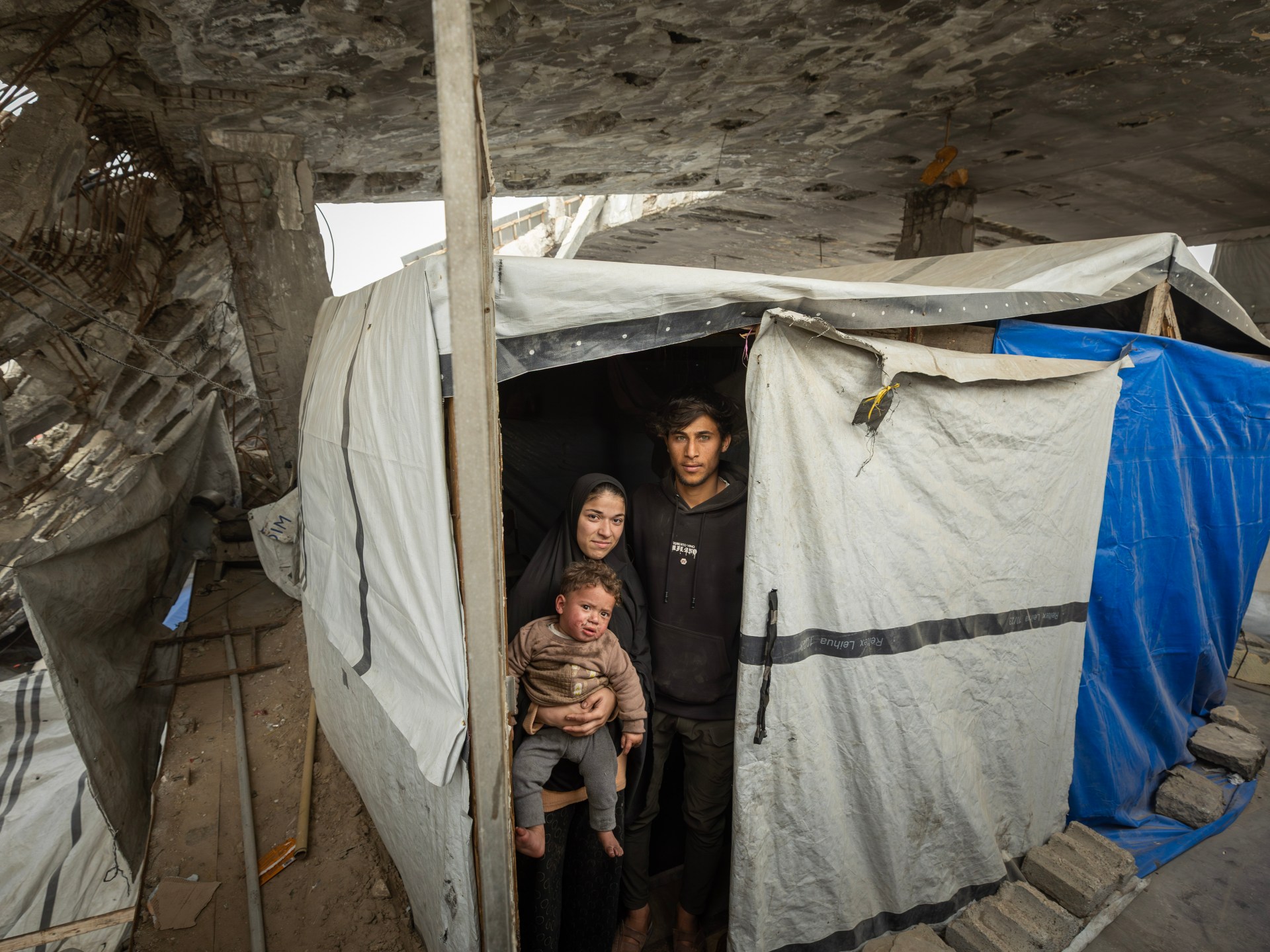


![“Home is the first homeland,” says Zakaria Aqel, “the place that holds all the peace in the world. A person without a home is a person without an identity. Each time [I was displaced], I felt a sense of belonging to the place I was in, a place where I had tried to build a life.” Zakaria and his family are from Jabalia refugee camp in northern Gaza. After being displaced dozens of times, they eventually settled in Gaza City's Zeitoun neighbourhood, where they were given a shelter that finally offered some stability after months of moving from place to place.](/wp-content/uploads/2026/07/15-Zakaria-Aqel-1784786704.jpg?fit=1170%2C780&quality=80)


