


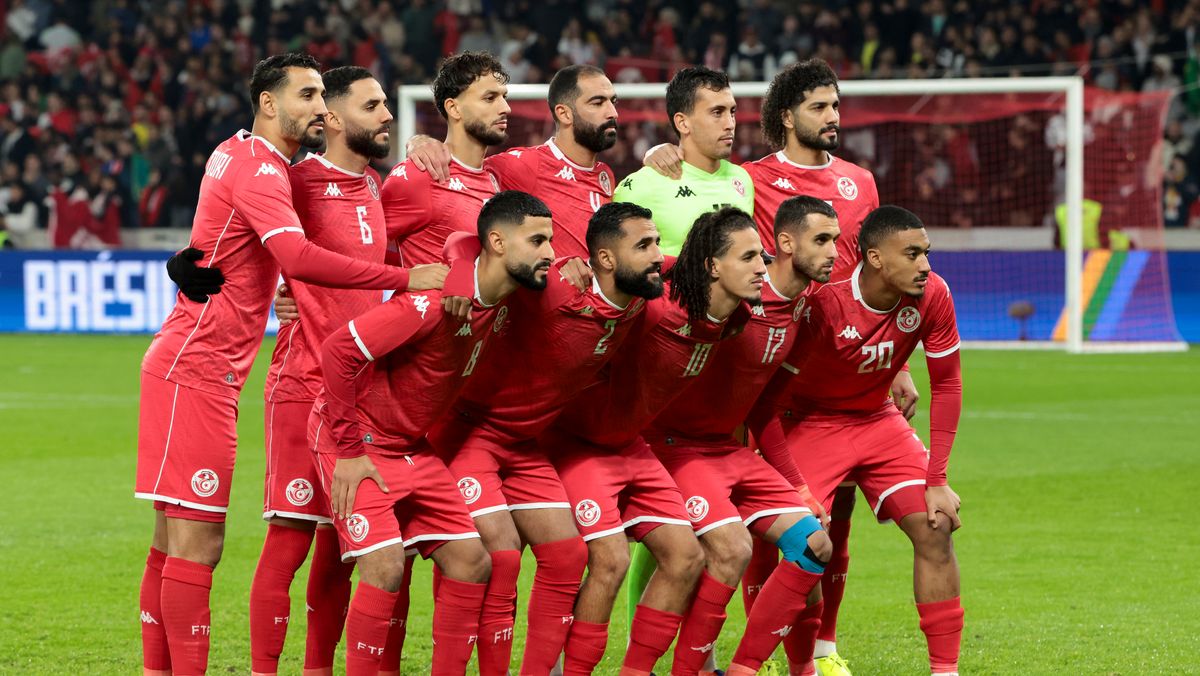
No one looks at Tunisia and expects a festival of free-flowing football. Over successive tournaments, the Carthage Eagles have mastered the dark arts of frustration, earning a reputation as international football’s ultimate survivalists.
They don’t mind playing ugly. In fact, they actively relish turning 90 minutes into a gruelling, joyless chore for their opponents. And being trapped in the definitive “Group of Death” alongside the Netherlands, Japan and Sweden, they’ll have ample opportunity to do just that.
To dissect how Tunisia plan to navigate this tournament minefield, we sat down with African football expert Ali Howorth on the latest episode of our Make Football Great Again podcast. For Howorth, Tunisia’s formula remains blissfully simple: lock the gates at the back and pray that a technical midfielder can conjure a miracle in attack.
- Get the latest World Cup news straight to your inbox by signing up to our Make Football Great Again newsletter now!
Leadership of the Tunisian national team rests on two contrasting pillars: the seasoned reliability of Eintracht Frankfurt’s Ellyes Skhiri and the raw, unfiltered fury of Burnley’s Hannibal Mejbri.
Hannibal’s transition into the nation’s true on-pitch talisman was solidified not by a piece of skill but by a scathing post-match tirade after a disastrous AFCON exit to a 10-man Mali side.
“Hannibal went viral in Tunisia because he went on this huge rant about how Tunisian football needs to be reformed from the bottom all the way to the top,” Howorth explains. “He called the standards and structures embarrassing. In many ways, it set him up as the future leader of this country. He’s only 23, but he already has 44 caps. He and Skhiri are the two totems of this team.”
 View 3 Images
Burnley star Hannibal Mejbri will be running the show for Tunisia(Image: Getty Images)
While Hannibal has endured a frustrating club career – lacking a defined role at Manchester United before suffering relegation in a stagnant Burnley side – his role for the national team is entirely different.
“For Tunisia, he plays a much more creative role as a number 10 or coming inside off the wings,” Howorth adds. “He was by far Tunisia’s best player at the AFCON. A lot of Tunisians would love to see him move away from Burnley to a more progressive team that suits his technical capacity.”


Tunisia know exactly what they are and they make zero apologies for it. Internet football culture has famously tagged their style of play as the ultimate manifestation of “Haram Ball” – defensive, miserable, anti-football designed purely to nullify the opposition.
“They have it in them to make life very difficult for everyone,” Howorth notes. “England witnessed it first-hand in 2018 in that incredibly dire 2-1 group stage match. It is firmly in this team’s DNA to be defensively resilient.”
That defensive wall has been significantly supercharged by an unexpected international recruitment coup. Rani Khedira – the Union Berlin midfielder and brother of German World Cup winner Sami Khedira – officially switched his nationality to Tunisia.
 View 3 Images
Tunisia will be looking to frustrate their opponents all tournament(Image: Getty Images)
“Sabri Lamouchi has come in as coach, but the structure remains the same,” says Howorth. “They have a very solid defence and two excellent sitting midfielders in Skhiri and Rani Khedira, who added a massive amount of deep-line quality when he committed to the team. They are incredibly tough to break down.”
Tunisia’s defensive rigidity means they enter the ‘Group of Death’ with a very specific set of anxieties. When asked whether the Carthage Eagles would be more worried about stopping Sweden’s elite frontline of Alexander Isak and Viktor Gyokeres, or trying to score against the Dutch pairing of Virgil van Dijk and Micky van de Ven, Howorth’s answer is immediate.
“Trying to score, to be honest,” Howorth admits. “They know how to defend as a team. The issue is upfront—they don’t have any natural goalscorers, no one they can truly rely on. They will be far more scared of trying to find a way past Van Dijk and Van de Ven.”
Because of those attacking limitations, Tunisia’s entire tournament hinges on their opening fixture. With Japan tipped by Howorth as a dark horse semi-finalist and the Netherlands heavily favoured, Sweden represent their lone tactical target.
“Expectations are low, but if they get out of this group, it is a huge, monumental success,” Howorth concludes. “Sweden is the one team Tunisians will be actively targeting. You never truly know what you’re going to get with the Swedes – they can be brilliant, but they can also be really grim to watch. If Tunisia can frustrate them, play their classic defensive game, and nick a win in that opener, they set themselves up to dream.”