


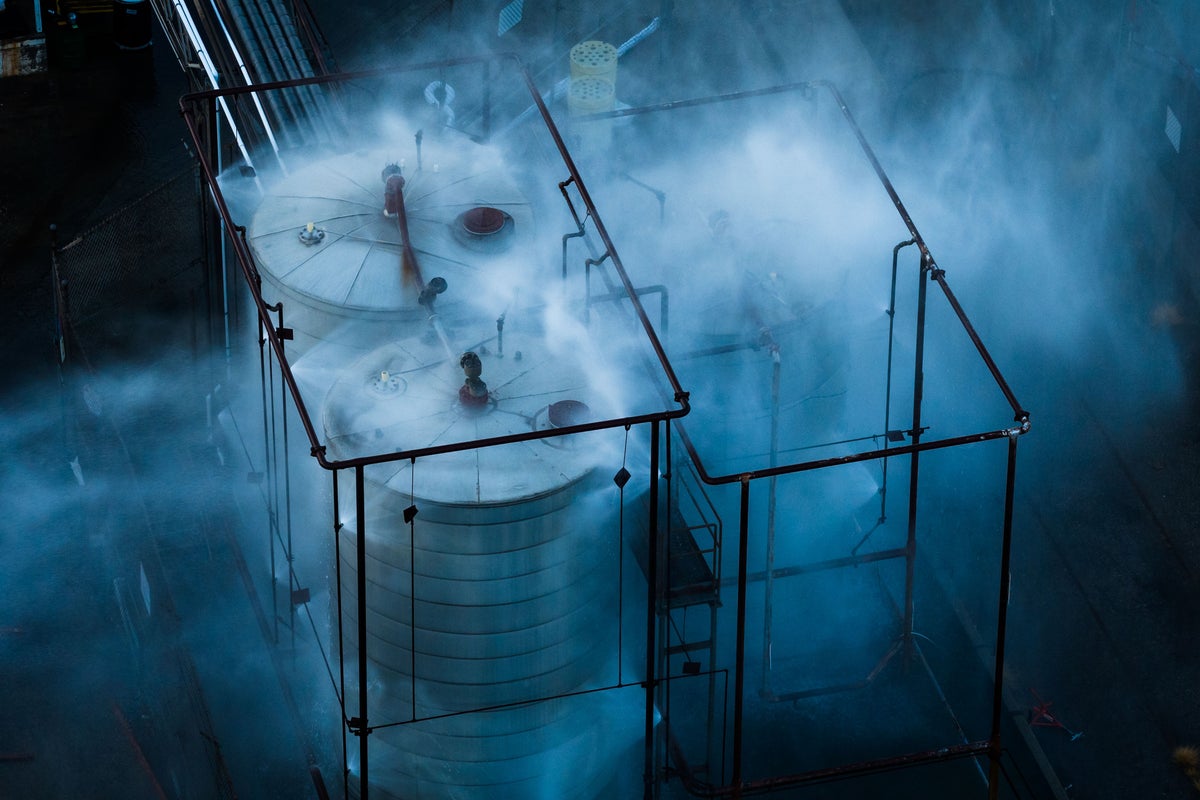
There are millions of chemical tanks around the U.S., and experts say it is exceedingly rare for them to fail as long as they are properly maintained and inspected.
Yet this past week, there were two major hazardous chemical emergencies on the West Coast. A large tank containing a corrosive chemical at a Longview, Washington, paper mill ruptured on Tuesday, killing two and possibly nine others. And late last week about 50,000 people were evacuated in Southern California after a chemical tank overheated and threatened the area with a catastrophic explosion. Authorities mitigated that risk, and people have been able to return home.
The incidents have raised questions about who is responsible for regulating companies that handle dangerous materials. An Associated Press review has found that officials at the local, state and federal levels all play a part in keeping these facilities safe.
Here’s what to know:
Tanks typically have robust safety standards
Chemical engineering professor Stephen Kmiotek said almost every industry uses chemical tanks. They are common because most manufacturers will use chemicals at some point of their process.
Kmiotek said there might be millions of tanks across the country, but they are generally safe as long as companies are following the standards for how they are built, maintained and inspected. The Worcester Polytechnic Institute professor said the failure rate of chemical tanks is about 1 failure per 1 million tanks per year.
“There are a lot of measures in place to keep people safe,” said Kmiotek, who has tracked the Washington incident closely.
But it is important that companies keep up proper maintenance and inspections, particularly after the tanks get older. Inspections should be increased after a tank passes 10 years, he said. That is especially true for tanks that use highly caustic substances, like the white liquor in the Washington tank. Valves on the tank will need to be replaced more often.
Authorities in Washington said they don’t yet know how old the tank was or how recently valves had been replaced.
After the Bhopal, India, disaster at a pesticide plant in 1984 that killed at least 3,800 people, the chemical industry took a number of steps to improve safety, including making sure chemical tanks are built right and inspected, informing workers about the risks and analyzing what could go wrong if the tank fails and who is at risk.
State agencies are responsible for inspections
The U.S. Environmental Protection Agency was involved in the response to both situations, and the U.S. Chemical Safety Board said Wednesday it was opening an investigation into the Washington incident. It is an independent federal agency that investigates incidents that could cause “the catastrophic release of extremely hazardous substances.”
But it was state agencies in Washington and California that oversaw the safety at the two companies, along with local fire marshals and hazardous materials teams, said Marissa Baker, an associate professor in the University of Washington, Department of Environmental & Occupational Sciences. The California Division of Occupational Safety and Health and the Washington state Department of Labor and Industries would have been responsible for conducting inspections, she said.
In Washington state, where there are far more chemical sites than there are inspectors, the state labor agency generally opens investigations based on complaints or incidents, Baker said.
Baker noted that the Washington company, Nippon Dynawave, was the subject of two investigations by the state labor and industries agency, although the issues were not related to the current situation, and it had fires in recent years.
Federal agencies provide some oversight
Federal regulators require facilities that store or use hazardous chemicals to maintain a “safety data sheet” that details the hazards and offers guidance on the emergency response. Businesses must share that information with state, tribal and local officials. Under an EPA right-to-know rule, the companies must allow fire departments to conduct inspections upon request.
The federal Occupational Safety and Health Administration has established protocols for industries that use or store highly dangerous chemicals, known as Process Safety Management standards. They involve inspections, training, special work permits, operating procedures and emergency planning and response.
While the GKN Aerospace plant in Garden Grove, California, would fall under this type of regulation due to the materials it used in its manufacturing process, it was not immediately clear whether the Longview paper mill had to follow the Process Safety Management protocols.
The public danger from some chemicals isn’t always clear
Stephen Lester, a public health expert and the former science director of the Center for Health, Environment & Justice, said he is concerned that there aren’t clear standards for exposure levels. One of the primary standards is for workplace exposure, and there isn’t a proven standard for how much of a chemical it is safe to be exposed to after a spill or explosion.
“Without these health-based guidelines, you’re ending up with some person making the judgment about what’s acceptable and what’s not,” said Lester, who has spent more than 40 years helping communities assess their health risks.
And the workplace standards are based on an average man, so they don’t account for children or the elderly or anyone with a compromised immune system.
“It’s a very tough situation. I don’t envy the scientists and the toxicologists in the position of advising the decision makers because that person’s going to have to make a judgment call in their best opinion based on what information he knows and he’s been able to research and generally accept it about the exposure to these chemicals,” Lester said.