


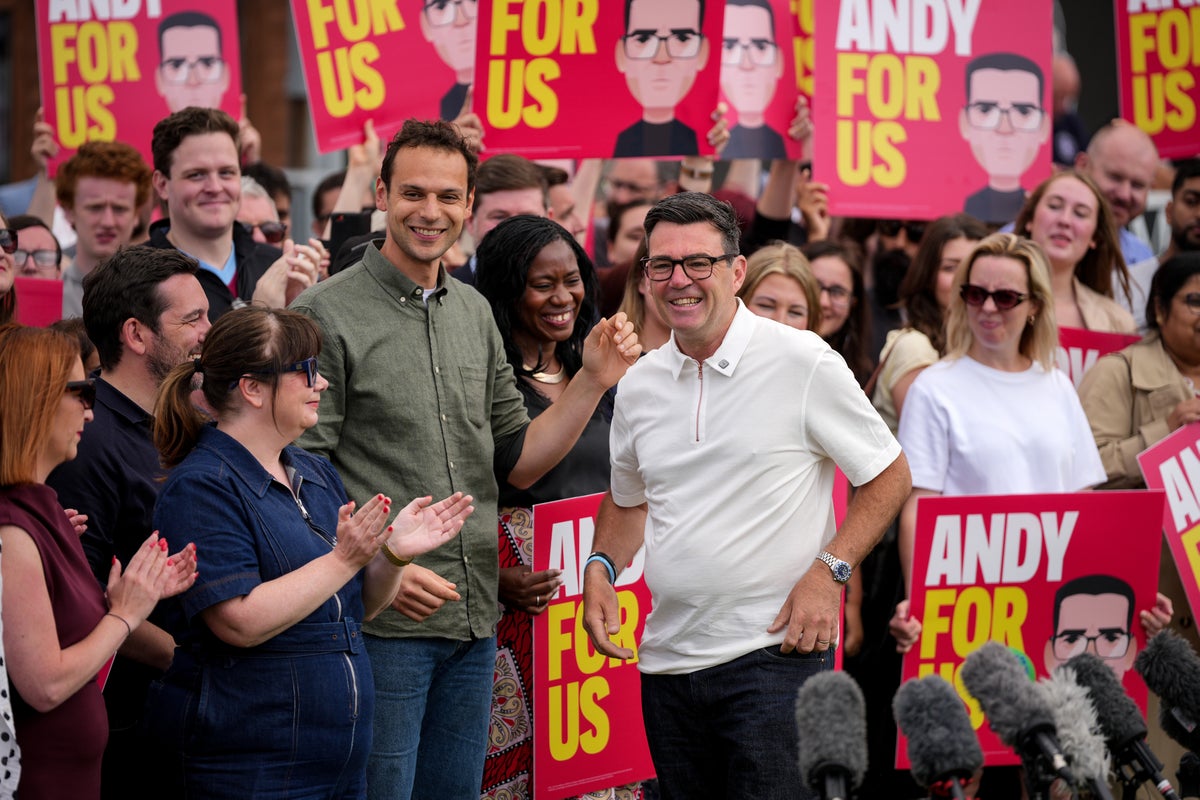
For several days now, and who knows for how much longer, the UK has been in the extraordinary position of having two prime ministers – and none. Ever since the scale of Andy Burnham’s by-election victory became apparent in the early hours of Friday morning, power has gravitated towards the outgoing mayor of Manchester, while inexorably draining away from the actual PM, Sir Keir Starmer.
Only a little more than 48 hours later, that harsh change seemed to be sinking in. For all Starmer’s repeated insistence that he would stand and fight, by Sunday the message had changed, even as the two principals themselves observed a wise silence. The combative talk from the Starmer camp had evaporated. Indeed, it is not unreasonable to ask whether such a camp existed any more, given the number of ministers and MPs reported to have called on Starmer to set a timetable for his departure.
In its place came rather a different message from Peter Kyle, the smooth-talking business secretary landed with the unenviable task of representing the government on the Sunday talk-shows. The prime minister, he said carefully, was considering the “political realities” of today. Speculation mounted that his resignation could be expected as early as Monday – or not.
Such leaderlessness at the national level, and the uncertainty it inevitably generates, is not a good position for any democratic country to be in, still less one long admired for its tradition of stable government. Regrettably, that tradition has been broken, to the point where we have had an almost continually changing cast of prime ministers, four of them – Theresa May, Boris Johnson, Liz Truss, and Rishi Sunak – initially assuming the top job without an election. That prospect, which has drawn unflattering comparisons with how Italy used to be, looms once again.
Regardless how soon the situation may be resolved, damage has been done. As a recent cabinet secretary, Simon Case, now Lord Case, pointed out, leadership uncertainty is “enormously disruptive”, not just with urgent decisions being deferred, such as those on defence spending, education and the health service, but economically and diplomatically. Interest rates on the UK’s debt, he said, were rising “with every moment of uncertainty”, while another change in prime minister was likely to cost the UK influence internationally.
Given that Sir Keir’s departure now looks inevitable, the priority has to be not just for the speediest possible restoration of order at the top of government, but for the best possible candidate to take over the job, which should militate against a “coronation” of Andy Burnham as the front-runner. Burnham is a competent and empathetic communicator, which gives him a distinct edge on the current occupant of No 10, and he has impressive achievements to his name in Manchester.
But it has to be recognised that his victory in Makerfield probably owed at least as much, if not more, to his promise as a replacement for the highly unpopular Starmer as to any policies that might have been on offer. The risk now is that, in the rush to install a new party leader and prime minister, this country has someone thrust upon it whose policies are largely unknown, beyond – in Burnham’s case – an ill-defined ambition for “hope” and “change”.
The advantage of a leadership contest is that the candidates would have to declare their intentions. They would also need to make clear where they stand on the manifesto on which the party was elected in 2024. There were inklings of an appetite for airing competing ideas following Sir Tony Blair’s recent essay critiquing the Starmer government.
After all the policy changes and reversals over the past two years, some clarity would not come amiss, and a contest could be the best way of bringing these to the widest possible public. The Labour Party needs to take responsibility for choosing a leader based on more than personality and success in the Northwest of England. As has been noted many times in recent days, being prime minister is very different from being mayor of a major city, and it is a perverse system indeed where the 44,000 or so who turned out to vote in Makerfield essentially get to decide who becomes rime Minister. The UK public deserve a great deal better.
If, as he has said, his priorities are country and duty, rather than stubborn self-interest, Sir Keir Starmer must not dither in deciding his next step, whether it is to step down at once or set a date that allows for a leadership contest first. Nor should his time as Prime Minister be dismissed as only failure. He led Labour to a landslide election victory; whatever your view, he honoured manifesto pledges on employment rights and renters reforms among others, and he represented the UK creditably on the world stage.
That he has become the least popular prime minister in recent history, however, reflects in part his propensity for U-turns, in part a sense that his government was little less sleazy than its predecessors, and to a large extent his inability to communicate effectively even with the party’s own Labour voters. Above all, though, he proved unequal to using the electoral victory he won; it now seems inevitable that this task will now pass to a successor, in a matter of days, or weeks.