


Scientists link Nepal flood to glacier collapse
August 27, 2026 9:42 am

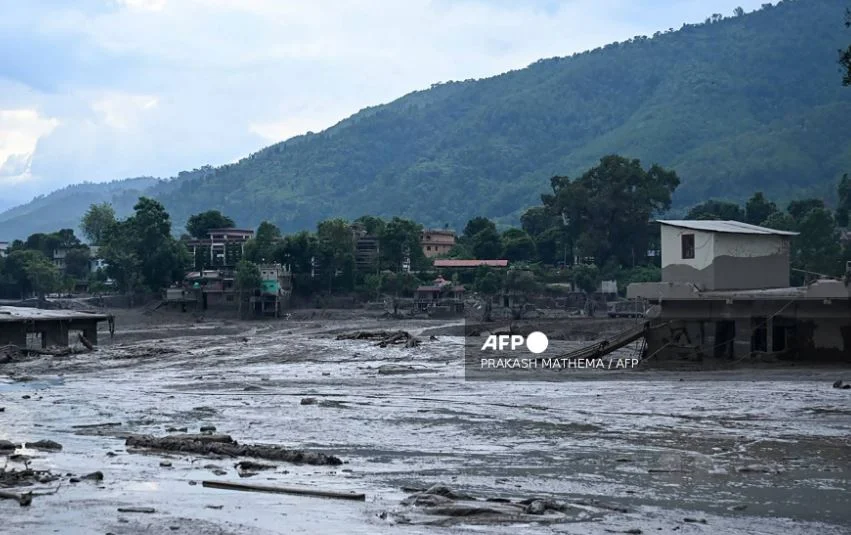
Houses lie deluged in sludge after flash floods at Devghat in Nepal’s Nuwakot district on August 26, 2026. Credit: AFP
Scientists say a glacier collapse likely triggered the devastating flash flood that swept through parts of Nepal and Tibet, killing more than 160 people and leaving hundreds of others missing.
The disaster struck on Wednesday after a large section of ice and rock is believed to have broken away from a glacier near Langtang Lirung in Nepal’s Himalayas. Satellite imagery reviewed by experts suggests the mass of ice and debris plunged from high altitude into a valley, sending a powerful surge into the Lhende Khola river.
The sudden surge carried huge amounts of water, mud, rocks and debris downstream, devastating communities and damaging roads, bridges and hydropower infrastructure along the Nepal-China border.
Initial reports suggested that an earthquake may have triggered a landslide. However, the US Geological Survey later clarified that the seismic signal detected during the disaster was generated by the collapse of glacial ice and rock and the resulting debris flow, rather than a conventional earthquake.
As reported by The BBC on Thursday, scientists studying the event say the collapse may have begun on the slopes of Langtang Lirung, about 15km from the area where the flooding caused widespread destruction. The force of the falling ice and rock was immense, producing seismic energy equivalent to a magnitude 5.2 event.
The exact reason why the glacier collapsed remains unclear. However, scientists warn that rising temperatures are making Himalayan glaciers and surrounding mountain slopes increasingly unstable.
Climate change is causing glaciers to shrink and permafrost, permanently frozen ground that helps hold steep mountain terrain together, to thaw. Experts say these changes can increase the likelihood of glacier collapses, landslides and other cascading disasters.
Scientists caution that it would be premature to say climate change directly caused Wednesday’s disaster. Instead, they say warming conditions may have increased the instability of the glacier and surrounding terrain, creating conditions in which a catastrophic collapse became more likely.
The disaster has highlighted the growing risks facing communities living in the Himalayas, where rapidly changing ice and snow conditions are increasingly combining with steep terrain and powerful rivers to produce sudden and difficult-to-predict hazards.
Rescue operations are continuing on both sides of the Nepal-China border as authorities search for survivors and assess the scale of the destruction.
Gilbert Ekugbe is a journalist at Punch Newspapers with over a decade of experience reporting on business and economic affairs. He covers markets, corporate developments, finance, and Nigeria’s broader economic landscape. His reporting is informed by extensive newsroom experience and a strong commitment to accuracy and responsible journalism, helping readers understand complex business issues.
All rights reserved. This material, and other digital content on this website, may not be reproduced, published, broadcast, rewritten or redistributed in whole or in part without prior express written permission from PUNCH.
Contact: [email protected]