


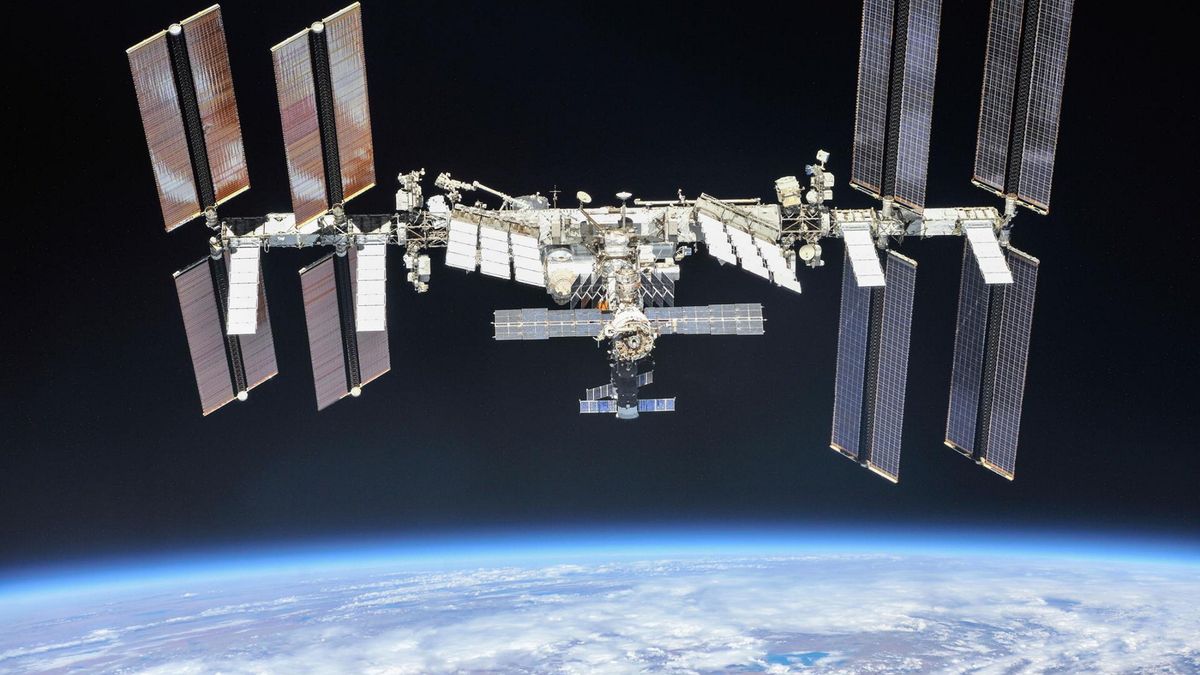
Astronauts aboard the International Space Station (ISS) were ordered to shelter inside their spacecraft after a worsening air leak sparked safety concerns on the orbiting outpost.
NASA said the issue is affecting part of the station‘s Russian segment, where a crew member is attempting repairs.
The space agency warned the crew to prepare for a possible evacuation if the situation deteriorates further. The leak has occurred in the Zvezda service module transfer tunnel – a narrow, pressurised passageway at the back of the ISS.
New UpdatesView PostView PostView PostView PostView PostToday19:50 BST
NASA’s astronauts have resumed their work on board the ISS. Some have been heard talking with their handlers back on Earth on a livestream.
Shortly before 7pm BST, French astronaut Sophie Adenot spoke with NASA about possible tasks the crew can get started on while mentioning an in-joke with another crew member. NASA astronaut Christopher Williams also offered to do some more work.

Sophie Adenot on board the ISS (file image)(Image: NASA/Chris Williams / SWNS)
Adenot was heard saying at one point: “I have a little bit of time, so I was going to offer to do two things, and you choose, or maybe if you have another idea, depending on your priorities, of course, I will not take Jessica’s [NASA astronaut Jessica Meir’s] WinSCAT, although she would love me to do that – that’s a running joke between the two of us, whatever sorry.”
Zahra KhaliqToday18:31 BST
The decision to move crew members into the Dragon spacecraft was a precaution in case the leak suddenly worsened.
While Russian cosmonauts carried out repairs in the affected area, the rest of the crew remained inside the aircraft, ready to leave in the event the cracks had widened unexpectedly – which would have seen the rate of air loss increase rapidly.

Crew members sheltered in the Dragon spacecraft(Image: NASA / SWNS)
After years of repair attempts, engineers believed they may have finally brought the leak under control earlier this year.
NASA said pressure readings in January suggested the problem had stabilised following inspections and sealant work. But there were lingering doubts over whether the leak had actually been sealed.
Those concerns resurfaced in May when sensors detected a fresh pressure drop, signalling that air was once again escaping from the station.
Zahra KhaliqToday17:26 BST
The air leak that put astronauts on alert today is far from a new problem.
First reported by Russia’s space agency in 2019, the leak has become one of the most persistent issues in the International Space Station’s history.
The problem is linked to tiny cracks in a tunnel connected to the station’s Russian segment, allowing air to slowly escape into space.
Over time, the leak worsened, eventually forcing NASA to classify it as the station’s highest-level safety risk.

Zvezda, where the leak occurred, is the capsule on the left of the ISS(Image: NASA)
NASA and Russia’s space agency Roscosmos have reportedly disagreed for months over what’s causing the air leak aboard the ISS and how best to fix it.
While the leak has been small and has come and gone over several years, concerns grew today after the amount of air escaping doubled from a pound of air to two pounds, Reuters said, citing a senior NASA official.
It reported that officials from NASA and Roscosmos have held differing views on both the source of the problem and the best way to address it.
Zahra KhaliqToday16:53 BST
The full impact of the air leak remains unclear.
Earlier, NASA said it had paused repair efforts and that crew members sheltering on the Dragon spacecraft were told to return to the ISS.
But it remains unclear whether the repairs have fully addressed the problem, if further work is required or how extensive the damage may be. The Mirror has contacted NASA for comment.

NASA said repair efforts aboard the ISS had been paused(Image: NASA/AFP via Getty Images)
Russia’s Roscosmos space agency says two leaks have been identified on board the ISS – and that one has already been fixed – according to the country’s Interfax news outlet.
The report says the leaks were found in the Zvezda module after it was re-pressurised. One was reportedly sealed quickly while preparations were underway to fix the second leak.
According to Roscosmos, the crew and the ISS onboard systems were not in danger, reports Russia’s Tass news agency.
Zahra KhaliqToday16:31 BST
The four astronauts on NASA’s Crew-12 mission were sent into space to serve as a relief crew after an unprecedented medical evacuation of the previous team.
NASA Administrator Jared Isaacman said shortly after the launch: “In the last couple of weeks, we brought Crew-11 home early, we pulled forward Crew-12 to the launch […] all while simultaneously making preparations for the Artemis 2 mission.”
Crew-12 arrived in space in February to “conduct scientific investigations and technology demonstrations to help prepare humans for future exploration missions to the Moon and Mars, as well as benefit people on Earth,” according to NASA.

A still image from a NASA livestream shows Crew-12 answering questions during a livestream aboard the International Space Station (ISS) on February 14, 2026(Image: NASA/AFP via Getty Images)
NASA says repair efforts aboard the International Space Station have been paused with “safe haven procedures” ended.
NASA spokesperson Bethany Stevens said this is to allow “more measurements and data” to be assessed.
Crew members sheltering on the Dragon spacecraft have been told to return to the ISS.
Zahra KhaliqToday15:52 BST
Crew-12 – Jessica Meir, Jack Hathaway, Sophie Adenot, and Andrei Fadeyev – is a long-duration ISS rotation mission under NASA’s Commercial Crew Program.
The astronauts were sent to space to:
- Live and work aboard the ISS for around 8–9 months
- Carry out scientific experiments in microgravity
- Help with technology tests for future Moon and Mars missions
- Conduct research in areas like medicine, biology, and materials science in space
They are now sheltering inside their spacecraft while a crew member attempts to repair the air leak.
Zahra KhaliqToday15:43 BST
An air leak on the ISS means that some of the breathable air inside the station is escaping into space through a crack, hole or faulty seal.
Astronauts rely on that air to survive. If too much air escapes, pressure inside the station can drop, making it difficult or impossible to breathe.
NASA has asked its astronauts to shelter “out of abundance of caution” while crews attempt to fix the leak.

Efforts are underway to fix the air leak
NASA has told the four astronauts to “assume an elevated safety posture in the Dragon spacecraft” while the Russian cosmonaut attempts to repair the air leak.
The space agency said the advice to shelter is “out of an abundance of caution”.
It added: “We continue to work with our Russian counterparts, along with the rest of the international community that supports the space station, to arrive at a more permanent resolution.”
Zahra KhaliqToday15:29 BST
There are a total of seven people on board the International Space Station.
They are Christopher Williams (NASA), Jessica Meir (NASA), Jack Hatahway (NASA), Sergey Mikayev (RSFA), Sergey Kud-Sverchkov (RSFA), Andrei Fedyaev (RSFA), Sophie Adenot (ESA, France).
Astronauts of NASA’s Crew-12 mission received orders from NASA mission control at 9:04am ET (13:04 GMT) to enter their Crew Dragon spacecraft docked to the station and put on their spacesuits in case the air leak warrants an emergency evacuation, a NASA official said.
Those told to shelter include American astronauts Christopher Williams, Jessica Meir and Jack Hathaway, French astronaut Sophie Adenot of the European Space Agency and Russian Roscosmos cosmonaut Andrey Fedyaev.

(L-R) Roscosmos cosmonaut Andrey Fedyaev, NASA astronauts Jack Hathaway and Jessica Meir and European Space Agency (ESA) astronaut Sophie Adenot(Image: Anadolu via Getty Images)
Efforts are underway to seal a worsening air leak aboard the ISS, with a Russian cosmonaut carrying out repairs as the crew prepares for a possible evacuation.
NASA said the leak is located in part of the station’s Russian segment. Astronauts are currently sheltering inside their spacecraft.
Zahra KhaliqToday15:14 BST
The air leak is taking place in the Zvezda service module transfer tunnel – a narrow, pressurised passageway located at the back of the International Space Station (ISS).
This area has suffered from cracks and leaks for some time, says NASA spokesperson Bethany Stevens.
“The Zvezda service module transfer tunnel, known as PrK, has suffered from cracks and leaks for some time, and has been mitigated by Roscosmos as much as possible to date,” she says.
These cracks “have always been a concern” that NASA monitored closely. The space agency is working to “determine the root cause of the cracks,” Setevens adds.
Zahra KhaliqToday15:08 BST
Astronauts aboard the International Space Station have been told to prepare for evacuation over a worsening air leak.