


AdvertisementSmart Policing Joint Innovation LabTech
Hong Kong Police and Cyberport join forces to launch AI lab against sophisticated scams
New Smart Policing Joint Innovation Lab brings together police expertise with Cyberport’s AI Frontier ecosystem and supercomputing capabilities to combat industrial-scale fraud and deepfake threats
Paid Post:Cyberport3-MIN READ3-MIN Listen
-of-the-Hong-Kong-Police-Force-(HKPF)-signed-MoU.jpg?itok=-rSNu6QK)
Advertising partnerPublished: 12:00am, 29 May 2026
[The content of this article has been produced by our advertising partner.]
The Hong Kong Police Force (HKPF) has joined with the city’s digital technology community to open a new AI lab to combat tech-enabled crime, particularly large-scale fraud operations.
The Smart Policing Joint Innovation Lab was officially launched on 22 May at Cyberport, which coincided with the signing of a memorandum of understanding between the HKPF and Cyberport.
Advertisement
The launch took place on the same day as the Cyberport AI Frontier 2026 forum, which brought together more than 400 leaders from government, industry, academia and research.
The event focused on how enterprises can scale AI responsibly while balancing trustworthiness, controllability, innovation and compliance.
Advertisement

Simon Chan, Chairman of Cyberport, said: “As AI evolves from an auxiliary tool into autonomous agents, we must ensure its trustworthy and controllable application while promoting its widespread adoption, balancing innovation with risk management to unlock broader application potential.
“Anchored by our AI Supercomputing Centre, Cyberport is building a comprehensive ecosystem covering computing power, data, models, risk assessment and AI governance,” he added.

“The development of AI has entered a phase of accelerated deployment, while challenges to public safety are evolving at an equally rapid pace,” said Joe Chow, Commissioner of Police, in his opening remarks. Advertisement
“We need a more open, flexible and forward-looking collaboration platform that integrates the Hong Kong Police Force’s operational experience, Cyberport’s innovation ecosystem and the expertise of technology enterprises.”
Chief Superintendent Raymond Lam of the Cyber Security and Technology Crime Bureau of the Hong Kong Police Force painted a sobering picture of the threat.
He reported that technology crime cases exceeded 31,000 last year, with financial losses reaching HK$6.3 billion. Lam explained that police no longer deal mainly with individual offenders but with organised operations that function on an industrial scale.
Advertisement
“Every day we are dealing with criminal syndicates that operate like large enterprises,” he said during the public safety panel.
These groups run sophisticated scam centres in other countries that employ thousands of people and make heavy use of AI for deepfakes and large-scale fraud, according to Lam.
In response, the new lab will draw on Cyberport’s AI Supercomputing Centre to support joint projects focused on deepfake defence and proactive threat detection.
Advertisement
Acting Commissioner for Digital Policy Daniel Cheung welcomed the police-Cyberport partnership as a prime example of combining research strengths with operational needs.
He noted that the government continues to issue guidance on AI ethics while advancing practical applications in public services.

“Companies are underestimating AI’s capabilities,” said Dr Rocky Cheng, CEO of Cyberport. “Modern AI systems, particularly AI agents, now possess memory and context awareness that allow ordinary employees to deploy them easily. This significantly lowers the barrier for adoption, but it also increases security risks if proper oversight is absent.” Advertisement
He cautioned that once organisations grant AI agents greater permissions to gain their benefits, new vulnerabilities emerge. “We need another pair of eyes to monitor these AI agents to prevent them from making mistakes or sending out information that should not be released.”
In response, Cyberport has supported more than 30 cybersecurity companies, many of which apply AI to scan new tools and agents for risks. The organisation is also preparing targeted activities on AI agent security and governance standards.
Moreover, it offers platforms such as the AI Agent Platform and GenAI Sandbox that allow companies to test applications in controlled environments.
Advertisement
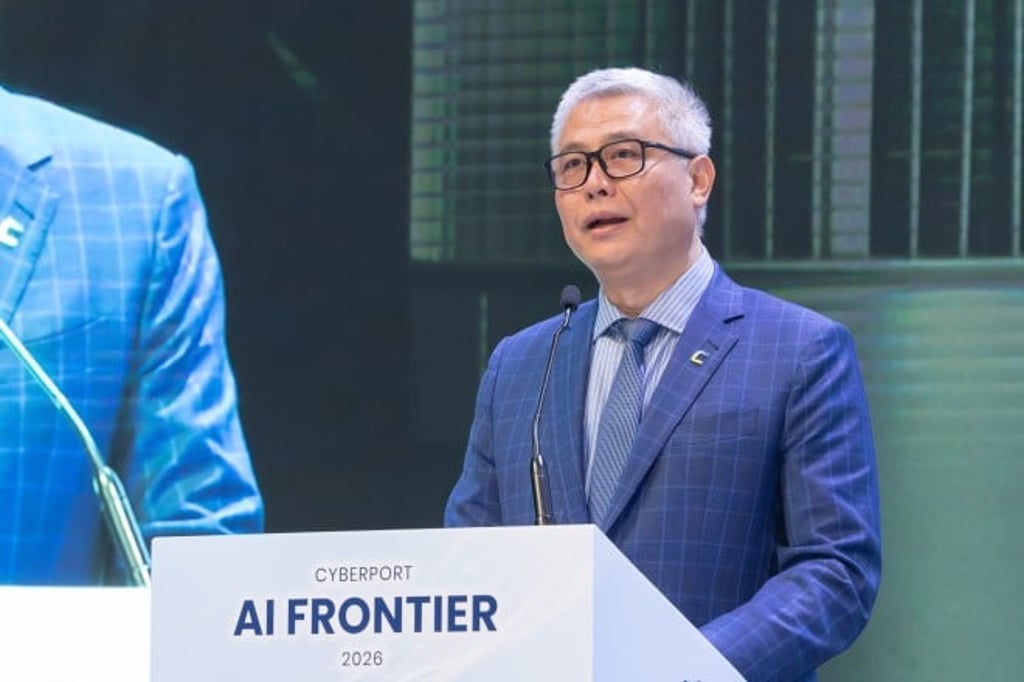
During the forum, several AI-powered cybersecurity firms presented practical solutions. DeepBrain Tech (in partnership with NyxLab), Bolian Intelligent Technology and Veeam demonstrated tools for threat detection and data protection.
OneConnect Financial Technology’s General Manager Daniel Ling highlighted an AI-driven multi-modal identity verification platform. The system integrates police and banking data in real time to assess risks based on identity documents, location and device information.
Panels featured SenseTime’s smart city AI applications and RealAI Technology’s deepfake detection powered by large language models. OneConnect also presented a multi-modal fraud detection platform developed with the police.
Advertisement
In the AI chips session, NVIDIA, Suanova Technology, Biren Technology and Moore Threads discussed hardware diversity for next-generation AI models.
Separately, Asia Insurance, Standard Chartered Bank and Ricoh Hong Kong shared real-world deployment experiences, while Threatbook and the Electrical and Mechanical Services Department spoke about embedding security by design.
Looking ahead, Cheng said Cyberport would continue to convene cybersecurity companies, organise forums with international and mainland experts, and develop governance frameworks suited to fast-moving technology.
AdvertisementAdvertisementAdvertisementSelect VoiceSelect Speed00:0000:001.00x