


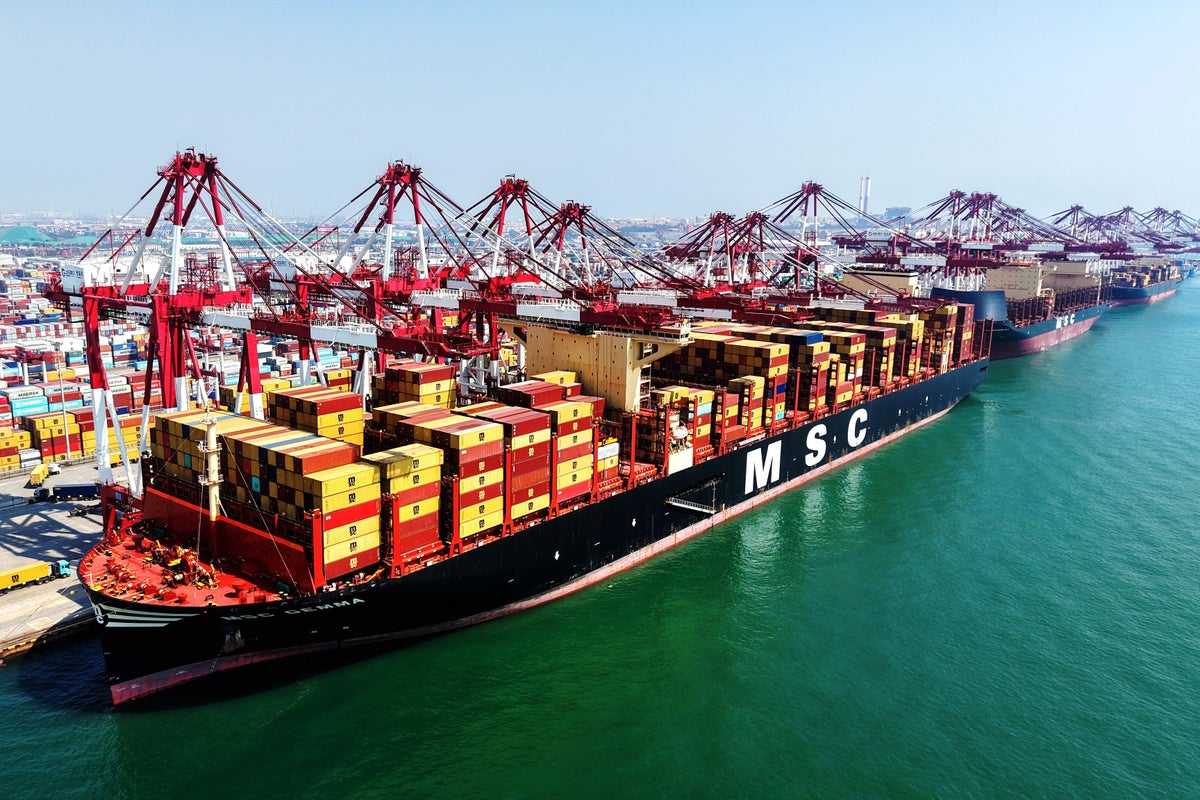
China’s foreign trade is on track to maintain steady growth this year, supported by continued export upgrading towards high-tech, green and higher-value products, with expanding domestic demand creating more opportunities for foreign businesses, government officials and company executives said.
As this growth comes amid a challenging global trade environment, it reflects the ability of Chinese businesses to adjust to external pressures and maintain competitiveness in international markets, they added.
According to data released on 7 August by the General Administration of Customs, China’s foreign trade increased 17.3 per cent year-on-year to reach 30.13 trillion yuan (£3.28 trillion) in the first seven months of 2026.
While exports rose 14 per cent year-on-year to 17.44 trillion yuan (£1.9 trillion), imports surged 22 per cent year-on-year to 12.69 trillion yuan (£1.38 trillion), the data showed.
Lynn Song, chief economist for China at Dutch bank ING, said that strong imports growth underscores China’s role as a major global market, with businesses worldwide benefitting from demand for advanced technologies, key components and high-quality products.
Lyu Daliang, director of the GAC’s department of statistics and analysis, said that China’s trade with more than 180 countries and regions continued to grow during the January to July period, reflecting more diversified trade ties and stronger links with global markets.
Ye Dingda, vice-president of the Beijing-based China Machinery Industry Federation, noted that China’s foreign trade is evolving beyond scale expansion, with new growth increasingly coming from technology-intensive products, green industries and higher-value exports.
For example, the exports of mechanical and electrical products, such as electric vehicles, 3D printers, industrial robots and wind turbines, increased 21.2 per cent year-on-year to 11.12 trillion yuan (£1.21 trillion) between January and July, accounting for 63.8 per cent of China’s total exports, up 3.8 percentage points from the same period last year.
Wen Bin, chief economist at China Minsheng Bank, noted that Chinese-made products — ranging from ice cream machines and air-conditioners to smartphones and computers — provide consumers in various countries with more choices, lower consumption costs, and a buffer against inflationary risks.
Global investment in artificial intelligence supply chains, a relatively benign international trade environment, and stronger competitiveness in new energy products will continue to support China’s exports growth in the coming months, Wen said.
He Shaojun, deputy director-general of the department of foreign trade at the Ministry of Commerce, said that China’s export of production equipment and intermediate products has strongly supported the industrialisation of its trading partners.
China supplies over 80 per cent of the world’s photovoltaic modules and 70 per cent of global wind power equipment, supporting the green transition of trading partners, according to information released in July by the Commerce Ministry.
Foreign-invested companies are also responsible for 16 per cent of China’s trade surplus while generating significant returns from their operations in the country, said the ministry.
He, the ministry official, said that China’s strong trade also generated broader benefits for the global economy through foreign companies’ participation and international supply chains.
That sentiment is in line with the latest customs data. Foreign-invested companies in China recorded 8.78 trillion yuan (£957.4 billion) in imports and exports between January and July, an increase of 17.6 per cent year-on-year.
Leser GmbH & Co KG, a German manufacturer of industrial safety valves, will position its manufacturing base in North China’s Tianjin municipality as one of its most important innovation and export hubs.
The group plans to leverage its China operations to improve delivery efficiency and better serve customers as regional industrial investment and trade continue to expand.
Beyond manufacturing, global service providers are also expanding their presence in China to support the country’s evolving trade flows and increasingly sophisticated supply chains.
Federal Express Corp, a United States-based logistics company, announced on 4 August the launch of a nonstop freighter service between its hub in Guangzhou, South China’s Guangdong province, and Sydney in Australia, with the route operating five times a week.
“As China’s trade landscape continues to evolve, speed, reliability and resilience are becoming increasingly critical for both exporters and importers,” said Poh-Yian Koh, president of FedEx China.