



Ai Weiwei: Button Up! review – skeleton chandeliers, a real-life temple – and too much silly Lego
Aviva Studios, Manchester
The artist’s latest show is a staggering takedown of colonial history, warfare and the migrant crisis, featuring buttons by the tonne and richly perfumed tea
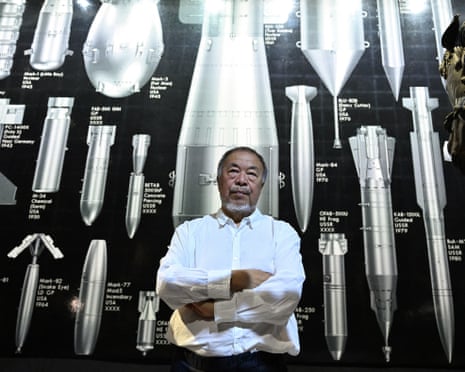
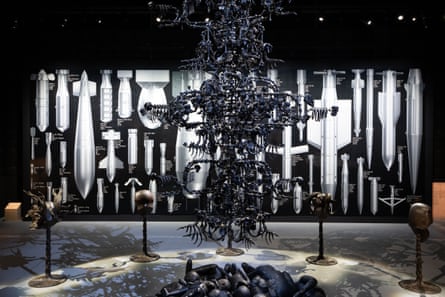
History has repeated itself all over Ai Weiwei’s vast exhibition of monumental sculpture in Manchester. The flags of long-lost nations hang from the ceiling, bronzes looted by dead empires have been recast and reclaimed, dilapidated ancient ruins have been rebuilt. Everywhere you look here, you will find death, exploitation, greed and suffering from across human history, brought back to life and put morbidly on display. The first thing you see is a black glass chandelier made of skeletons – The Human Comedy – and a wall covered in images of the most powerful bombs ever invented. Like a head on a stake, this is art as warning.
This massive, ambitious exhibition is the Chinese artist at his most monumental, and as a result at his most effective. His subject matter works best at enormous scale, blown up, expanded, shoved in your face. Lining the back wall of this warehouse is a giant inflatable dinghy, 100 metres long, filled with figures in lifejackets. Think you can ignore the migrant crisis? Not here you can’t, because Ai has taken everyday, normalised tragedy and made it into a monument. He spent years interviewing hundreds of refugees, meeting people desperate for safety and a new life and produced a huge amount of work about it. This is the culmination of that project. Is it a good-looking work of art? Not really, but it makes a point, and makes it loudly.
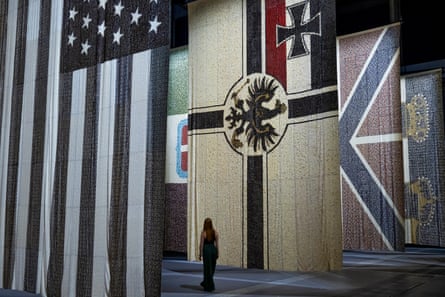
Which is what he does over and over. Hanging from the ceiling is his latest work: house-sized flags sewn using the tonnes of buttons he bought from a bankrupt English button factory. The flags represent the eight-nation alliance – including Britain, US, Japan, France and the Austrian-Hungarian empire – that invaded China in 1900 in a bid to reopen its ports. He has woven together narratives of industrialisation, colonialism and historic violence into a complex image of modern history. Look at these empires, look what they’ve done to each other, see which have risen, which have fallen and try to calculate the cost. The flags look heavy, they feel heavy, weighed down by history and its continuing impact.
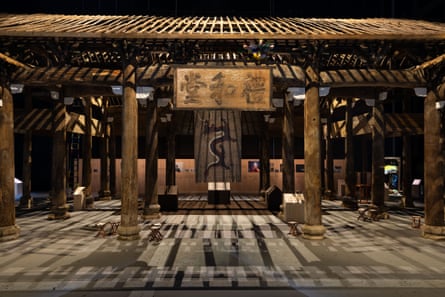
It’s not the only history he is trying to keep alive here. The most visually impressive work is the Wang Family Ancestral Hall, a real-life temple found collapsing to ruin in the Jiangxi countryside, and reassembled piece-by-piece here. It’s a towering window into the past, to long-lost values, to a time before industrialisation and rampant capitalism, when China was vulnerable and open to attack. Under the temple’s columns, boxes hold pages of Chinese history – inaccessible and hidden narratives.
In the middle the temple, three dolls’ houses sit on a bed of brown mulch. All of it is made of pu’erh tea, compressed, dark leaves that accrue value as they age and ferment. They’re symbols of Chinese culture, of togetherness and community and Daoist values, but also of wealth and its accumulation. “To drink a cup of tea,” we learn, has now become a euphemism for dragging people in for questioning by Chinese state police. It’s the best work here, by far – filled with clashing, fascinating signifiers of the past and present, assembled into something beautiful, perfumed, powerfully symbolic. Simple material turned into something devastating.
Not everything here is that good, sadly. When Ai takes Jacques-Louis David’s famous portrait of Napoleon, swaps his horse for a zebra and hangs it upside down, the symbolism is so heavy-handed it feels as if Banksy did it. It’s the same when Ai puts migrant boats on Hokusai’s great wave. We get it: colonialism is bad, nationalism is evil, migration is a crisis, but you’ve already made the point elsewhere, and you’ve made it better. His use of Lego too – both of those images are mosaics made of toy bricks, as is the History of Bombs – just feels too obvious, basic, unsubtle and silly.
after newsletter promotion
But when Ai’s good, his work has an emotional impact that few artists can match. He treats history as both a warning and a roadmap: all of the injustices of today can be explained by and traced back to moments in the past. If you want to understand the migrant crisis, or the collapse of late-stage capitalism, or the rise of authoritarianism, you just have to look at the endless horrors that our ancestors suffered through. This whole show is a plea, maybe a knowingly futile one, to heed those lessons before it’s too late.
Explore more on these topics