


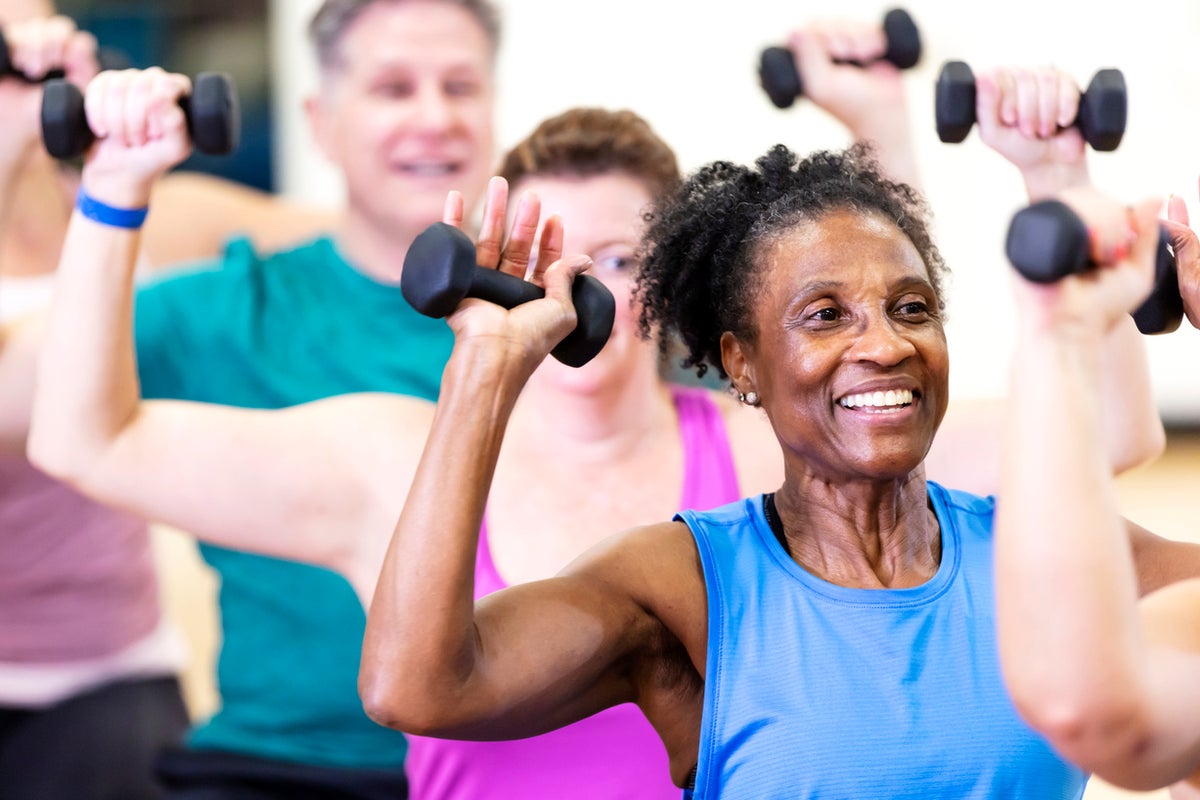
This newsletter often centres around how to start exercising. Why? Because this is the major health hurdle most people face. But after nine months of weekly updates, I’m secretly hoping I’ve encouraged a few people to lace up their trainers and enjoy regular movement.
Today’s newsletter is for this group: you’ve been exercising for a while, and now you’re looking for ways to streamline, spice up or simply refresh your regular workouts.
What you will find below are a few techniques for sprinkling a little extra intensity into your workouts, making them more effective at improving your health and fitness in less time. Not a bad sell, eh?
“Whenever we talk about working out, people assume that, to get the benefits, you have to spend hours and hours in the gym,” says Dr Milo Wolf, a strength training specialist, fitness coach and founder of training app MyoAdapt.
Sign up for the Well Enough newsletter here
“In reality, you don’t need to spend that much time training to see results. And if you employ certain strategies, you can get away with as little as half an hour to an hour in the gym each week and still see really solid progress.”
The first thing he recommends for time-efficient training is antagonist supersets. A superset involves performing two exercises back to back with no rest between. An antagonist muscle pairing comprises two muscles that conduct opposing actions. For example, the biceps flex the elbow while the triceps extend it, so you might pair a biceps curl with a triceps overhead extension.
“In traditional strength training you do a set of an exercise, take a rest interval, usually of one to two minutes, then do another set,” explains Dr Wolf. “You do all sets of one exercise then move on to the next one.
“But with antagonist paired supersets, you do exercise A, then exercise B, and then you rest. Effectively, while one muscle is resting, the other one is training, and vice versa.
“You can also superset any two exercises that don’t have any meaningful overlap.” An upper body exercise and a lower body exercise, for example.
This shaves down the amount of rest time needed in your workout considerably. Dr Wolf’s research suggests you could enjoy the same benefits from strength training in as little as half the time by taking this approach.
Dr Wolf also recommends doing fewer overall sets in your workouts, but applying extra effort to those that remain. For example, rather than doing five sets of 10 repetitions of an exercise, you might do two or three really challenging sets. Ensuring your muscles are sufficiently challenged can help “make those sets as effective as possible”.
WORKOUT OF THE WEEK
Time-savvy strength training
Superset 1
Exercise 1A: Dumbbell bent-over row 3×10
Exercise 1B: Dumbbell walking lunge 3×10 (on each leg)
Rest: one minute
Immediately after your final set of dumbbell walking lunges, drop one dumbbell and complete as many dumbbell goblet walking lunges as you can. Immediately after this, drop the remaining dumbbell and complete as many unweighted walking lunges as possible, then rest before superset two.
Superset 2
Exercise 2A: Dumbbell Romanian deadlift 3×10
Exercise 2B: Press-up 3×10 (or a challenging number of repetitions)
Rest: one minute
Immediately after your final set of press-ups, complete as many kneeling press-ups as you can. Immediately after this, place your hands on a sturdy elevated surface and complete as many hands-elevated press-ups as possible.
The higher your hands, the easier this exercise becomes. You can also start with hands-elevated press-ups then move to a slightly higher surface with each drop set. For example, switching from a chair to a table to a kitchen counter.
This workout works every major muscle group, and should provide your body with the stimulus it needs to become considerably fitter and stronger in just 20 minutes.
Agonist supersets, where you perform two back-to-back exercises that work the same primary muscle groups, can be a good way to do this. It works best if the second exercise is easier than the first.
For example, rather than just doing 10 press-ups, you might do 10 press-ups straight into as many kneeling press-ups as you can to truly test the chest, shoulder and triceps muscles. Or instead of doing 10 goblet squats, you could do 10 goblet squats into as many bodyweight walking lunges as you can to build stronger legs.
Another similar technique for working your muscles harder is drop sets.
“With drop-set training, you start with a heavy set of an exercise then immediately pick up a weight that’s about 20 per cent lighter and do another set,” Dr Wolf says.
“You repeat this process several times – so you might start by lifting 50kg, then 40kg, then 30kg, and so on, taking each set to failure [the point at which you can’t perform another repetition with good technique].
“…In some studies, we’ve seen that drop-set training leads to the same muscle growth in anything from 30 to 70 per cent less time [than traditional strength training].”
In our workout of the week, you can find a sample full-body dumbbell workout that puts these techniques to good use.
Get the Well Enough newsletter
To receive Well Enough with Harry Bullmore, simply enter your email address in the box at the top of this page.
You can also head to our newsletter preference centre to sign up for the email.
Once there, all you need to do is press the ‘+’ button and enter your email address to sign up.