


‘Writing is exactly like love – you need to do it in the dark’: novelist Leila Slimani on why literature is erotic
Now in residence at the Madrid Prado, the author talks about its dark, inspirational Goyas, the clandestine nature of her writing – and why she finally wrote about her jailed then posthumously exonerated father
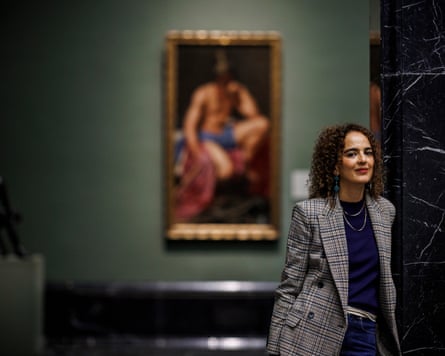
It is a bright, chilly spring morning in Madrid, and the Museo del Prado doesn’t open to the public for another hour. Without the crowds, the museum is amorphous and eerily silent. A pale light pools in the corners and casts long shadows around the paintings, as if the figures inside them have slipped quietly into the room. It is here that I meet the French-Moroccan writer Leïla Slimani, who has spent the past two weeks using the space as inspiration for her work.
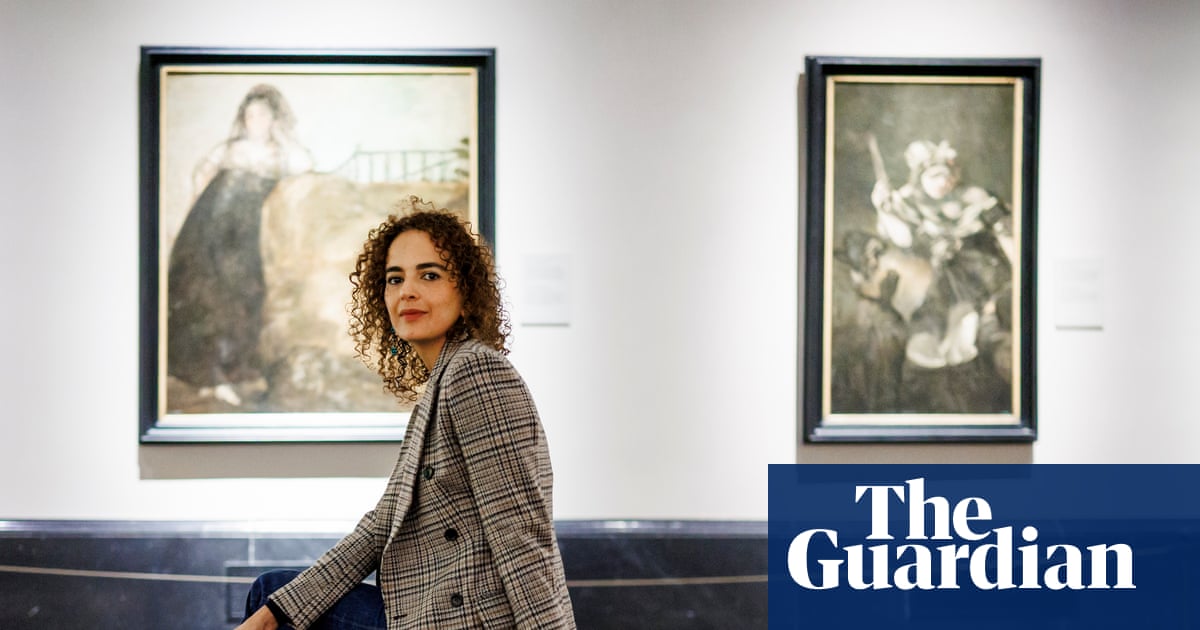
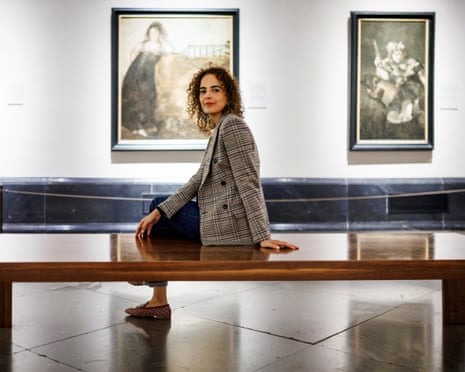
With quick strides, Slimani leads us to a basement gallery housing some of her favourite works: Francisco Goya’s dark and haunting Black Paintings, created later in life when the Spanish artist had adopted a particularly bleak outlook on humanity. Among them are Saturn Devouring His Son, a violent depiction of the god biting into his own child; The Fates, with its three ominous figures spinning the thread of life; and Witches’ Sabbath (The Great He-Goat), in which the devil appears as a goat presiding over a coven.
“Being in a room alone with a Goya is really special,” Slimani tells me later, over cappuccinos in a nearby cafe. “He didn’t paint the present or the past – he painted the future, our own situation. He saw things others don’t.” She pauses. “There’s something about disappointment – 25 years after the French revolution – in the way he looks at society. I feel very connected to that.”
Slimani is in Madrid as part of Writing the Prado, a residency inviting international authors to produce a new work inspired by the museum. For her, the relationship between literature and painting is instinctive. “Sometimes when I write, I put paintings near my desk,” she says. “In a painting, there’s the exact atmosphere you’re trying to convey. Every book has a colour.”
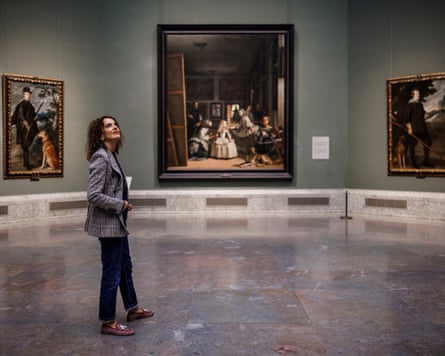
Goya’s vision resonates with her own preoccupations as a writer. “I always ask myself, ‘Are you aware of what’s happening around you? Or are you blind? Are you spoilt?’” Perched on the edge of her chair, in blue jeans and a checked blazer, Slimani seems anything but. She is smiley and unpretentious but there is a steely determination behind her large brown eyes. She talks freely, rarely second-guessing herself.
A preoccupation with what lies beneath the surface – with contradiction, power and human frailty – runs through Slimani’s life and work. Born in Rabat in 1981, the daughter of a doctor and a government minister turned banker, she left for Paris at 17, studied at Sciences Po, then began her career as a journalist. Her first fiction manuscript was widely rejected before she produced her debut novel, Adèle, about a bourgeois Parisian wife and mother leading a sexually promiscuous double life.
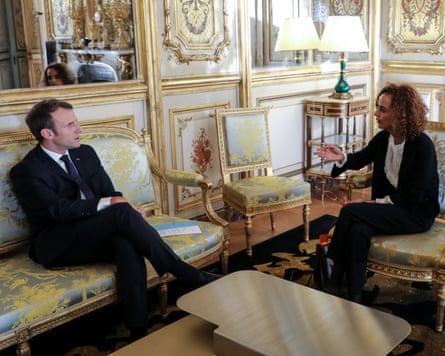
Where Adèle established her taste for transgression, it was her second novel, Lullaby, that transformed her into a literary star. Inspired by real-life childcare tragedies, it opens with an act of unthinkable violence and works backwards, dissecting class, race and maternal anxiety. In 2016, it made Slimani the first Moroccan woman to win the Prix Goncourt, and her public profile shifted overnight. She was later appointed by the French president Emmanuel Macron as his personal representative for promoting the French language and Francophone culture.
“I was very excited,” she says now. “Did I deserve it? I don’t know. But it was happening and I wanted to enjoy it. Some people were like, ‘Aren’t you afraid they gave you this prize because you’re a woman and you’re an Arab? I was like, ‘So what?’ I’m not going to try and find a reason not to be happy.”
Her refusal to diminish her success is sharpened by a formative family trauma. When Slimani was 20, her father was arrested and imprisoned on charges relating to a financial scandal. He died before the case came to trial but was posthumously exonerated, and Slimani has often described her early impulse to write as driven by anger and a desire for revenge. That impulse, she says, remains. “Literature is probably the best way to give justice back to people who are not understood or listened to. A writer can go very deep into someone’s mind and try to put light on contradictions. And as a reader, you feel empathy and tenderness for this human being that probably in real life you would never have.”
In recent years, Slimani has turned her gaze to her own family history in The Country of Others trilogy, culminating in I’ll Take the Fire, published this year, which follows two sisters as they navigate identity, belonging and escape. “I was very anxious about writing this book, because it’s about my father,” she says. “I wasn’t sure I was strong enough.”
The novel’s title comes from a line urging the protagonist to leave Morocco “and take the fire with you. Don’t look back, don’t dwell on your childhood or your country.” But is that ever possible? “It’s possible,” says Slimani, “and I think it’s very important when you emigrate not to spend all your time looking back. Nostalgia can be a poison. One of the secrets of happiness is to be able to look straight ahead of you.” She smiles. “But my memory is like a fish – I forget a lot, so it’s easier!”
That forward momentum she speaks of comes with tension. Arriving in Paris as a teenager, Slimani embraced reinvention, telling herself she would succeed as a writer if she could sit at Café de Flore with a glass of wine and a cigarette. But she has described integration as a kind of fragmentation, a “violent” demand to shed one identity in order to be legible within another.
“I knew freedom would come with solitude, but I was, and remain, convinced that it’s worth it.” As a young woman, she admits she often performed versions of herself to belong, even laughing along with racist jokes. “When you’re young, you just want to belong. But at what cost?”
It’s a question that extends into her broader thinking about freedom. “Freedom is always partial. I’ve never met someone who is totally free. If they are, it means they have nothing to lose.” She resists the label of the “free” or “brave” woman, calling this “ridiculous”. She says: “I don’t want to play that role. Sometimes I’m very alienated. Sometimes I’m a coward.”
The waiter arrives to clear our cups and Slimani mischievously takes a hit of her vape. Her impulse to speak and act on her own terms is longstanding. When she was four, she told her parents: “It’s my mouth and I’ll say what I want,” earning her the family nickname Cémabouche (“C’est ma bouche” – “It’s my mouth”).
Her work consistently returns to the constraints placed on women, particularly in Morocco. In her nonfiction book Sex and Lies, she gathered testimonies from women about their hidden sex lives, and she has been outspoken on abortion and sexual freedom. What does it mean for a woman to be brave today? “To be selfish, and accept not always being likeable.”
As a journalist, she covered the Arab Spring; since then she has written forcefully about extremism, identity and racism in France. Does she think Europe makes it easier or harder to hold multiple identities? “There’s a new kind of racism that is about contamination,” she says. A fear that proximity to the “other” will erase identity. “People are obsessed with losing their culture, their tradition, their privilege. You see it in the UK, with Reform and their flags. In France it’s the same.” Everyone feels lost, she adds, “and the extreme right and populists are winning everywhere. The narrative is theirs now.”
But it is not only the west she challenges. Slimani has also spoken about feeling betrayed by those from her own background who embrace Islamism while rejecting the cultures they inhabit. “You can’t win,” she says. “I criticise Islamists in Morocco, and in France people are happy to hear it – but for the wrong reasons. You feel that you’re instrumentalised by people you’re not friends with.”
What she argues for instead is complexity. “The world is not black and white. We deserve nuance. There are many ways to define yourself as a Moroccan.” She resists being cast as an exception. “They want to make an icon out of you – ‘Look, she’s Muslim and she’s drinking and she is speaking loudly, how brave.’ No, I am just me!” She describes a recent conference at which the person introduced her by cataloguing her positions on abortion, homosexuality and Islam before concluding: “We are so lucky to be French.” She shakes her head and says: “I felt so embarrassed for him.”.
For Slimani, literature remains the best way to maintain nuance, and she calls it “an important weapon against dogmatism, fanaticism, stupidity”. She is less interested in the performance of being a writer, preferring a certain clandestinity. “You need to do it in the dark. It’s exactly like love – you do it and you don’t talk about it. Literature is very erotic.”
At the Prado, she has been trying to hold on to a private space, structuring her days around looking and thinking as much as producing. At first, she found the pressure paralysing. “I couldn’t write for the first days. Then I told myself, ‘Stop. Just enjoy being here and see what comes.’”
For the past few years, she has been living in Lisbon with her husband and their two children. Letting go of pressure is something she’s still working on. “Now I have children, travel, promotion, it’s difficult to steal time just to think. So Prado has been a dream come true.”
-
Writing the Prado is a joint initiative between the Prado Museum and the Loewe Foundation, in collaboration with Granta en Español