


Video footage has captured just how close the world’s biggest aircraft carrying vessel came to going under, despite claims made by the US Navy back in March that all was well after a fire broke out on board the massive ship.
US aircraft carrier, the USS Gerald R Ford, suffered from severe damage after ‘system failure’ during an Iran attack, with a fire tearing through part of the ship several months ago. At the time, the US Navy had the world believe it was fine and that the blaze had been “contained”.
Two seamen had received medical treatment for “non-life-threatening injuries”. It would appear, however, not all was well and the ship took on much more damage than the public was led to believe, as per fresh footage obtained by CNN.
 View 8 Images
Imagery of the fire that gutted parts of the USS Gerald R Ford in March(Image: CNN)
The shock video shows twisted bunks where sailors once slept. What is left is not much more than charred metal, twisting upward as if still trying to escape the flames. Wires can be seen dangling from the ceiling, while small mountains of ash and debris litter the ground.
“I seriously thought we were going to lose the ship,” one sailor said. He described how he felt when tackling the monster blaze on board back in March: “It’s either fight or die.”
 View 8 Images
Gerald R. Ford Carrier Strike Group and U.S. Air Force B-52 Joint Operations(Image: Getty)
“It shouldn’t have gotten that bad. The fire-suppression system built into the ship should have put it out,” the sailor said, speaking on the condition of anonymity to avoid retaliation from the US Navy.
They added: “Everybody — me included — helped put the fire out.”
One US official told CNN that the Navy’s public statement put out in the wake of the fire – that the carrier was “fully operational” – despite the blaze, downplayed the impact the flames had on the American vessel as it continued on its work in the Red Sea to support US military operations against Iran.
 View 8 Images
The USS Gerald R. Ford is undergoing repairs at Naval Support Activity Souda Bay on the Greek island of Crete, following a fire that reportedly broke out in a laundry room on the aircraft carrier earlier in March
It took the ship’s crew about 30 hours to put out the fire in total, as well as cleaning up and ensuring hotspots were unable to reignite. About 600 sailors lost access to their bunks due to the damage, CNN had previously reported.
The fire also had an effect the ship’s capabilities as a warship and as a support vessel. Chief of Naval Operations Admiral Daryl Caudle confirmed back in April that a whole two days had passed before the USS Ford was able to fly sorties again. The ship had to head to a port in Greece anyway for temporary repairs.
 View 8 Images
The USS Gerald R. Ford aircraft carrier docked at Souda Naval Base on March 23, 2026(Image: AP)
The USS Ford, a £9.6-billion vessel, played a pivotal role in American military strikes against Iran. While its pilots launched continuous bombing missions that struck Iranian assets, the aircraft carrier was not just acting in an offensive capacity.
The carrier strike group that includes the Ford was under “persistent threat from enemy missiles and one-way attack drones,” according to a Presidential Unit Citation awarded to the ship’s crew.
Videos and personal anecdotes of the challenges faced during the ship’s historic 11-month mission at sea saw the massive record-breaking deployment punctuated by significant military events, including the rendition of Nicolás Maduro in Venezuela and the American conflict with Iran.
 View 8 Images
A view of the US aircraft carrier USS Gerald R. Ford at a US Navy base in Souda Bay, Crete, where it underwent repairs on March 23, 2026. (Image: Getty)
“Big fires are always a challenge, and this was significant — laundry and dryer-based fire,” Adm. Caudle said once the USS Ford returned to its home port in the US.
“The crew handled that so well, and they fought it brilliantly and courageously and basically was back in the fight within a matter of days.”
According to maritime strategist Hunter Stires who advised the Navy secretary until 2025, the vessel’s rapid return to service following the fire highlights the crew’s resilience and exceptional training during an unprecedented deployment. The consequences of the blaze could have have been far more severe, he said, but the ship’s survival and subsequent recovery was testament to its gutsy crew.
 View 8 Images
U.S. Navy Sailors signaling to an E-2D Hawkeye aircraft(Image: AP)
“Fire and flooding are the two greatest dangers aboard any ship,” Stires said. “The US Navy, to its credit, has an organisational culture and design philosophy that is relentlessly focused on damage control preparation and system redundancy in order to assure ship survivability.”
“War and battle damage is inherently unpredictable,” Stires said, when asked about the failure of the fire-suppression system. “You don’t know what is going to break,” he said, adding that’s why training and preparing sailors is so important.
Article continues below
 View 8 Images
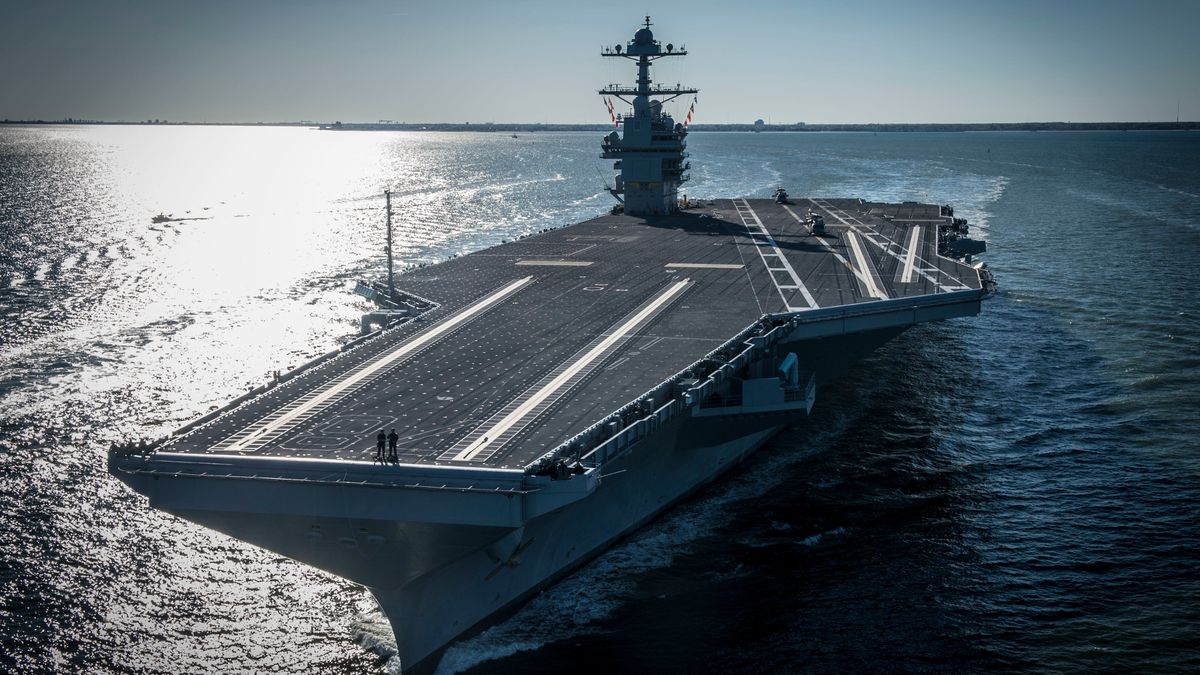
The USS Gerald R. Ford, America’s most advanced aircraft carrier(Image: US NAVY/AFP via Getty Images)
Commissioned into the Navy in 2017, the USS Ford is the newest and most technologically advanced of the 11 US nuclear-powered aircraft carriers.The ship’s electronic catapult system allows it to launch anything from small drones to big aircraft, giving US officials a range of firepower options, US navy veteran Brent Sadler previously said in the press. According to the former submarine tech, the US’ other 10 aircraft carriers don’t have that capability.Following the fire and the significant wear-and-tear of its almost year-long voyage, the USS Ford is entering a lengthy maintenance period.It may be at least a year before the vessel returns to sea, potentially requiring other ships to bridge the operational gap in the interim, one US official revealed.