


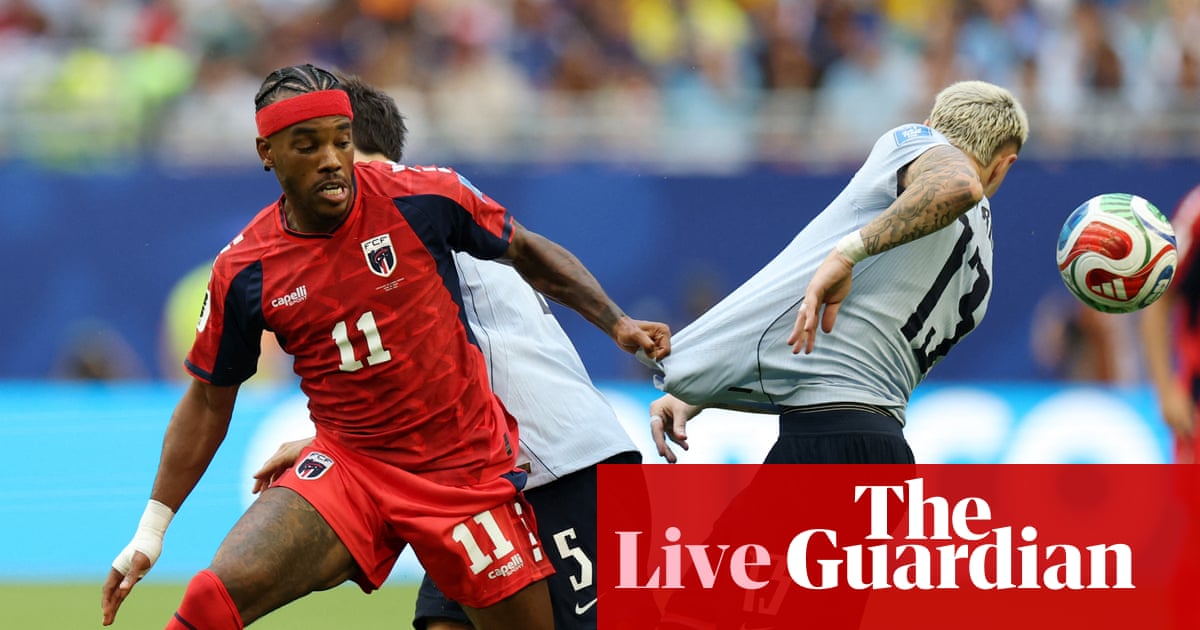
Key events
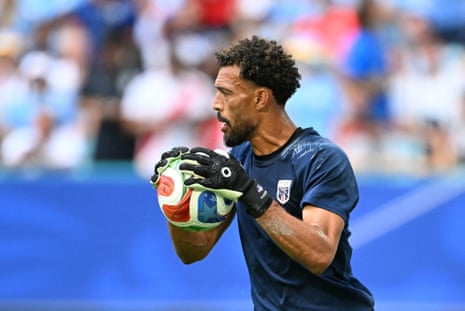
17 min Vozinha confidently collects the cross from the corner. He tries to go long with his distribution but sends it out of play.
16 min Uruguay attack quickly on the left and play the ball into the box, cleared for a corner. Still – pressure, but no serious chances.
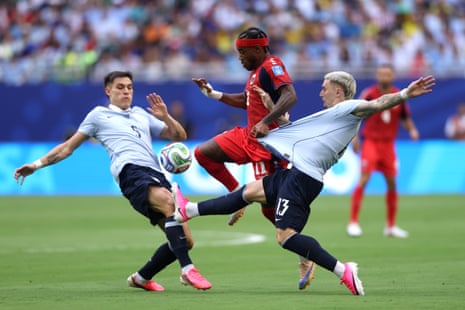
15 min Cape Verde attackers run into each other, and Uruguay go on the break. Valverde drags his shot well wide of the far post and knows he could’ve done better.
14 min A touch for Vozinha, who catches an arcing pass like an outfielder in baseball. Hasn’t been put to work yet.
13 min A rare foray forward for Cape Verde, but it leads only to a misplayed cross.
12 min Another Uruguay corner accomplishes little, and they end up hitting a hopeful ball forward that sails out.
10 min Good diagonal ball to the left flank for Uruguay that’s clipped back for a close-range header that slams into the shoulder of a Cape Verde defender.
Let’s explain the multiple reasons why that wasn’t a handball:
1. There was an offside call in the buildup.
2. The shot hit the player at close range, and the arm was in a natural position.
3. The shot hit the shoulder. Not lower on the arm.
Everyone got that? Good.
9 min Uruguay are playing like Uruguay. Sharp short passes. Good movement. No chances created yet, but this will be nervy for Cape Verde, especially as they’re playing with four at the back and leaving someone open on the opposite flank.
7 min Cape Verde get several attempts to clear this ball, but they don’t get it out of there.
Cano is again annoyed for some reason.
6 min Corner kick to Uruguay after a clinical rapid attack up the left.
5 min The referee is putting a stop to this nonsense now. Lopes Cabral is very late to a challenge and picks up yellow, which means we will not see him in the third match of the group stage.
4 min Cano is down, having received a small shove from Borges that, if his reaction is to be believed, dislocated several vertebrae.
3 min Lopes Cabral is judo-tossed again. What’d he do to deserve this?
Reminder – a yellow card for persistent infringement can be awarded even if different guys are fouling the same person.
2 min Cano mugs Lopes Cabral in an effort to get to a ball played across the field. The referee believes that is not allowed.
We’re off. Uruguay in their pleasant blue and white. Cape Verde in all red.
I very much like the Cape Verde national anthem. I’ll see if my band can open our next show with it, though this rendition has the odd tempo change that would probably throw us off.
Pregame ceremonies are moving swiftly, so kickoff should be on time.
More match facts
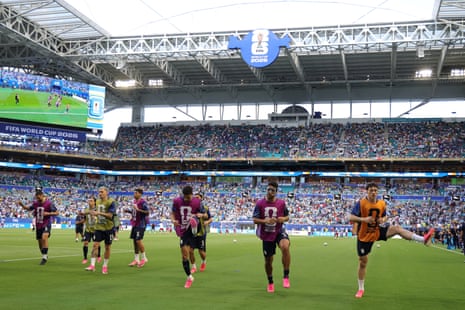
Venue: Miami Stadium. You might know it as Hard Rock Stadium, but not on this occasion.
Weather: Don’t complain about the hydration break in this one. It’s hot – 31 degrees Celsius or 88 degrees Fahrenheit – and humid (68%).
Referee: Espen Eskås leads a Norwegian crew, with ARs Jan Erik Engan and Isaak Bashevkin. The fourth official and reserve officials are two of the outstanding crew of US women that handled the Czechia-South Africa game – Tori Penso and Brooke Mayo. The lead in the VAR room is Willy Delajod, joined by fellow Frenchman Jerome Brisard and Dennis Higler of the Netherlands.
Jose Mourinho once labeled Eskås “arrogant,” which many people would likely take as a compliment. That was after the then-Fenerbahce manager believed his team had three penalties denied as they exited the Europa League at the hands of Rangers.
The combined population of these two nations is around 4 million, with Uruguay having about 3.4 million and Cape Verde around 525,000.
That makes this the smallest population represented in any group-stage game. Only Curaçao (185,000) is smaller than Cape Verde, and their group-stage opponents (Germany, Côte d’Ivoire and Ecuador) are all considerably bigger than Uruguay.
Meanwhile, let’s check in on the top 10 countries in population to see how they’re doing:
-
India – did not qualify
-
China – did not qualify
-
United States – doing OK so far
-
Indonesia – did not qualify
-
Pakistan – did not qualify
-
Nigeria – did not qualify
-
Brazil – leading Group C
-
Bangladesh – did not qualify
-
Russia – suspended from competition
-
Ethiopia – did not qualify
The next few countries made it, at least.
Uruguay
Muslera; Sanabria, Olivera, Caceres, Varela; Bentancur, Ugarte, Araújo, Valverde, Cano; Viñas
The single change from their lineup that started their 1-1 draw with Saudi Arabia: Agustin Cano (Fluminense) replaces Viña (River Plate). Defender Ronald Araújo has been battling injury and misses the starting XI again – that’s Maxi Araújo, the goal-scorer in the opener, in the starting midfield.
Cape Verde
Dias (“Vozinha”); Lopes Cabral, Borges (“Diney”), Lopes (“Pico”), Moreira; Pina, Rodrigues, Monteiro, Mendes, Arcanjo; Tavares (“Benchimol”)
Telmo Arcanjo cracks the starting lineup after a brief stint as a substitute against Spain. Gilson “Benchimol” Tavares also is in, along with 35-year-old midfielder Garry Rodrigues, neither of whom figured in the first game. Out: Jovane Cabral, Laros Duarte, Dailon Livramento.
Rodriguez was the first Dutch-born player to represent Cape Verde, starting in 2013. Benchimol had a hat trick against Liechtenstein in 2022.
Paradoxically, this World Cup has been the year of high scores – the average number of goals per game is a little above 3.0, a number not seen since the 1950s – and the year of the goalkeeper.
Eloy Room of Curaçao wowed Cup-watchers with 15 saves, the most in a 90-minute match since modern record-keeping started (Tim Howard had 16 in an extra-time game to become the most meme-worthy person in the USA for a while).
Iranian goalkeeper Alireza Beiranvand posted a save that will rival the legendary Gordon Banks save against Pele in the just-concluded game against Belgium.
And Cape Verde goalkeeper Josimar Dias, better known as “Vozinha,” has become an international superstar after slamming the door on Spain.
Will Uruguay manage a way past Vozinha? Will Cape Verde manage a goal of their own? Did you expect to be contemplating such questions a month ago?
Contemplate for the next couple of hours right here …
Beau will be here shortly. In the meantime, here’s what to know about Uruguay and Cape Verde before they meet in a few hours in Miami.
Uruguay
Marcelo Bielsa has left his indelible mark on this Uruguay team. His 4-3-3 system is built for direct football, allowing his side to press their opponents high up the field and chase the ball at all times. There is no letup in attacking when Uruguay have possession.
Ignacio Alonso, the president of the Uruguayan Football Association, set the target: “Uruguay have to aspire to be in the world’s top 10 and therefore we have to reach the quarter-finals.” Alonso also addressed concerns over Uruguay’s form. “Bielsa is very excited for the World Cup,” he said. “He’s got his mind focused on the preparations. His objective is to have a great World Cup. It’s his aspiration, the result of all his work, research and preparation.”
Cape Verde
The Blue Sharks of Cape Verde are swimming in uncharted waters as they make their World Cup debut, but you wouldn’t want to bet against them. The tiny archipelago off the coast of west Africa played their first World Cup qualifier in 2000, but if any team can handle the pressure of a meteoric rise to the top of world football it is Cape Verde. After all, the country’s national slogan – morabeza – roughly translates to “no stress”. They will need that mentality as they take on Spain, Uruguay and Saudi Arabia in Group H.
It is an eclectic group of players assembled by Pedro Leitão Brito, known as Bubista. The 26-man squad represents 25 clubs from 14 countries and has more players born in Rotterdam (six) than in Cape Verde’s capital, Praia. But for a nation built on immigration, navigating complex identities and languages isn’t a challenge, it’s something to be embraced.