


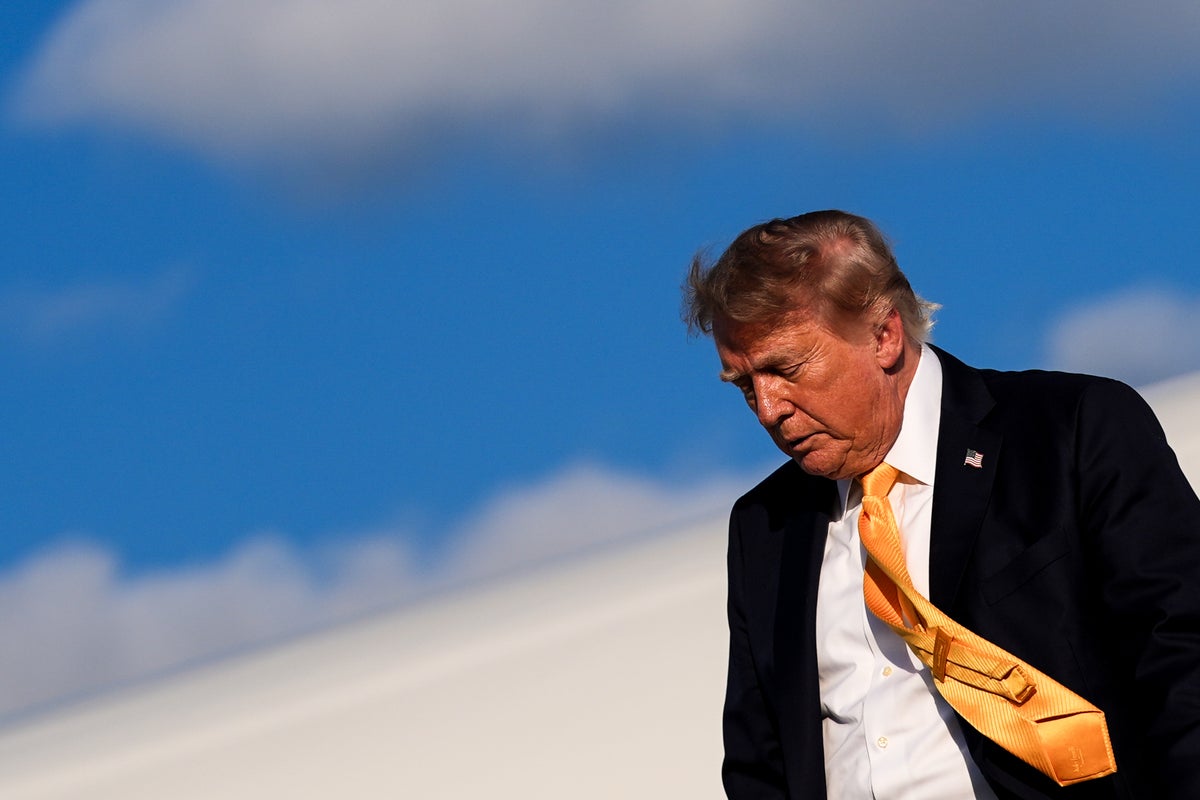
Donald Trump’s approval rating has dropped to a record low in a major poll, presenting a headache for Republicans in the lead up to the midterm elections.
Less than two months before November’s elections in the US, a Financial Times poll carried out by Focaldata found that only 33 per cent of registered voters approve of Trump’s performance as president.
This is the lowest number recorded since the newspaper began asking the question in May and a three-point decrease from the previous month.
Pessimism about the economy and the cost of living among Americans was a primary reason for Trump’s dropping numbers, the poll suggested, as the majority of those polled rejected his trade and tariff policy.
Almost two-thirds of registered voters said they believed the economy was heading in the wrong direction, and 57 per cent said they were worse off financially under the Trump presidency.
Only 53 per cent of Republican voters said they were in favour of how Trump has handled jobs and the economy, representing an almost eight-point drop from the previous month.
It comes as fuel costs hit an unprecedented high in the US on Friday, with diesel soaring to a record national average of $5.85 a gallon as the ongoing war with Iran continues to disrupt global fuel flows.
Trump on Friday backed up comments from his vice president and insisted the Iran conflict is a relatively minor operation, rather than a full-on war.
“I call it a military conflict because it’s small potatoes for us,” the president told reporters in the Oval Office. “It’s not a big thing.”
During his comments on Friday, the president also downplayed the centrality of the Hormuz Strait, another important aspect of the war.
The president claimed that new pipelines, shipping routes and overland oil transport would replace the key waterway, which is a major global oil hub.
“The Hormuz Strait is not what it used to be,” Trump said.
Iran has used its proximity to the strait to hamstring global oil trade and continues to exert leverage over the US, though the president claimed the waterway was dwindling in importance.
“They’re going to end up with a Hormuz Strait that’s not very necessary anymore,” he said.
The poll will make for tough reading for Republicans who hope to retain control of the House and Senate in November’s elections.
A separate poll found that a growing number of Americans now identify as Democrats.
The latest Gallup data shows 31 per cent of US adults identified as Democrats in the second quarter of 2026, compared with 25 per cent who identify as Republicans.
That six-point advantage is the largest Democratic lead in party identification in more than a decade.