


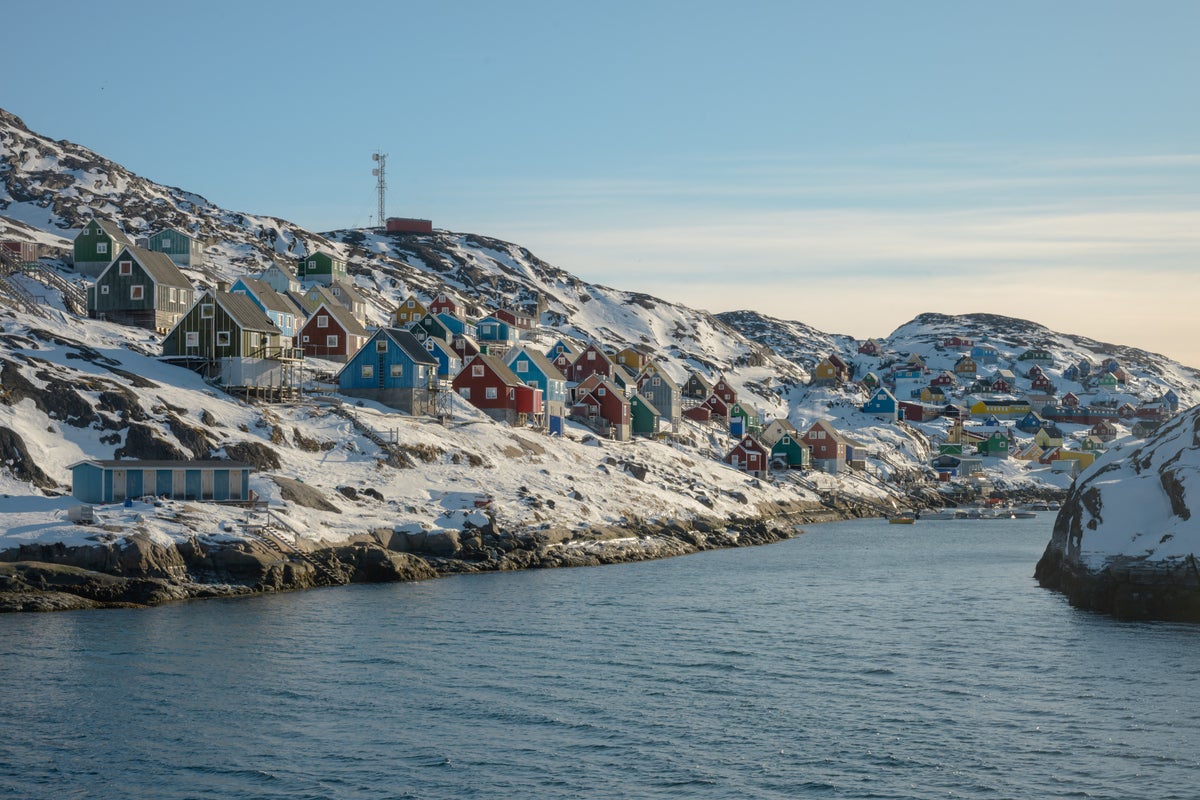
The Trump administration has made multiple cases for acquiring Greenland, pointing to strategic security interests, untapped mineral wealth and what it describes as Denmark’s inadequate stewardship of the vast Arctic territory.
Now, a much stranger justification has entered the mix: that by taking control of Greenland’s seafood industry, the U.S. could secure a limitless pipeline of shrimp for Red Lobster customers.
Tom Dans, the Trump-appointed chair of the United States Arctic Research Commission, made that pitch earlier this year, back when the billionaire president’s desire to annex the world’s largest island dominated headlines.
“My view is that the United States could take all the seafood Greenland could produce, and cut out the middleman, and keep it from China — and you could bring back all-you-can-eat shrimp at Red Lobster,” he told The New Yorker.
The company, which boasts hundreds of locations across the country, scrapped its “endless shrimp” promotion in 2024 after filing for Chapter 11 bankruptcy. The promotion has since returned to the restaurant.
 open image in gallery
Dans, a one-time pecan farmer and venture capitalist, is one of a small group of Americans the Danish government has identified as spearheading “influence operations” in Greenland, the outlet reported.
He previously worked at the Treasury Department during Trump’s first term and served on a secret National Security Council task force focused on gaining control of the territory of roughly 57,000 people.
Despite never having set foot in Greenland, Dans insisted that U.S. acquisition of the territory — which would eclipse the Louisiana Purchase in scale — is a no-brainer.
“There’s nothing secret about the contours of the thing — if you study Greenland at all, you quickly arrive at the point that, you know, they’re asset rich and cash poor,” he told The New Yorker. “So, like, this is not a toughie, if you come from an investment-banking or dealmaking background, to solve.”
 open image in gallery
Trump initially floated the idea of incorporating Greenland as a U.S. state during his first term, but it was only after he returned to office last year that his rhetoric on the issue intensified dramatically.
The 80-year-old president has claimed that Denmark — which signed a 1951 treaty allowing the U.S. to build bases in Greenland — has not done enough to bolster the island’s defenses, dismissing its military assets there as “two dog sleds.” He’s argued that the U.S. needs to “own” Greenland to prevent Russia and China from seizing it, along with its vast mineral resources.
“We’ll get Greenland. Yeah, 100 percent,” he told NBC News last March.
“There’s a good possibility it could be done without military force,” he said before adding: “I don’t take anything off the table.”
This hostile language, which was parroted by other administration officials, was met with alarm and condemnation across Greenland, Denmark and much of Europe.
In January, Danish Prime Minister Mette Frederiksen said she “strongly” urged the U.S. “to cease its threats against a historically close ally, and against another country and another people who have stated very clearly that they are not for sale.” Soon after, the Danish military reportedly began flying troops to the island in preparation for an attack.
Later in January, during a trip to Switzerland, the American president appeared to soften his stance on Greenland, stating that he would not seek to annex the territory with military force, but called for “immediate negotiations.”
 open image in gallery
Since then, the thorny issue has largely fallen out of the spotlight as the Iran war, launched in February, has dominated U.S. foreign policy conversations.
Still, the Republican president occasionally returns to it — often as a justification for his hostility toward NATO.
“It all began with, if you want to know the truth, Greenland,” Trump said during a press conference in April. “We want Greenland. They don’t want to give it to us. And I said, ‘bye, bye.’”
The following month, The New York Times reported that senior administration officials have been holding closed-door meetings with negotiators from Greenland and Denmark about the future of the Arctic island — indicating the president’s interest in that region remains steadfast.
A majority of Americans, 86 percent, oppose the U.S. taking over Greenland by force, according to a January Quinnipiac survey. The overwhelming majority of Greenland’s residents are also opposed, according to recent polls.
The Independent has reached out to the United States Arctic Research Commission for comment.