




Trafficked, beaten and raped: raids reveal scale of abuse of women in Asia’s cyberscam centres
As tens of thousands are freed, female survivors are increasingly reporting gender-based violence in the compounds, previously thought to hold mainly men
Late one evening in October 2023, Sarah* felt labour pains starting. It was 11pm, but at the cyberscam compound inside Laos’ Golden Triangle, workers were logging on for a long night shift, scamming Americans online.
Every night, workers sat at their computers until the early hours, building fake profiles of glamorous, jet-setting women on Facebook and Instagram. Sarah trawled the web to find older men to target with messages, where she fawned over their jobs, asked how their day had been and exchanged photos of luxury travel and beach trips. Each conversation she had was meticulously designed to follow a multi-day script, and monitored by bosses who walked up and down the long rows of desks.
Eventually, Sarah would lead the conversation towards crypto investments and share fake screenshots of sizeable profits. The hope was that the person on the receiving end could be reeled in for a payout: a transfer of funds to an investment scheme that would eventually reveal itself to be fraudulent.
This form of scam, known as “pig-butchering”, is now so profitable that entire compounds have been set up by criminal groups – many of them staffed by men and women, like Sarah, who have been trafficked from other countries.
A 39-year-old former shopkeeper from Uganda, Sarah was lured to Laos by the promise of a job as a social media manager, before being sold between three Golden Triangle compounds starting in 2022.
A few months after arriving, she experienced several days of sexual abuse inside what workers called the “dark room” – separate quarters in which compound bosses doled out beatings and rapes. A group of men were forced to rape Sarah and three other women as a joint punishment after they refused to scam more victims.
She had hidden her pregnancy, terrified the Chinese bosses running the compound would kill her if they found out. But now the baby was coming.
Sarah grabbed the office’s shared smartphone and ran downstairs to the building’s entrance, where the guard was momentarily absent. Using Google translate, she asked a taxi driver to drive her to a hospital.
“I can’t even believe it, because I just went out,” Sarah says, now in Kampala, as her two-year-old son plays on the floor next to her. “Maybe God helped me to go.”
Like the hundreds of thousands of people who have been trafficked into south-east Asia’s scam compounds, Sarah’s day-to-day life inside the Golden Triangle consisted of forced labour, cramped living conditions and beatings.
But she also experienced the additional trauma of sexual abuse, a common but overlooked reality reported by a growing number of women who have escaped the industry.
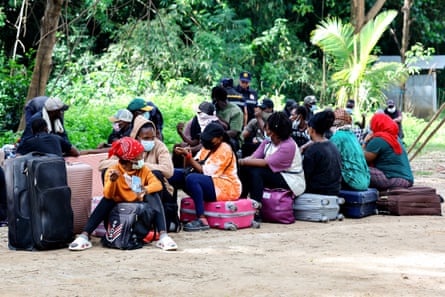
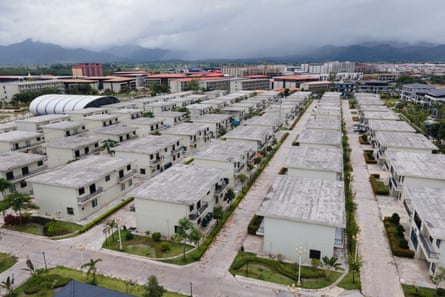
Run primarily by Chinese and Taiwanese criminal syndicates, illicit cyberscamming has expanded across Laos, Myanmar and Cambodia since 2020, leading to estimated fraud losses of tens of billions of dollars.
Like the men, female cyberscammers are expected to lure victims via chats – but they are also used to pose in fake social media profiles or speak over video calls.
Experts have long understood the workforce to be overwhelmingly male. But as government-led raids in Cambodia and Myanmar have freed tens of thousands of workers in recent months, female survivors are increasingly sharing stories of gender-based violence that previously received little media or government attention.
The Guardian spoke with six women, all former compound workers, who described gendered exploitation, including sexual attacks, lack of access to sanitary products and verbal abuse. Compound bosses use rape to punish women, they said, as well as a reward for men who successfully completed lucrative scams.

Human rights groups and other organisations have started tracking sexual violence inside the compounds. The UN office of the high commissioner for human rights (OHCHR) noted in a recent report that “sexual violence against female and male victims [has] reportedly increased dramatically since 2024,” citing 12 women who were raped and impregnated in Myanmar, as well as a pregnant Filipina woman who was electrocuted.
Amnesty International has also documented an increase in sexual abuse over the past year, including what its regional director, Montse Ferrer, calls “extreme” cases of rape, forced abortion and abortion-related deaths.
It is unclear whether the increase is due to more reporting or shifting gender ratios inside compounds. Overall, women made up about half of the nearly 80 survivors interviewed by Amnesty International over the past year, compared with about one quarter the year before.
Women are often driven towards labour migration because of financial burdens linked to caring for children and ageing parents, says Ling Li, co-founder of EOS Collective, an anti-scam nonprofit organisation. Many report being trafficked by family members or partners.
Four of the scam workers interviewed by the Guardian are single mothers. Rachel*, a 29-year-old Kenyan, borrowed 200,000 shillings (£1,150) in late 2024 to pay a broker who offered her work in a Thai sweet factory.
Instead, she was sold across two Myanmar scam compounds, where she worked 18-hour days chatting with at least 100 potential scam victims at a time.
after newsletter promotion
When she failed to respond fast enough, the boss punched her in the head, kicked her and sexually abused her, she says.
“If I’d had someone who could tell me, ‘Wherever you’re going, it’s not good’ – I could have listened,” says Rachel, who supports her parents and young son. “But I had no idea about anything. I only wanted to go and work, and to earn for myself and for my family.”
Not all women return home. Twenty-two-year-old Lintang*, a scam worker from Indonesia’s Riau province, was barely able to walk when she was admitted to a Cambodian hospital on 20 February.
Lintang told an NGO case handler, who asked to remain anonymous for safety reasons, that she had been repeatedly gang-raped. Lintang was diagnosed with HIV and tuberculosis, according to the Indonesian embassy. Several NGOs tried to send Lintang to Indonesia for treatment, but it proved expensive and difficult. She died on 10 March.
As Sarah laboured in the hospital early that October morning, the health staff demanded payment for her treatment. “I had nothing, not even clothes,” she says.
But she did have a friend: Ketsana*, a Lao citizen now living just outside the Golden Triangle. At about 5am, Sarah texted Ketsana a photo of her newborn son. Bewildered, Ketsana “just asked whose child it was,” she says.
A mother of two who had worked as a local government administrator, Ketsana was trafficked into a Golden Triangle scam operation in 2022 after being promised work as a housekeeper, then sold to two other compounds, before eventually being moved to the same building as Sarah. Because of the language barrier, the women only spoke a few times, but they exchanged Facebook details before Ketsana escaped during a police raid.
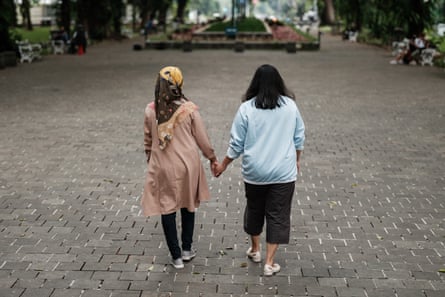
Ketsana sent a taxi to pick up Sarah and her baby, and for the next month, the trio shared a two-room apartment.
Sarah flew home to Uganda 40 days after her son was born with the help of an NGO. She has since trained to work as a tailor, earning about 7,000 Ugandan shillings (₤1.40) a day, but it is not enough to cover living expenses.
She warns other women – often other single mothers – that they should think twice before travelling abroad to work, lest they return as “bodies”.
On days when there is nothing to eat in the house, or no money for a doctor’s visit, a mix of emotions washes over Sarah: frustration over her finances, love for her son – and memories of “the many things I went through” in the Golden Triangle.
“When he’s sleeping, when I don’t have anything to feed him – that’s when I think about it.”
*Names have been changed to protect their identities.
-
Konlaphat Siri contributed to this report.
-
This reporting was supported by the Overseas Press Club Foundation.
Explore more on these topics
- Cybercrime
- Rights and freedom
- Laos
- Asia Pacific
- Human rights
- Human trafficking
- Rape and sexual assault
- Uganda
- features