



Ronnie Johnson’s show business CV reads like a movie script.
A child actor talent spotted at his Surrey primary school aged six by director Richard Lester, he appeared in iconic 1960s films The Knack starring Rita Tushingham; Oliver! the musical as “Fagin’s Boy”, and The Beatles’ A Hard Day’s Night.
But by his late teens he decided “the play’s the thing” wasn’t the thing for him after all, and took up playing electric guitar instead.
He was soon in demand at the famous Speakeasy Club on the fringe of London’s Soho, where everyone from the Rolling Stones and Bowie to Elton John and Bob Marley played in the 1970s.
The list of stars Johnson has performed and/or recorded with in half a century since then reads like a roll‘n’roll hall of fame: Van Morrison, Bob Dylan, Sting, Tom Jones, Joe Cocker, John Lee Hooker, Georgie Fame, Fleetwood Mac’s Peter Green, Leo Sayer and many more.
Nor are his skills limited to his beloved Fender Stratocaster: he was director of music for Van Morrison for a decade.
.jpeg) open image in gallery
open image in galleryJohnson is one of the most prolific and enduring British electric guitarists you have never heard of – unless you read specialist music magazines, where he has often been lauded.
He spent a decade with Van Morrison with his back permanently faced to the audience as he led a band of up to 10 musicians.
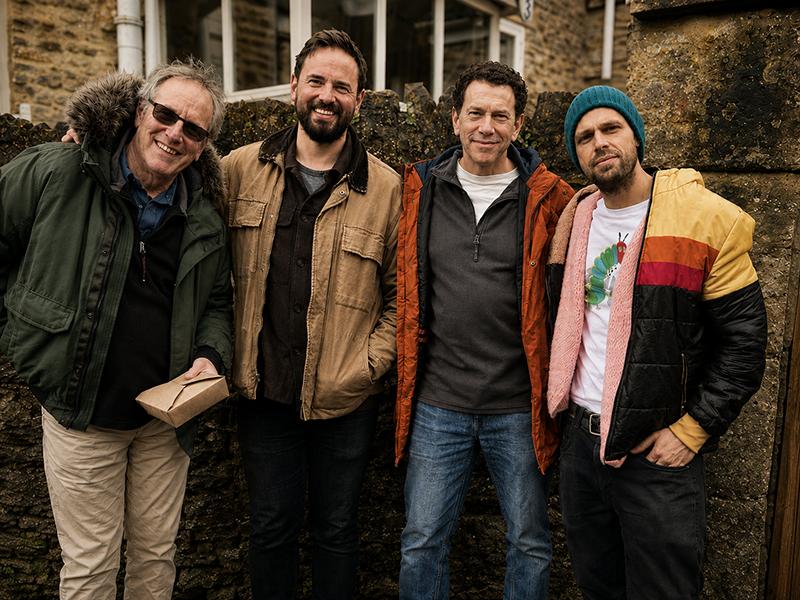
But now Johnson is emerging from the shadows with a new album of his own music with his own band, the quirkily named Dez Ezé (pronounced Dez Ezzay).

Enjoy unlimited access to 100 million ad-free songs and podcasts with Amazon Music
Sign up now for a 30-day free trial. Terms apply.
ADVERTISEMENT. If you sign up to this service we will earn commission. This revenue helps to fund journalism across The Independent.
The band’s eponymous debut album has been variously described as “guitar-led rock and jazz improvisation and ambient soundscapes”.
Having had an exclusive preview for The Independent, I detect shades of Ry Cooder, Pat Metheny and Steely Dan.
But the four piece Dez Ezé have a style all their own too. Wave after wave of swooping and beguiling music, two lead guitars weaving in and out of each other, switching from melody to harmony as though they share a musical DNA.
Which in fact they do. More of that later.
But first, what is it like working for the famously – to put it mildly according to some – intimidating Van Morrison?
Johnson should know: he was the Northern Irish blues and soul legend’s lead guitarist for most of the 1990s, as well as music director.
He has done several world tours with Van Morrison, sharing top billing on one with Bob Dylan, while acting as both his band leader and lead guitarist. He has played on some of Van Morrison’s most successful albums, such as Days Like This and The Healing Game and regularly collaborates with him to this day.
Loyal Johnson says Van Morrison is not as moody as has been claimed. He puts it more diplomatically, saying his reputation is all down to his being “impatient to get things right”.
 open image in gallery
“It’s true he is demanding: he has a song called ‘Why Must I Always Explain?’ – that pretty much tells you all you need to know!” says Johnson with a loud cackle, adding: “Honestly, he is a darling sweet man.”
He claims Van Morrison told him he employed him not for his musicianship but because he makes him laugh. After interviewing Johnson I can believe it – up to a point. His conversation is littered with jokes and wisecracks delivered in a “Sarf London” accent that makes Mick Jagger sound posh. Part of him is still auditioning for “Fagin’s Boy”, though the jokes are a mask to leaven the refined and meticulous way he actually approaches his craft.
Johnson’s sense of humour got him into trouble while recording with Sheffield-born gutsy singer Joe Cocker.
After deciding Cocker – “the nicest man I ever met” says Johnson – needed cheering up with “some working-class humour”, he was rebuked by Cocker’s po-faced manager.
“He barked at me ‘cut the jokes – you’re employed to play guitar not make him laugh’.”
What makes Van Morrison so good?
“He has a stunning voice – even now in his late seventies, phenomenal stamina, is blessed with extraordinary phrasing and writes incredible songs.”
That should do.
Johnson says Van Morrison plays down his familiar bluesy songwriting style as “re-inventing the wheel”. Johnson is more generous: “Van invented the wheel in the first place!”
He name checks his favourite rock guitarists, Jimi Hendrix, Frank Zappa and Jeff Beck. “They all play guitar that gets you in the solar plexus,” he says, holding a clenched fist to his stomach, “they have heft.” Before quickly adding “heft” does not mean “heavy”.
He is no fan of heavy metal, calling it “a sausage fest” in reference to the historically male-dominated scene.
Before we explore the music of Dez Ezé, where does the name come from?
It is apparently all the fault of “punk poet” John Cooper Clarke. Johnson is a big fan and heard him choose Against Nature, an obscure 19th-century novel by Joris-Karl Huysmans, as his favourite book on BBC Radio’s Desert Island Discs.
 open image in gallery
Johnson bought a copy and loved it, calling it “a bible of hedonistic decadence”. The name of the protagonist Des Esseintes was shortened to Dez Ezé for the band.
The aforementioned shared DNA of the two lead guitarists is explained by the identity of Johnson’s co guitarist: son Patrick, 38, who matches his father mellifluous riff for riff and choral chord for chord.
The album is a joint effort by them in terms of writing and playing, with the exception of one “cover” song, “Wichita Lineman”, written by Jimmy Webb for Glen Campbell.
Johnson senior says: “Patrick and I sat down and jammed one day a couple of years ago and I couldn’t believe what came out between us. His music has a romantic sound which I think compliments mine.”
It isn’t all plain sailing. He smiles: “There’s the usual father-son tensions. Going to a gig together I’d turn up and he’d still be in his dressing gown. So we go separately now. The father-son thing is often reversed with Patrick shouting at me: ‘No dad, not like that! More reverb!’”
One of the most striking aspects of the album is that it has no vocals. Johnson says: “I often joke the only reason you need a singer is if the music isn’t good enough. Well it is here!”
Try saying that within Van Morrison’s hearing. More seriously, he maintains the dual guitars give voice to Dez Ezé more eloquently than any human voice.
The Johnsons rely heavily on so-called “floating” chords (“‘suspended” to use the technical term) to shape their distinctive sound.
It is a method used notably by Joni Mitchell, one of Johnson’s most profound inspirations, to conjure an airy, dreamy feel, with songs ending mysteriously and unresolved, rather than all loose ends neatly tied up.
Mitchell called them her “question chords”. Dez Ezé’s music poses questions to listeners and offers a soothing response. Not that it is all intricate patterns and aesthetics: they don’t shrink from using a bit of “heft” when required, aided by powerful US-born drummer Neil Burton.
 open image in gallery
Johnson refuses to take himself seriously, but over the course of an hour the carapace keeps lifting up at the edges. Asked to elaborate on suspended chords, he grabs an acoustic guitar and strums one, observing casually: “Ravel and Debussy did something similar.”
Come again?
French classical composers Claude Debussy and Maurice Ravel understood the link between music, colour and tone. Contemporaries of artists like Monet, they were called “Impressionist” composers.
“I know it sounds pompous but the way I see it we are painting with music,” he says.
“I think it is one reason our music has an appeal to both genders, it is a palette with many colours, not like the ‘sausage fest’ preferred by some.” (He means men)
Johnson has spent most of his career letting others hog the limelight.
An unlikely frontman, he walks gingerly, the painful legacy of a mid-concert fall caused by a rogue amplifier lead a few years back. The musical ringmaster in him watches every move by Dez Ezé as they play. But between songs, he is an angular bundle of energy, irreverent and playful, the child actor in him not yet totally extinguished.
The Dez Ezé line-up is completed by young funk-loving bass guitarist Dylan Bond. Johnson is proud that the album was recorded live over three days at The Wool Hall studio in Somerset without a single overdub.
“It is a measure of the fantastic quality of the other musicians in the band and makes the whole sound so much more coherent and complete,” he says.
The studio is where Johnson recorded Days Like This with Van Morrison 30 years ago. He is hoping to replicate a slice of its success for Dez Ezé.
They play their first public gig at The Old Court in Johnson’s home town of Windsor, Berkshire on Saturday 26 September. The album is released the same day.
Tickets and info: www.oldcourt.org.uk/events.