


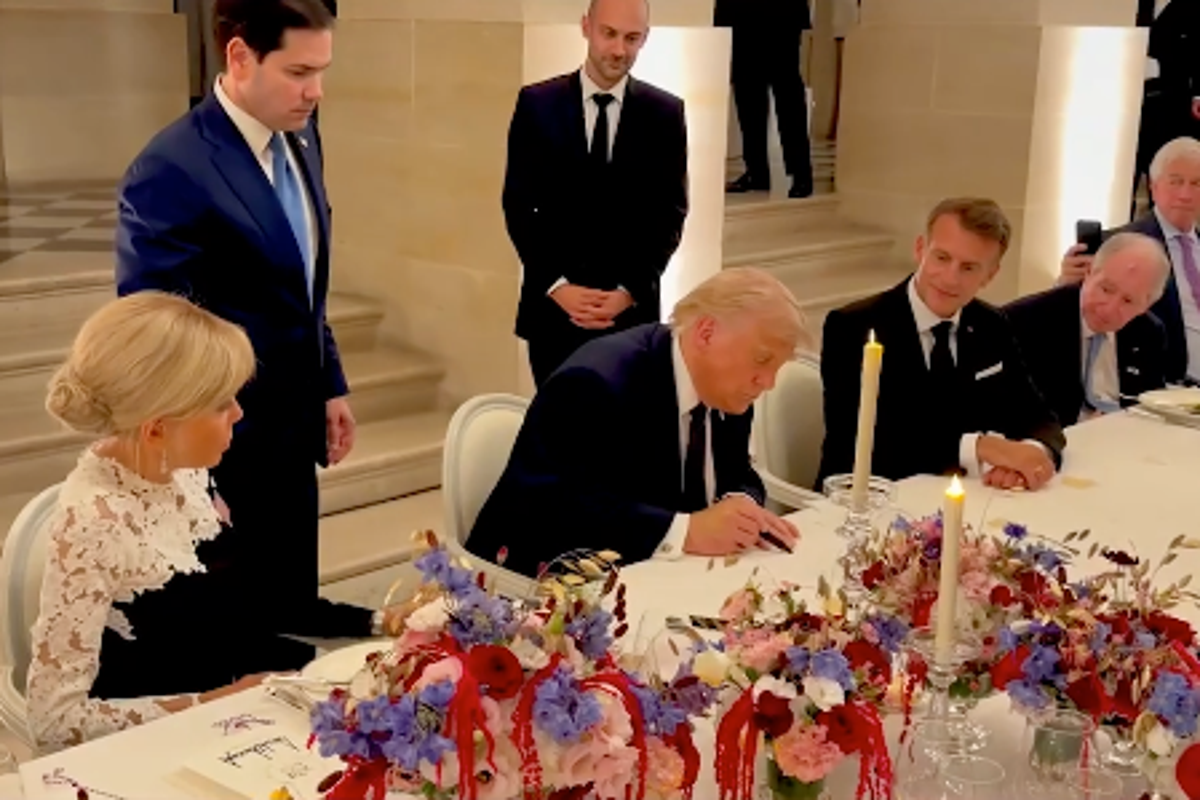
With no great sense of history, and still less shame, Donald Trump signed the memorandum of understanding (MoU) with Iran in the grand setting of the Palace of Versailles, flanked by his secretary of state, Marco Rubio, and Emmanuel Macron, president of the French Republic.
It was a historic, if odd, moment. There was no representative from the Islamic Republic to join the US president in the brief ceremony, and the “treaty” had already been agreed by the vice-president, JD Vance, and signed off by both sides “digitally”, with Israel glaringly excluded.
Earlier, Mr Trump had joked that he wasn’t even sure if such a flimsy, low-level diplomatic instrument warranted his formal signature, and that Mr Vance could take the blame if things went wrong. Like so many of the president’s wisecracks, this carried a hint of menace – a subtle reference to Mr Vance’s chances of succeeding Mr Trump in 2028.
In the event, Mr Trump couldn’t resist the call of destiny, and put Sharpie to paper. No doubt he will claim this as the ninth or 10th war he has ended, leaving the question of who started it to the “fake news” people to point out. No matter. Operation Epic Fury has ended up an epic defeat.
However, for all the MoU’s many flaws and tragic ironies, the immediate feeling must be one of relief. The war is over. That is reason enough for celebration. Even if the MoU is no better than the Iran nuclear deal that Barack Obama negotiated in 2015, or the Omani-brokered settlement reached in February this year, Iran’s renunciation of nuclear weapons is a precious achievement – the tragedy being that this war was not necessary to accomplish it.
The Iran war has ended because, not to be too fastidious, America lost – and for that reason is unlikely to restart it. The US Navy is retreating from the combat zone, and the chiefs of staff, based on bitter experience, are in a better position to counsel the president not to bother returning. Formally, the ceasefire lasts for only 60 days, but it is impossible to imagine that, come August, with the midterm elections almost upon him, Mr Trump would willingly choose to inflict chaos on the world, and higher inflation on Americans, just as he is trying to retain control of an increasingly troublesome Congress.
As he has admitted, he may end up being impeached, again. As things stand, however, resistance to the MoU among Senate Republicans will make things difficult for him in any case. Senators are required by law to review any agreement with Iran involving nuclear material, and they will also have to approve the relaxation of certain sanctions. Mr Trump will need to mobilise his sceptical Maga base to help him end the kind of costly, risky, intractable conflict in the Middle East that he promised never to embroil America in again. In that very real political sense, President Trump has emerged a loser from this process.
So too, and to a more mortally dangerous extent, has Israel. Mr Trump was either talked into this doomed adventure by Benjamin Netanyahu or encouraged into it, but it was illegal, unplanned and unnecessary, and a calamity for Israel. It was designed to humble Iran, crush the terrorist proxies so intent on the destruction of the state of Israel, and end, for the foreseeable future, the threat of long-range ballistic missiles armed with nuclear weapons reaching Israeli territory.
Instead, this war and the terms of the MoU now necessary to end it have left Israel less secure, and its relationship with the US distinctly soured – another cause for delight in Tehran and, for that matter, Moscow. To the barely concealed fury of Mr Netanyahu, the MoU explicitly extends the ceasefire to Israel’s activities in Lebanon, and guarantees Lebanese sovereignty, implying immediate Israeli evacuation. Mr Trump wonders aloud whether Syria might be better at “taking care” of Hezbollah, and openly criticises Israel’s disproportionate and cruel methods of making war.
Israel was not consulted about the MoU, and it shows. Under the Trump plan, Iran will be permitted to develop ballistic missiles and enrich uranium for electricity generation – difficult to police. More to the point, after more than three months of bombardment and assassinations, the Islamic Republic’s current leadership, which Mr Trump affects to like, is more militant, about $400bn (£300bn) richer, and in a stronger position than before the war, when internal unrest was growing so ominously.
Israeli and American leaders promised the Iranian people that “help is on its way”, that there would be regime change, and that the ayatollahs and the Islamic Revolutionary Guard would be forced into “unconditional surrender”. Now Mr Trump denies that was ever his intention, and would be perfectly happy to shake hands with the very men he tried to kill only days ago.
America’s allies, such as Britain, may feel vindicated that they didn’t sign up for this disastrous attempt at neo-imperialism, and grateful that a world recession has been averted, but now we have to live with an emboldened and economically restored Iran. America has demonstrated the limits of its power, and divided the West.
As it happens, and almost by accident, the Iranians have given up on a nuclear deterrent – which was never going to be of much practical use anyway – but gained a far more flexible weapon of mass destruction: de facto control of the Strait of Hormuz, and with it the ability to hold the global economy hostage whenever it suits them. It is a priceless reward for their stubborn resilience.
The Iran war, without the US ever intending it, offered the Iranians an opportunity to perfect their methods of modern asymmetrical warfare, unleashing cheap drone technology against expensive American equipment and poorly defended US bases in the region, as well as civilian targets in the Gulf states.
Recent weeks have given “proof of concept” to Iran’s ability to blackmail the wider world, and soon, the revenues from unrestricted oil and gas exports will revitalise the Iranian economy and quell dissent among its citizens.
All of America’s tactical wins – sinking the antique Iranian navy, killing Ayatollah Khamenei, wrecking bridges – are dwarfed by its strategic blunders. It could hardly have turned out better for Iran, but the fundamental problem for the US and the West – of taming this rogue regime – remains, and indeed, is now even more acute.
Like that other Versailles treaty – signed by President Woodrow Wilson back in 1919, and intended to put an end to wars – this deal leaves much unfinished business.