


‘There were bad moments and bad behaviour’: Alan Davies on booze, ego, comedy and cancer
At 60, Davies is less of a hell-raiser than he once was – but a great deal happier. He talks about the excesses of the 90s, the sexual abuse that made him such an ‘angry boy’, his recent bladder cancer, and fatherhood
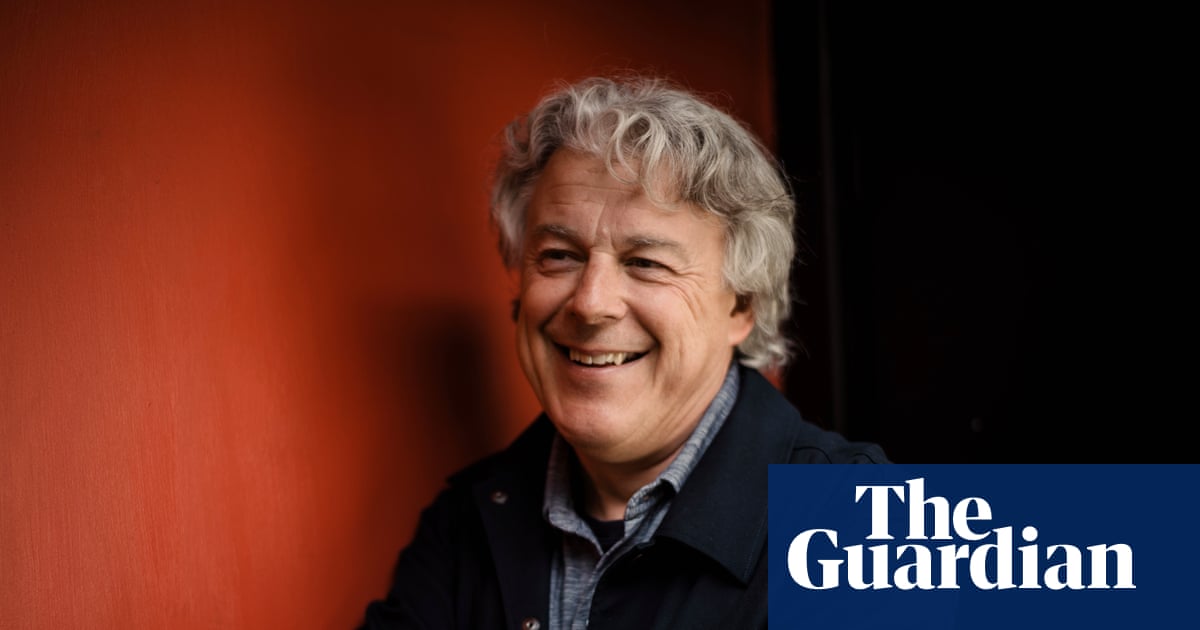
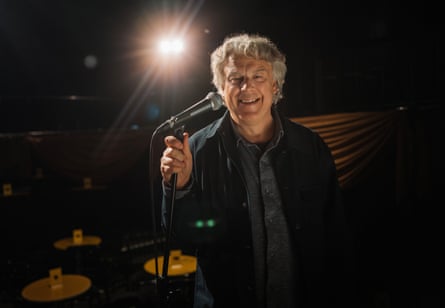
It looks as if Alan Davies is in the wrong place. Not as in the wrong venue: he’s here at the Pleasance theatre in Islington, a north London fringe theatre and comedy venue, where we arranged to meet. But he’s in the wrong part of it. Although there’s a stage with a single microphone at standup height, Davies – who has performed here many times – joins me in the auditorium, sitting down at a table. Someone in the shadows is testing the lighting, and suddenly there’s a spotlight on the stage where the mic is. Is it tempting to jump up there and do his thing, even to an audience of one? “It is a bit, yeah,” he admits.
When I started the interview, I’d found that the notebook I’d brought with me contained some diary entries from my 14-year-old son. “Have you got the wrong notebook, or has he been writing in your notebook?” Davies asks. I think B. “Sounds like he wants it to be found.”
Davies also has a 14-year-old son, and a 16-year-old daughter, and another 10-year-old son. He’s thinking a lot about family at the moment; it’s what his latest memoir is really about, though he didn’t realise when he started it. In his previous autobiography, Just Ignore Him, published in 2020, he wrote about being sexually abused as a child by his father. In 2017, he had found out that his dad had a huge collection of pornography featuring boys. Davies wanted to have him prosecuted but by then his father was in his 80s and had Alzheimer’s. He has since died.
I ask him about the reaction to that book. “People have contacted me, messaged me, talked about similar experiences, not just in terms of those things happening in their childhoods, but in terms of not telling anyone, even people close to them. Some have even said they’ve been able to take that next step in part because they read the book, so if it helps, that’s gratifying, makes it worthwhile.”
It’s been helpful to Davies too, getting it out there, “revealing this long-hidden part of my childhood. It was necessary work for me, because these issues were still impacting my behaviour, my happiness – a sort of latent anxiety or whatever you want to call it. The process of turning round, looking back and facing it … there was a lot of time sifting, reflecting and analysing, and it’s been beneficial to have that mental sort-out.”
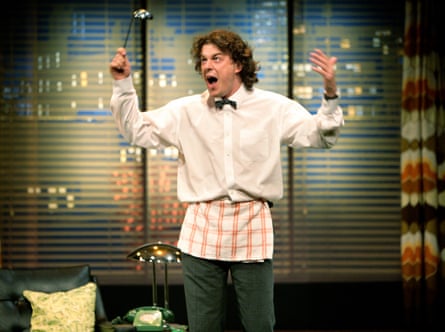
His follow-up biography, White Male Stand-Up, published in 2025, sets off on happier territory: the comedy circuit in the 1990s and the laughs, loves, successes and excesses that went with it. He called it White Male Stand-up because, he says, apart from a few exceptions, “that’s what we all were”. It was brilliant and Davies loved it: the camaraderie, famous friends, the job itself – just getting up there on the stage in the spotlight with that mic. “If you have an aptitude for it, you can make them laugh, you feel those laughs, it’s fantastic, the adrenaline and the excitement of it.”
But it came with dangers. He dodged some of the bullets; others got him. He didn’t dive into the mountains of cocaine that were apparently everywhere as enthusiastically as some of his contemporaries (he did the drug, but says he never reached the point where he needed to take it). Booze was trickier. “It can be a very destructive thing, so there were some bad moments and some bad behaviour and things you can regret.” At times he was downing two bottles of wine a night.
The job came with jeopardy too. “You can develop quite an ego, if you’re young, in your 20s, getting up on stage like that. There’s rooms full of people laughing, comedy clubs are booking you left, right and centre. What sort of ego do you have to be to think: well, I’m in a room of 500 people – it’s probably best if I’m the only one talking?”
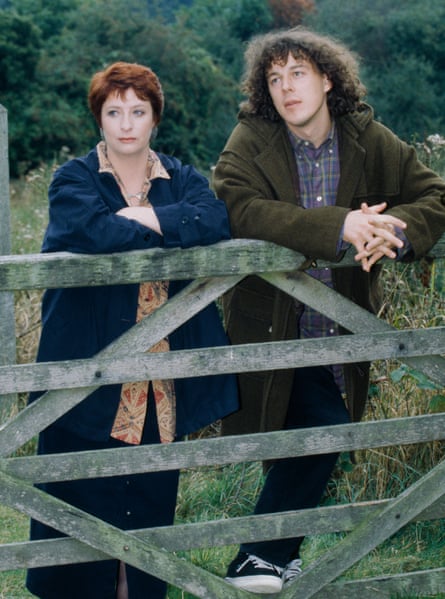
When he got the title role in Jonathan Creek, David Renwick’s long-running BBC crime drama, which was first broadcast in 1997 and got 12 million viewers on a Saturday night, Davies became even more famous. QI, the funny-clever panel-gameshow he starred in alongside Stephen Fry (and continues to be in with Sandi Toksvig) came a bit later, in 2003. “If you’re starting to develop a high opinion of yourself, there’s plenty of opportunity to stoke that, you know: it’s not just me who thinks I’m wonderful.”
A lot of it was an illusion, though, “that I was going somewhere and leaving something behind. It took many years to realise that wasn’t quite possible.” He was still very much the “angry boy” he describes in his books. It was his friend, fellow comic (and former psychiatric nurse) Jo Brand who recognised it wasn’t wonderful in the 90s. She suggested therapy, which Davies has found useful. Some of White Male Stand-up consists of dialogue, like a transcript of sessions with the therapist.
But still there were troughs, dark places, booze-fuelled rows, blackouts, violence. Anger. In 2007, he was accused of biting a homeless man’s ear outside the Groucho Club in London. He denies this, but admits to injuring his own hand after punching a pal; and resetting his own nose after being hit by a fellow Arsenal supporter in a pub; and hiding from police in a soft play area after an altercation with another dad; and locking his wife, the writer Katie Maskell, out of the house after a drunken row, then hiding in the toilet when the police arrived; and – earlier – in a hotel room overhearing his then girlfriend and Jonathan Creek co-star Julia Sawalha telling someone on the phone: “I’ve come on holiday with a cunt.”
I’m finding it hard to reconcile that person with the softly spoken, thoughtful man sitting at the table. Now 60, and with silver curls, he’s less famous and OK with that – although he does get mistaken for James May. Or Hugh Fearnley-Whittingstall. “I want to be famous because of the events of my childhood and I can’t tolerate being famous because of the events of my childhood,” he recalls saying to his therapist in the new memoir. And then concludes: “Fundamentally, it’s all my dad’s fault.”
It is estimated that about one in six men and boys have suffered some sort of sexual assault or abuse. And abuse doesn’t end with the act itself: it hangs around, affecting everything and everyone. “The impact – societally, culturally – of having that number of survivors is enormous, in terms of the likely outcomes for a lot of those people. Things like more contact with the medical profession, more contact with the psychiatric profession, more risk of addiction, drug use, alcohol abuse, relationship breakdowns, problems with families.
“The consequence of having had a fractured and dysfunctional family life means you’re looking for that throughout your life,” he says. “And quite possibly once you’ve found something resembling a family, you might then start to act on it in a negative way, to cause there to be stresses and cracks, because that’s what you’re used to.”
He says he found Bessel van der Kolk’s The Body Keeps the Score useful reading. Writing about it has helped, and the therapy, one-to-one and also together with Katie. “We talked a lot about having gone on for quite a long time without properly realising how damaging that sort of childhood trauma can be.”
Davies’s mother died of leukaemia when he was six. He calls it “the presence of absence”, because that’s what his therapist calls it. It has been especially present since he’s had his own kids. “When I saw them at six, which is when I lost my mum, and when Katie was 38, which is the age my mum was when she died, and seeing them together and realising what was suddenly gone overnight.”
While working on his new book, Davies had his own cancer scare: blood in his urine, tests, bladder cancer, an operation. “It was a bad week, waiting for the results to see if it’s gone anywhere else,” he says. It made him realise how much he still wanted to be around to see his young family grow up. Fortunately, only one tumour was found and it was removed.
The diagnosis gives this memoir an additional story arc. He didn’t want his second book to be a misery memoir, or what he calls “another shit showbiz book”. He wanted it to be honest, but also funny, and it is. I enjoyed his description of a bladder examination, using a rigid cystoscope, which the urologist unzips from its bag and screws together, and which Davies compares to Eddie Redmayne’s sniper’s rifle in The Day of the Jackal.
It’s also material for his standup. “I feel my current tour is a more complete picture of who I am, what I’ve experienced, talking about childhood abuse for the first time and trying to find a way to weave that into a comedy show.”
Is it funny, though? “Oh, God, I think it’s the funniest show I’ve done.”
Getting this stuff out there, he says, shows that whatever terrible things happen to you, “That’s not what defines you and it’s not the deciding factor of whether you enjoy your life or whether you have a nice time with your family.”
I wonder how much his kids know about his childhood. So far, he says, they’ve shown about as much interest in reading his books as they have in watching QI. “In other words, none at all.” That said, “They can Google you, they’ll have seen things, have had their own thoughts and conversations, conversations with their mum.” As he said to me earlier, if he put it in a book, it sounds like he wants it to be found.
White Male Stand-Up by Alan Davies is out next week in paperback (Octopus, £10.99). The Alan Davies: Think Ahead tour starts on 21 September in Truro; alandavies.live