


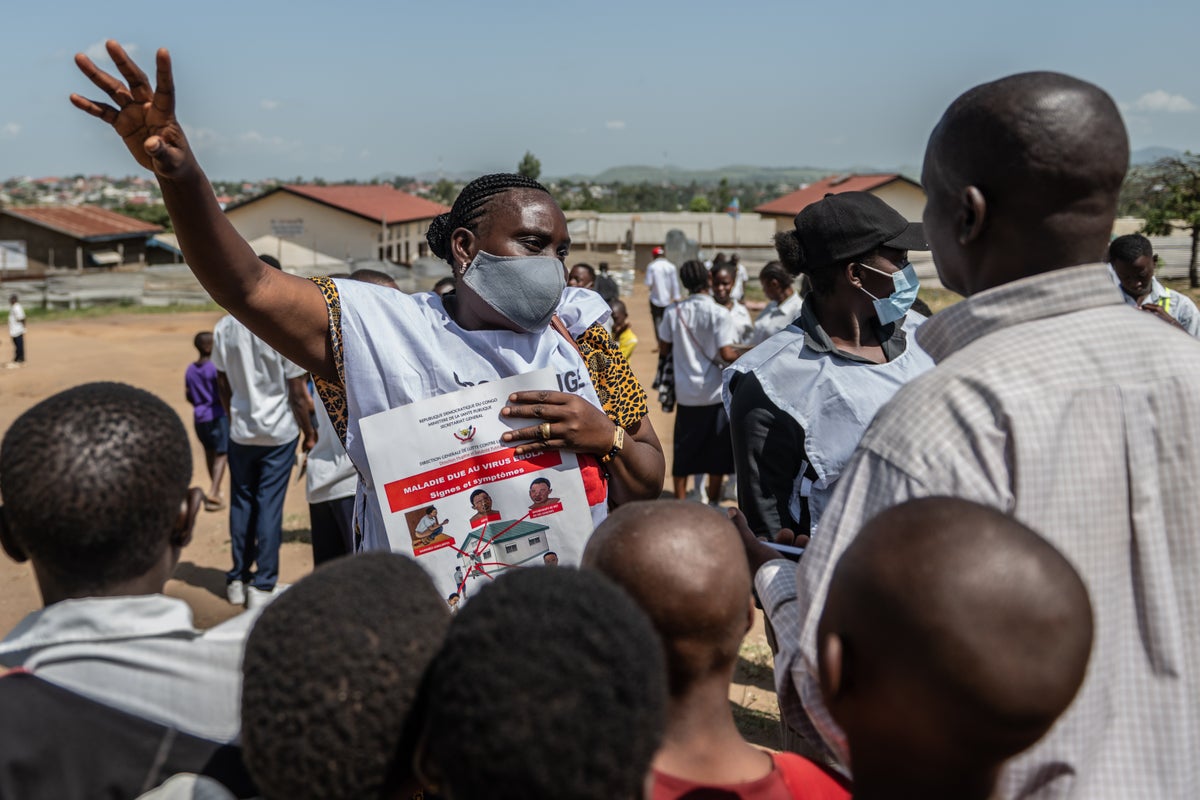
Every time Vanny Birungi, a volunteer with the Red Cross in eastern Congo, goes out to raise awareness about the latest Ebola outbreak as suspected cases near 1,000, she faces a double threat.
One is the rare Bundibugyo type of Ebola, with no vaccine or treatment. The other is the anger and suspicion of residents who have pelted her with stones and verbal abuse in Bunia, a city at the heart of the outbreak.
“We continue to tell them that the disease is out there. Some accept, and others don’t,” Birungi told The Associated Press on Monday as she and colleagues spoke with groups of people in a working-class neighborhood under the scorching sun.
Aid workers are especially at risk in this volatile region where residents, like Birungi, have long been under threat of armed groups that have killed thousands of people and displaced many more in recent years.
Trust is hard to find among the traumatized population that is wary of outsiders, even those trying desperately to contain the rapidly spreading outbreak that experts say was discovered weeks late. Surveillance for such diseases has been weakened by U.S. and other aid cuts.
“These people should stop bothering us. They just want to get rich. Let’s not forget that Ebola is a white man’s invention,” declared Pierre Basola, a 56-year-old resident of Bunia, who added: “Stop talking to me anyway.”
Cases are nearing 1,000 but health centers are burned
Three times in the past week, healthcare facilities have been attacked. On Sunday, angry young men stormed a hospital treating Ebola patients, forcing medical staff to evacuate them as gunfire rang out.
On Saturday, a group of residents set fire to a tent for suspected and confirmed Ebola cases run by Doctors Without Borders in Mongbwalu, and more than a dozen people suspected to have the virus fled. On Thursday, a center in Rwampara was burned after relatives were barred from retrieving the body of a man suspected to have Ebola.
Anger is amplified as virus prevention practices keep loved ones from handling bodies in final rites following an illness some have described as sudden and dramatic, with vomiting and bleeding.
The Ebola virus is spread through close contact with sick or deceased patients’ bodily fluids, such as sweat, blood, feces or vomit. Experts say healthcare workers and family members caring for patients face the highest risk.
“Trust is almost as important as the health response, because if you get this massive distrust in the communities, they’re not going to go to the health centers,” said Heather Kerr, country director for the International Rescue Committee in Congo.
Armed conflict in the region poses another challenge. To travel from Bunia, the capital of Ituri province, to Mongbwalu, aid groups risk potential attacks in a region more than 1,000 kilometers (620 miles) from Congo’s capital, Kinshasa.
Meanwhile, the outbreak now has over 900 suspected cases and more than 220 suspected deaths, the director general of the World Health Organization, Tedros Adhanom Ghebreyesus, said Monday.
“We are now playing catch-up with a very fast-moving epidemic,” he said.
‘We leave everything to God’
Mado Nditamba, a 70-year-old Bunia resident, said she has seen students running away from aid workers.
“The last time Ebola came, it was not on the scale that we see today,” Nditamba said. “But this epidemic today is worse. We go to the doctors in the hospitals, but they also die. That’s what worries us. We don’t know what to do and we leave everything to God.”
Congo has had 17 Ebola outbreaks, and the WHO says the country is equipped to respond. But early tests in this outbreak were conducted for a more common type of Ebola, losing valuable time. Experts are still trying to determine when this outbreak began.
There are few places to test for this Bundibugyo type in a region where clinics can run on generators and a major airport serving as a humanitarian hub has been in the hands of rebels for over a year.
Health workers on the ground have told the AP they are underprepared and underprotected. Now an unknown number of responders have been infected, and some have died.
A Congolese doctor was reported dead on Sunday in Rwampara, Rubens Dhedgia, coordinator of the Ebola response in the region, told the AP. In neighboring Uganda, where a far smaller number of cases has begun to spread after Congolese traveled there, at least three health workers have been infected.
And perhaps most worryingly, the International Federation of Red Cross and Red Crescent Societies says three volunteers died in Mongbwalu after it believes they handled bodies on March 27 during work unrelated to Ebola.
If confirmed, that would significantly push back the timeline of the outbreak from the first confirmed death in late April in Bunia.
Some residents still believe Ebola is a myth
Even as at least one funeral home manager dusted off coffins for sale alongside a road in Bunia, experts reported a lack of trust among some residents of the region who do not believe the virus exists.
Action Aid, another of the international humanitarian groups responding, said a high level of skepticism and lack of understanding remains, citing residents it questioned in mid-May in Ituri province just after the outbreak was announced.
“The only way to go, as far as this particular virus is concerned, is community engagement,” said Yakubu Mohammed Saani, country director for Action Aid in Congo.
How that will be improved, and quickly, is still not clear. Meanwhile, both the WHO and Africa Centers for Disease Control and Prevention believe the outbreak is larger than the cases reported so far.
___
Adetayo reported from Abuja, Nigeria. Associated Press writer Jean-Yves Kamale in Kinshasa, Congo, contributed.