


The politics of devious faith
August 20, 2026 1:20 am

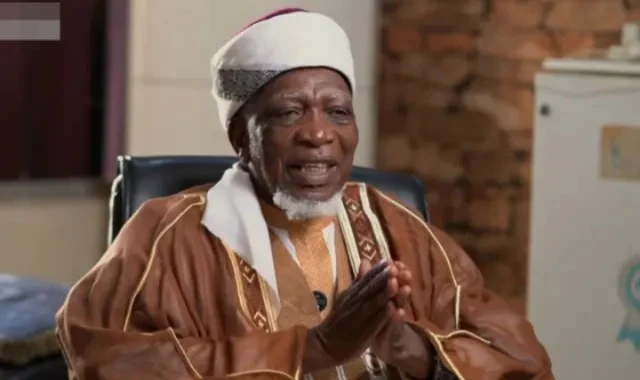
Sheikh Sani Yahaya Jingir, National Chairman of the Council of Ulama of Jama’atu Izalatil Bid’ah Wa’iqamatis Sunnah
Nkem Jacobs
A dangerous word is once again circulating in Nigeria’s political marketplace. “Infidel”, they call it. It is being used not simply as a description of religious difference, but increasingly as a political weapon—a convenient label for dividing Nigerians into those who supposedly belong and those who do not. That is dangerous.
If faith has any moral meaning, the real question should not be who worships differently, but who betrays the ethical obligations that faith demands. By that standard, those who invoke religion to divide citizens, excuse poor governance, or mobilise political hatred ought first to look in the mirror.
The latest controversy followed remarks by Sheikh Sani Yahaya Jingir, National Chairman of the Council of Ulama of Jama’atu Izalatil Bid’ah Wa’iqamatis Sunnah, at a mass wedding in Kano in early August. Jingir advocated the continuation of a Muslim-Muslim presidential ticket, urged Muslims to vote to demonstrate their numerical strength, described Nigeria as an Islamic state, and alleged that Christians were behind a mosque bombing in Kano. These are extraordinarily reckless claims in a country whose Constitution recognises no official state religion and whose social fabric is already under considerable strain.
The backlash was swift. Political figures, Christian leaders, civil society actors, and, importantly, fellow Muslims condemned the remarks. In a subsequent BBC Hausa interview, Jingir reportedly offered no apology, insisting he had no regrets while recalling past grievances.
But one point must be made clearly: Jingir does not speak for all Nigerian Muslims. Millions of Nigerian Muslims reject religious hatred just as millions of Christians reject the use of Christianity as a political weapon. A pulpit does not confer a licence to set a country ablaze. The issue, therefore, is bigger than Jingir; it is the increasingly cynical use of religion to pursue selfish political objectives.
To challenge this rhetoric honestly, we must acknowledge the grievances beneath it. Northern Nigeria faces severe problems—much of which are self-inflicted—including insecurity, poverty, unemployment, educational deprivation, weak infrastructure, and a persistent sense that government has failed its citizens. These grievances are real. But the struggle for survival exists across the entire country.
Nevertheless, the appropriate response to failed governance is not the manufacture of a religious enemy. The “infidel” narrative offers a remarkably convenient diversion. It transforms failures of leadership into a supposed battle between believers and unbelievers. Questions about schools, hospitals, jobs, roads, security, and public accountability are replaced with questions about religious identity. That is how political failure acquires a religious disguise. Instead of asking who failed to provide security, citizens are encouraged to ask who is against their religion. Instead of demanding competent government, they are told to defend their religious bloc. It is an old political trick designed to turn victim against victim while those responsible escape scrutiny.
There is something profoundly troubling about a brand of religiosity that speaks passionately about the afterlife but becomes strangely quiet about earthly obligations. Justice is an earthly obligation. Honesty is an earthly obligation. Compassion is an earthly obligation. The protection of the vulnerable and the responsible management of public resources are earthly obligations.
A moral framework that speaks fluently about Paradise while remaining silent about corruption, insecurity, poverty, and human suffering risks becoming performance rather than principle. Religion should make leaders more accountable, not less. It should make citizens more compassionate, not more hostile. It should make society more just, not more divided.
The argument for religious voting blocs rests largely on the assumption that greater religious representation at the highest level of government will translate into better outcomes for the community. Nigeria’s history offers little evidence for that proposition. Muslim leaders have occupied the country’s highest political offices repeatedly since independence. Indeed, while the current administration’s Muslim-Muslim ticket is the first such arrangement since the return to democratic rule in 1999, religious representation at the centre of power has never been absent. The real scarcity has been something else: good governance.
If religious solidarity were sufficient to produce development, the North would have little reason to complain today. Yet the region continues to carry a disproportionate burden of poverty, unemployment, insecurity, and educational deprivation, housing some of the country’s highest concentrations of out-of-school children. This should provoke a difficult question: after decades of political influence by leaders from the region, what exactly has religious solidarity delivered to the poorest citizens?
More importantly, how long can political leaders continue asking ordinary people to vote based on religious identity instead of demanding measurable performance? A hungry child does not eat religious representation. An unemployed graduate does not get a job because the president shares his faith. A family terrorised by bandits does not become safer because politicians won an argument about which religion dominates government.
Step outside political rhetoric and observe ordinary Nigerian life, and the “infidel” narrative collapses. Hospitals do not ask patients to prove their religion before treating them. Airlines do not check faith before flying passengers. Markets do not stop trading because buyers and sellers worship differently. Football clubs do not demand religious tests before hiring players.
Businesses employ Christians and Muslims every day. Traders buy from one another. Landlords rent across faiths. Neighbours trust one another with their property and children. The Nigerian economy functions because ordinary people cooperate across religious boundaries. Yet the same neighbour who is a trusted business partner for four years can suddenly be rebranded an “infidel” when an election approaches. When religious identity becomes useful only during election season, we must ask whether faith is actually being defended—or exploited.
The contradiction becomes even more striking in the politics of alcohol and public revenue. Several northern states operate Sharia-based legal systems and restrict or prohibit alcohol, with Kano’s Hisbah authorities repeatedly confiscating and destroying alcoholic beverages. Yet those same states participate in Nigeria’s federal fiscal system and receive allocations from nationally collected revenues, including Value Added Tax generated from alcohol sales elsewhere. The issue is not whether a state should permit alcohol—it is entitled to determine its policies within the law. The issue is consistency.
A political culture cannot condemn a product as sinful for public consumption while quietly benefiting from the economic activity and national fiscal arrangements generated by that same marketplace. Nor can religious morality be invoked selectively – strict when convenient, pragmatic when money is involved. That is not the fault of Islam; it is the problem of political hypocrisy.
Let us be clear about what this argument is not. It is not an attack on Islam. It is not an attack on Christianity. It is not an attack on Muslims or Christians who sincerely practise their faith. It is an attack on the cynical use of religion as an instrument of political mobilisation. Nigeria does not need more politicians teaching citizens to fear one another. It needs leaders capable of building schools, securing communities, creating jobs, attracting investment, strengthening institutions, and managing public resources honestly.
The poor Nigerian does not need to be taught who the infidel is. He needs to know why his children cannot attend a decent school. The farmer does not need another sermon about religious enemies; he needs security. The unemployed graduate does not need campaign arithmetic; he needs opportunity. And the taxpayer does not need to be told that his religion must determine his political loyalty; he needs accountable government.
Faith should make us better human beings—more just, more honest, and more compassionate. The neighbour who worships differently is not the enemy. The real danger is the politician who invokes God to divide citizens while failing to deliver justice, security, and prosperity. I am not an infidel because my neighbour prays differently from me, nor is my neighbour an infidel because I worship differently. If the word must be used at all, let us reserve our moral outrage for those who exploit faith to divide the people, excuse failure, and capture political power.
The greatest threat to faith is not the neighbour who believes differently. It is the leader who invokes God to divide the nation he seeks to rule.
Jacobs, a Lagos-based strategic communications and corporate identity specialist and the founder of Inscriptive Media, writes via [email protected]
All rights reserved. This material, and other digital content on this website, may not be reproduced, published, broadcast, rewritten or redistributed in whole or in part without prior express written permission from PUNCH.
Contact: [email protected]