


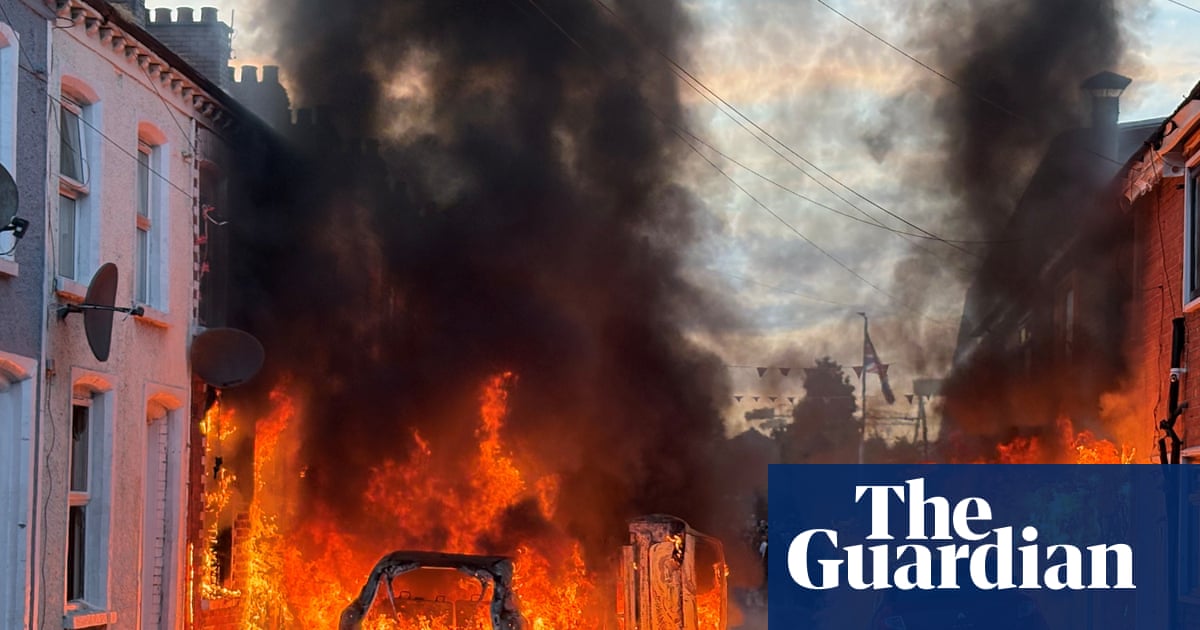

A horrific knife attack on a street in June sparked another summer’s night of racial violence, stoked by loyalist groups. How did the unrest erupt – and why do many fear it will happen again?
Shortly after 10.30pm on Monday 8 June, as a summer twilight lingered over Belfast, a horrific scene unfolded on Kinnaird Avenue: a man straddled and repeatedly stabbed a figure lying on the ground in a bloody assault that ended only after onlookers intervened.
Others captured the drama on cameraphones and uploaded the footage to social media. Once seen, the grainy images were hard to forget, and by dawn on Tuesday 9 June they were ricocheting around X, WhatsApp, Facebook, Telegram and other platforms.
Many commentators highlighted one aspect: the assailant was black, the victim white.
Police had a suspect in custody – he was initially identified as a refugee from Somalia, later corrected to Sudan – but this did not stem a cascade of outrage. What, commentators demanded to know, about other foreign men of “military age” in Northern Ireland? Had they been “vetted”? What “alien culture” had they imported?
 0:41
0:41By 9.30am a message – an exhortation – was being widely shared. “All business to close at 5.30pm tonight. No excuses.” It listed 25 locations around Northern Ireland for people to gather at 7pm. “Please forward [to] all men of the age of 18 and over. Wear dark clothing … and be prepared to fight or be arrested.”
It was an invitation to a pogrom.
Far-right agitators, such as Elon Musk and Stephen Yaxley-Lennon, known by his alias Tommy Robinson, amplified calls to protest, and those interventions were prominent in the coverage that followed.
Through a combination of interviews with witnesses and people who responded to the unrest, on-the-ground reporting in loyalist strongholds and at far-right rallies in Northern Ireland, and analysis of messages sent by figures connected to the extreme right, the Guardian has established the most complete picture yet of how a single incident of horrific violence precipitated the crisis. And it suggests that organisers in Belfast needed no encouragement or direction. This was their show.
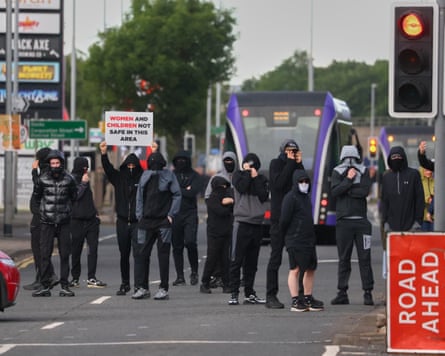
Drawing on previous eruptions of violence – this was to be the third consecutive summer of racial disturbances in Northern Ireland – the organisers issued further instructions: leave mobile phones at home and deactivate dashcams and doorbell cameras.
By early afternoon, schools were sending children home, public transport was halting and steel shutters were clanging down over foreign-owned barber shops, supermarkets and other businesses.
As families sat down for dinner, crowds gathered at designated roundabouts and intersections in loyalist areas across the city.
At about 7.30pm a woman with a megaphone on the Shankill Road recited the Lord’s Prayer to several hundred people, some draped in union flags. They marched through terraced sidestreets and halted outside the home of a Romanian family. A nearby Black family, anticipating trouble, had already fled and asked neighbours to move their car.
The Romanian family’s windows had been “put out” twice before, but the family had refused to leave. The previous night’s stabbing had nothing to do with the Romanians but somehow alchemised into what one woman in the crowd called “the last straw”.
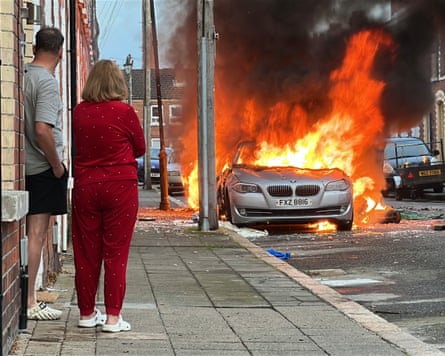
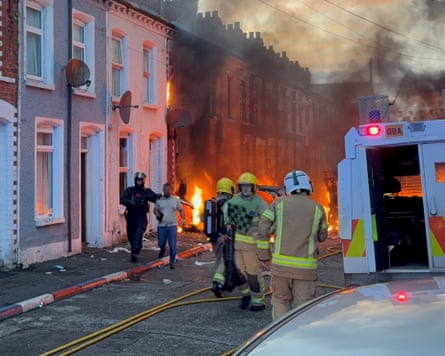
Dozens of boys and men wearing hoods and masks surged forward. Some launched bricks through windows, others shoved fireworks through the letterbox. A woman inside, visible to the crowd, watched helplessly as her home came under attack. The family’s car went up in flames, then men in balaclavas broke down the door.
Women and children in the mob observed proceedings. “There’s wee girls inside,” said one. In contrast to race riots in England and Belfast in 2024, and in Ballymena last year, the violence was not recorded or streamed on mobile phones. A teenage boy who ignored the injunction against filming was dragged aside and chastised.
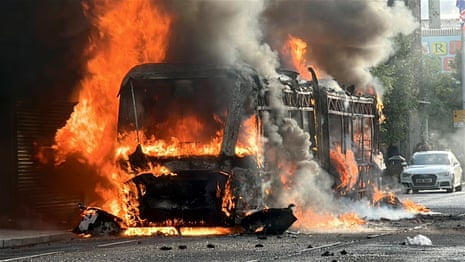
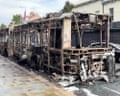
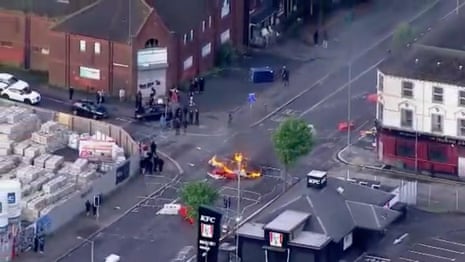
Similar scenes played out across Belfast. In the east of the city, families from Ukraine, Romania, Poland and Sudan left. Properties and vehicles, including a Glider bus, were set ablaze and plumes of smoke rose into the night.
 1:00
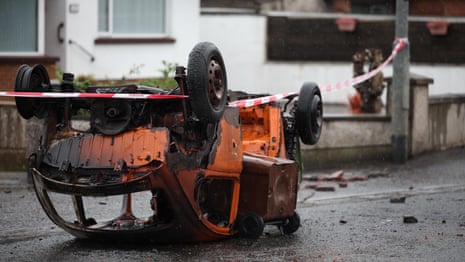
1:00On arterial roads and by roundabouts, crowds lit bins and set up roadblocks to question and intimidate suspected foreigners. In Sandy Row, central Belfast, Ethiopian and Chinese residents fled and arsonists burned a Syrian supermarket. On Crumlin Road, in the west, Ugandan health workers and Nigerian families sought refuge. In some places the police were absent or stayed back and it was left to community volunteers to navigate the mobs and escort families to safety.
At around 10pm the violence abated and crowds began to disperse. Some whooped in jubilation, others surveyed the smouldering debris with satisfaction. A point, they said, had been made. Rain began to fall, helping emergency crews to douse the embers of gutted homes and vehicles.
New loyalism
The riot should not have come as a surprise. Northern Ireland was primed for it. “We could see it coming,” said Daniel Holder, the director of the Committee on the Administration of Justice (CAJ), a Belfast-based advocacy group. “It wasn’t unprecedented, it was an escalation of an existing pattern.”
An escalation, and a learning curve. Drawing on lessons from 2024 and 2025, the agitators refined their methods to hit more targets and reduce the chance of arrest.
Far-right allies in England and the US were taking notes. Enrique Tarrio, the former head of the militant US group Proud Boys, recently visited and interviewed activists for a documentary. And last month, the Advance UK-affiliated YouTuber Sarah White was streaming multiple events in Northern Ireland, including an Orange Order march and an anti-migrant protest in Portrush.
The Northern Ireland “model” is not necessarily transferable. It has taken a unique mix – the legacy of the Troubles, xenophobia, social media platforms and state acquiescence – to create the toxic climate.
Until the 1998 Good Friday agreement the region was almost entirely white and native-born. As sectarian violence eased, immigrants trickled in. By the 2021 census, 3.4% of the population was from a minority ethnic background – small compared with 19% in England, but the sight of people from Africa, Asia and the Middle East still came as a jolt.
Many immigrants settled in working-class loyalist areas where the population was declining, property was cheaper – and paramilitary groups endured. Despite a state-sponsored “transitioning” process, the Ulster Volunteer Force (UVF) and Ulster Defence Association (UDA) split into sub-groups that continued to deal drugs and coercively control communities.
“Peace” walls between Catholic and Protestant neighbourhoods still stand, underlining the persistence of traditional sectarian divisions, but the waning IRA threat weakened loyalist paramilitaries’ claims to be community defenders, prompting them to seek a new bogeyman to justify their existence.
“Loyalism has always been a reactionary ideology based on keeping out ‘foreign’ influence,” said Stephen Millar, an academic and author of Performing Paramilitarism: Loyalist Songs, Conflict, and Culture War in Northern Ireland. “The pivot from [opposing] Irish nationalism to anti-migrant rhetoric is, to some extent, internally consistent, and serves to keep loyalism ‘relevant’, trading one form of racism for another.”
Sporadic attacks and harassment against minority ethnic families – paint bombs, smashed windows, “locals only” graffiti, threatening posters – have proliferated over the past decade, especially in County Antrim, where healthcare workers from Africa were among those targeted.
That turned out to be the warm-up for a full-scale riot in Belfast in August 2024 – a copycat response to mayhem in England after the killing of three girls in Southport. Then in June 2025, Ballymena, 25 miles outside Belfast, erupted after two Roma teenagers were charged with rape (the charges were later dropped).
June’s eruption completed a grim summer hat-trick.
Jon Boutcher, the chief constable of the Police Service Northern Ireland (PSNI), said the overall picture of paramilitary involvement in the most recent trouble was “inconsistent” but that paramilitaries were present.
However, many say the police have been slow to recognise, at least in public, the role of paramilitary groups in controlling the violence. Holder said: “To anyone on the ground, that was very obvious from the start.”
The UDA and UVF are fractured. Some factions urged restraint – that is partly credited with keeping Ballymena calm this summer – but independent observers say other factions orchestrated much of the violence. Firefighters had no doubt about paramilitary influence and sought permission from their leaders before tackling blazes, sources said.
The ferrying of teenagers to and from flashpoints was further evidence of orchestration, said Chris Quinn, Northern Ireland’s children’s commissioner. “There’s been a long history of child criminal coercion and child criminal exploitation.”
Such children should not escape legal consequences but they too were victims, said Quinn. Some heeded the call to riot to service debts, including drug debts, he said. Another source, a youth worker, said paramilitary groups paid boys £100 to join the rioting.
Instead of Catholics, it was now people of colour in the crosshairs of loyalist groups, said Michaela Rafferty, of Anaka, a women’s group that helped escort besieged families to safety. “There has been a sectarian element, obviously, through our years of Troubles and violence. Now that focus has kind of moved to brown and black people.”
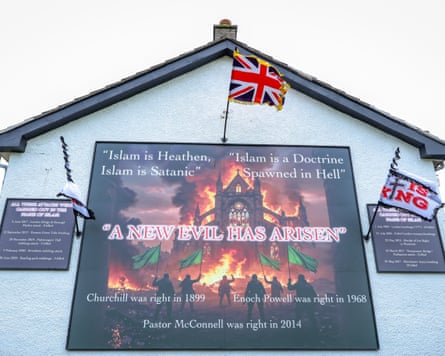
AI-generated anti-Islam murals have appeared in loyalist strongholds such as Moygashel and Newtownabbey. “Islam is Heathen, Islam is Satanic — A New Evil Has Arisen,” says one, “Not welcome, not wanted, not here,” says another.
New methods
Agitators have refined their methods. Most rioters in Ballymena last year wore masks or hoods but footage uploaded by participants and onlookers helped police identify and charge dozens of rioters. The lesson was not lost on the recent rioters in Belfast – they banned filming and made greater efforts to conceal identifying details, such as tattoos.
Through trial and error they also discovered that without a galvanising incident, such as a brutal crime allegedly committed by a foreigner, calls for mass mobilisation tended to flop, and this punctured morale.
Instead, they set up online community groups and joined existing ones to drip-feed anti-foreigner sentiment, said Dessie Donnelly of rabble.coop, a Belfast-based tech cooperative that tracks online xenophobia. “Ballymena was a watershed. You had loads of groups springing up online and a far-right network emerging.”
Before the most recent riot, posts about dark-skinned men in parks, and foreigners moving into houses of multiple occupation (HMO) on particular streets, proliferated. The tactic distilled Islamophobia to a hyper-local level, said Donnelly. “It prepares people for when there is an animating event.”
Activists in Belfast, Bangor, Coleraine, Derry, Newtownabbey, Portadown and other towns formed online “clusters” that shared and amplified posts and infiltrated online forums for loyalist bonfires and marching bands, said a researcher with Accountability Project Northern Ireland, a group that monitors online hate.
Last summer, the watchdog noticed that a Portadown-based Facebook group was circulating a screenshot of council-owned HMO properties – a ready-made hitlist of addresses that rioters used in June.
 1:36
1:36Burgeoning attacks – in the year to 31 March, police recorded 2,367 race incidents and 1,507 race crimes, the highest on record – created a sense of foreboding as summer approached, said Naomi Green, the Northern Ireland-based assistant secretary general of the Muslim Council of Britain (MCB). “We thought it was going to get quite scary very quickly, and it did.”
A week before the riot, anti-racism organisations convened an emergency meeting in Belfast because they feared trouble, said Holder. The marching season loomed and there was “a huge buildup” of racist activism on- and offline, he said. “For a third successive summer, it was waiting on an excuse.”
The attack at Kinnaird Avenue provided the spark. For foreigners who had been previously targeted there was a sense of inevitability, on the afternoon of 9 June, to what came next. “We’ve been sharing the same messages all day: go home early, stay inside, don’t go out,” Mohammed Mahmoud, 39, said as a crowd gathered near his Sandy Row grocery store.
The aftermath
The violence that night gave way to an eerie calm the next day. Central Belfast was like a ghost town, with most businesses remaining shut in expectation of fresh strife. A familiar message duly began to circulate on social media. “All business to close … wear dark clothing.”
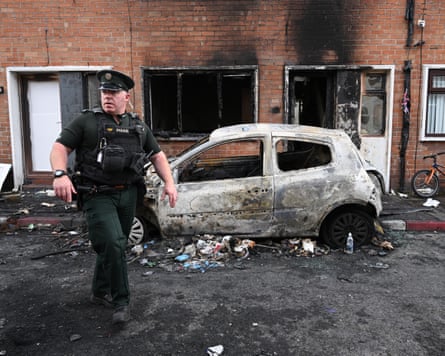
In fact, Belfast remained largely quiet on the night of 10 June but in Glengormley, 7 miles north, a mob tried to march on the Chimney Corner hotel, which had been used to house asylum seekers, and fought against police in riot gear. The crowd hurled bricks and rocks, lit bonfires in the street and torched a vacant house. Police used water cannon and plastic bullets to drive them back.
Around 11pm the violence dwindled and stopped, as if someone had turned off a tap. That was the last disturbance in June. But in some ways the aftermath has been just as troubling.
In a poll by the thinktank More in Common, 8% of people in Northern Ireland said it was justified to burn migrants out of their homes and 11% agreed with intimidating them out of an area. Forty-one per cent said they sometimes feel like a stranger in their own country and three-quarters worry about asylum seekers entering Northern Ireland.
Conleth Burns, the associate director and Ireland lead for More In Common, said polling in England showed similar results. “You’ve got a similar number of people in lots of societies who think that this level of violence against migrants is justified.”
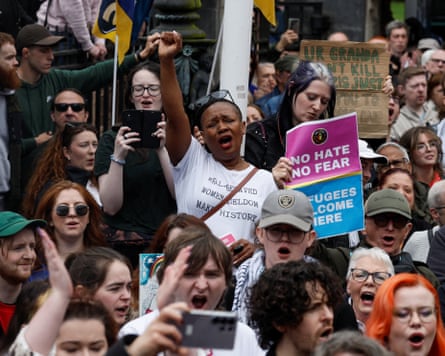
Northern Ireland, however, has far fewer foreigners and people of colour than England, which shows that even small numbers can have an outsized impact, said Burns. Most people expressed concern about immigration, racism and violence, he added. “People don’t see [those views] as being contradictory.”
The Institute for Strategic Dialogue, which tracks extremism and misinformation, said the unrest turbo-charged far-right activism online. Posts that promoted claims of anti-white police bias surged to more than 200,000 in the first two weeks of June compared with 104,000 in the whole of May, it said in a report published this week.
The main parties at Stormont strongly condemned the violence but critics say the executive failed to prepare for the crisis.
“This was the third time in two years,” said Donnelly. “They should have known something would happen, it was building up.”
Even though the Police Service of Northern Ireland had struggled to contain unrest in previous years it was still under-resourced, said Donnelly. “There was no acknowledgment that immigrants had been systematically attacked twice and that it would happen again.”
Holder said Stormont’s response had downplayed the gravity of the crisis. “You’d expect a racist pogrom to be the key issue for the institutions to deal with over the summer, and putting in emergency measures to prevent that happening again. But no, there’s no sense of urgency.”
Liz Griffith, the head of migration justice at the Northern Ireland Law Centre, said the devolved government had failed to update anti-racism legislation and downgraded a long-awaited policy document.
The strategy now focused on “race relations”, which Griffith said was “a discredited term now; it is woefully out of date and has been out of date since the 1970s”.
“It’s as if this was to do with somehow the relationships of people not getting on with each other,” Holder said. “That the people having the brick put through their window need to improve their relationship with those putting the brick through the window.”
The Stormont executive had failed to bring forward hate crime and race equality laws in line with the rest of the UK.
“The law in itself does not prevent racism but it’s the bedrock on which all your other initiatives rest,” Griffith said. “It’s been updated in England, Scotland and Wales, and ours is just antiquated. There’s constant talk of consultation after consultation to update this legislation, but it has just got stuck, it’s never moved.”
In the face of this inaction, many want Andy Burnham, the new prime minister, to step in. “Unless Westminster intervenes at this point and ensures that there are protections, and legal protections, and consequences for some of this behaviour, unless there is some accountability here, it’s going to continue,” Green said.
Many migrants and refugees think another eruption is likely but some try to remain optimistic. Suleiman Abdulahi, the founder and director of Horn of Africa People’s Aid Northern Ireland, has endured many attacks and reported 12 of them, most recently on 26 June. None have resulted in a prosecution but he did not wish to condemn his adopted home. “I’m not saying the Northern Ireland people – the majority – are racist. The majority are hospitable.”