


The new Razr Ultra isn’t your average phone — for better and worse
It’s a gorgeous phone with excellent battery life, but sometimes standing out isn’t so great.
If you buy something from a Verge link, Vox Media may earn a commission. See our ethics statement.
by May 27, 2026, 12:00 PM UTC
If you buy something from a Verge link, Vox Media may earn a commission. See our ethics statement.
 Allison Johnson is a senior reviewer with over a decade of experience writing about consumer tech. She has a special interest in mobile photography and telecom. Previously, she worked at DPReview.
I had one ask for friends, colleagues, the lady checking me in for a meeting at a large software company’s headquarters, and everyone else who stopped to admire the phone I’ve been carrying around.
“Pet it.”
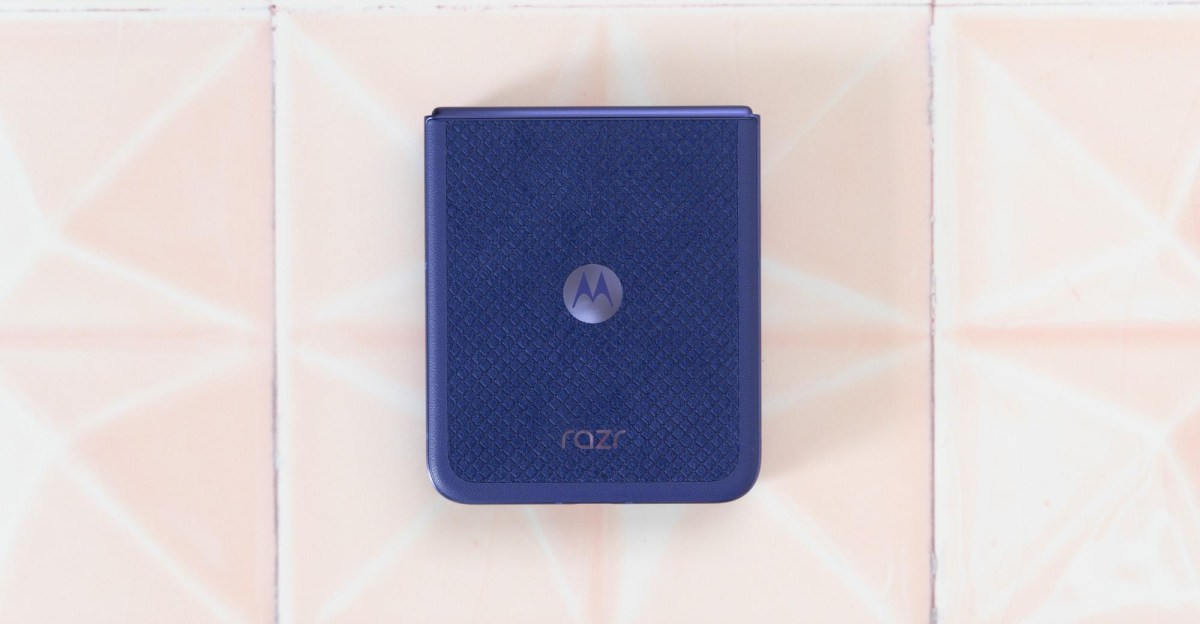
The Razr Ultra is not your average phone. I got the orient blue color option to test, which has a soft, woven back panel made of Alcantara fabric — which you’re more likely to find on the seats of a fancy car. I can’t stop petting it. I’m worried about how it’ll look after spending years in and out of dusty tote bags and my kid’s grubby hands, but after a couple of weeks of testing it hasn’t picked up any gunk or dirt that I haven’t been able to brush off.
Then there’s the above-average price. The Razr Ultra costs $1,499, which buys a well-equipped flip phone. I still think calling this phone an “Ultra” is a little too strong. You won’t get all of the trappings of a regular top-tier phone, like a telephoto camera, embedded magnets for Qi2 charging (just plain wireless charging), and full dust resistance. You pay for the privilege of the hinge and a seriously nice-looking (and -feeling) phone.
Motorola Razr Ultra (2026)
$1499$1499
The 2026 Razr Ultra offers excellent battery life despite the constraints of the flip form factor. But an inconsistent camera and steep price make it hard to recommend.
Read More$1499 at Amazon$1499 at Motorola$1499 at Best Buy
The pettable back panel isn’t even my favorite upgraded feature on the 2026 Ultra, which surprised me. It’s the battery. It has a 5,000mAh capacity, up from 4,700mAh on last year’s model. It manages to accommodate a battery with a capacity usually found on the biggest of big slab phones, even though it has to make room for a whole-ass hinge. Motorola can pull this off because it’s using silicon-carbon batteries, which provide higher capacity in the same amount of space a traditional lithium-ion battery takes up.
In practice, this meant I got comfortable committing battery crimes that I’d normally avoid with a flip phone. Using it as a hotspot while working outdoors on an 80-degree day? Forgoing a nightly recharge simply because the charger is across the room? Setting it up in tent mode and using the front screen as a Pomodoro timer? I did it all with the Razr Ultra. I never hit low power mode, and most days I didn’t even get down to 50 percent. This is very good performance from a phone with two physically small-ish batteries, and that’s a big win for the Razr.

Every time I revisit the flip form factor, I remember how great it is. You know what rules? Answering texts on the cover screen, typing single-handed while holding a coffee in the other hand. I used that front screen to catch up on Slack notifications, present my boarding pass to a gate agent, and entertain my four-year-old for a few minutes with a gyroscope-guided marble maze game. Doing these things without opening up the whole phone and inviting in that chaos feels like a cheat code. Motorola’s cover screen software makes it easy to access any app you want, and it handily beats Samsung’s outer screen UI.
I wish I had better news to report elsewhere. I had high hopes for the main camera, which uses a new physically larger 50-megapixel sensor than the previous gen. But Motorola is still making some weird photo processing choices. Colors are very saturated, bordering on artificial, and on an overcast day my photos turn out looking overly bright and flat. Someone who’s not too picky about these things probably won’t mind the look. I am picky, and I was hoping Motorola would have steered its processing back toward the real world with this new sensor. Sadly, that does not seem to be the case.


1/3
Then there’s the bloatware. This is a recent Motorola tendency that used to be worse on its budget phones, but has since leveled out to a bearable, if still gross, amount of preinstalled stuff on its whole lineup. You might think that spending $1,500 on a state-of-the-art foldable phone would spare you from looking at a third-party “Newsfeed” in the app drawer filled with “content that’s tailored to your interests,” aka targeted advertising, but you’d be wrong!
You can uninstall and disable a lot of the bloatware, and I highly recommend that you do. As I’m writing this, I’m waiting for Motorola to provide a comment on whether some of this software was hijacked by a bad actor to inject an affiliate code every time you open the Amazon app, as reported by 9to5Google. I’m not seeing this behavior on my Razr review units, and it doesn’t appear that anyone’s personal data is at risk based on what has been reported about this situation. But it’s very concerning, and seems entirely avoidable by not loading up the phone with third-party software to begin with.

Despite its good looks, the Razr Ultra isn’t the best option for someone seeking the thrills of a modern flip phone. I’d feel much more comfortable recommending it for like, $1,200, or if Moto had figured out how to seal up that hinge for full dust resistance. Or maybe if it cost as much as it does now, but didn’t come with a bunch of third-party apps that may be susceptible to bad actor shenanigans. It’s not your average phone — that much is obvious just looking at it. But maybe being a little more average in some ways isn’t such a bad thing.
Photography by Allison Johnson / The Verge
Every smart device now requires you to agree to a series of terms and conditions before you can use it — contracts that no one actually reads. It’s impossible for us to read and analyze every single one of these agreements. But we started counting exactly how many times you have to hit “agree” to use devices when we review them since these are agreements most people don’t read and definitely can’t negotiate.
To actually use the 2026 Motorola Razr Ultra, you must accept the following:
- Motorola’s Privacy and Software Updates
But you also get to decide how Motorola’s support works on your phone:
- Help improve Motorola products (optional)
- Enhanced device support (optional)
- Smart updates (optional)
After entering your Google account, you are asked to:
- Add a phone number to your Google account (optional)
And you must agree to the following from Google:
You’ll also need to agree to the following on Google Services:
- Install updates and apps: “You agree this device may also automatically download and install updates and apps from Google, your carrier, and your device’s manufacturer, possibly using cellular data. Some of these apps may offer in-app purchases.”
- Use basic device backup (optional)
- Use location (optional)
- Allow scanning (optional)
- Send usage and diagnostic data (optional)
Google Assistant:
- You can set up Google Assistant (optional)
- Activate Voice Match for Hey Google (optional)
- Access Assistant without unlocking your device (optional)
To use Moto AI:
- Motorola AI Terms and Conditions (optional)
Lastly, you have the option to join Motorola’s user community:
- Give permission to Motorola to send push notifications about its services and benefits (optional)
- Provide your email to Motorola (optional)
In total, you have to accept five main agreements and can bypass 14 when setting up the Motorola Razr Ultra.
Follow topics and authors from this story to see more like this in your personalized homepage feed and to receive email updates.