


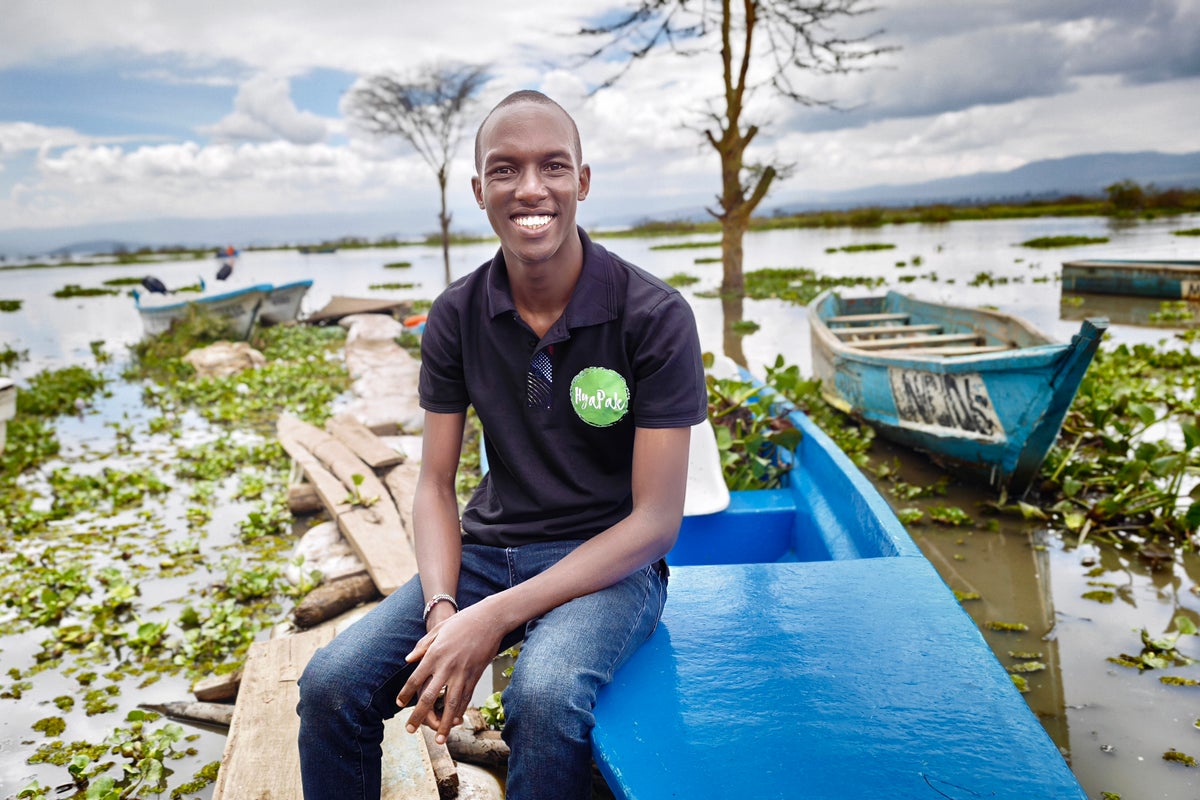
While on a university field trip in 2022, the boat Joseph Nguthiru was traversing Kenya’s Lake Naivasha in, suddenly came to a halt. It became tangled up in water hyacinth, an invasive plant that covers much of the water. Here, he and his fellow classmates in the boat were forced to sit for five long hours.
The hyacinth, which has been a problem in Kenya since the late 1980s, floats on the top of water, like a thick carpet and it can double in size every in just a number of days. It blocks oxygen from getting into the water, effectively making beneath it barren, killing aquatic life.
To win tickets to see Bel Trew’s latest compelling documentary click here
In some places, the hyacinth is so thick, engines need to be turned off and a long pole is used to pull boats through it.
Joseph, aged 28, says everyone in Kenya knows about the phenomenon, but it wasn’t until this trip that he’d “experienced the pain behind the people who face it every day”. The weeds mean it’s becoming almost impossible to fish here, which was a thriving industry and an important food source for local communities.
Joseph describes that day as a “crazy experience” but it left him thinking there must be a way to use this invasive plant, and help unclog the vital waterways.
People see the rubbish, but they don’t even have the time to think or to do anything about it. People have bigger problems to solve where I come from
Inspired, Joseph took some of the water hyacinth back to Egerton University in Kenya, where he was studying civil engineering, and specialised in water and environmental engineering. He decided to base his final year project on finding a solution for it. It took plenty of trial and error but he turned it into a bioplastic, which was something the country needed after banning single-use plastic in 2017, and the project was a success.
Joseph went on to form HyaPak, a startup turning the invasive water hyacinth into biodegradable packaging. His work earned him the East Africa Youth for Climate Action Award and the Young Champion of the Earth, part of the United Nations Environmental Programme. He’s also became a leader at the Obama Foundation, and was awarded a Presidential Awardee for Best Innovator in Kenya and included on the Africa 40 Under 40 list.
It wasn’t only that day on the lake that inspired him though. He grew up in the Eastlands side of Nairobi, where he says, “one of the things you’re constantly exposed to is pollution, as there’s a lot of trash lying around”. Here, people have different problems from paying rent and getting children in education, so pollution is a secondary problem. “You see it, but you don’t even have the time to think or to do anything about it. People have bigger problems to solve where I come from.”
And Joseph is aware that plenty of human-made waste ends up in the water. “The thing about humans is that we are really good at pollution, especially making trash go into water. So chemical waste, agricultural runoff, and even urban waste, some way or another, ends up in water bodies, and hyacinth derives from this”.
Anywhere you see water hyacinth, the water is polluted
The lake is also on the edge of one of Kenya’s biggest rose farming areas and it’s thought chemicals from the rose farm end up in the river, though more recently rose farms are using closed loop water systems which helps prevent this.
Water hyacinth is the indicator of those pollution problems. “Anywhere you see hyacinth, the water is polluted,” he says.
It’s technically easy to remove, as it just floats on water, but the issue is that after removing it, six-12 days later, it will have grown back. “It’s one of the world’s fastest growing plants,” Joseph says, explaining the issue is they have to keep on removing it over and over again.
So far, HyaPak has removed about 20 acres (eight hectares) of water hyacinth, according to its last annual figures at the end of 2025. Though its re-growth speed makes it hard to calculate accurately.
For this reason, Joseph doesn’t like to think of HyaPak as ‘removing’ the weeds, as it gives the impression it’s being eliminated and won’t come back. But that’s almost impossible to do, given the speed it grows. Instead he prefers to look at it as managing it. “We need to utilise it for something that has a value and a benefit to the people and communities that you’re working with,” he says.
 open image in gallery
It’s a bad problem fundamentally, but for Joseph, turning it on its head, he’s able to see how removing the weeds and replacing bioplastics feed each other. Finding a commercial use for this fast-growing weed also helps create what he calls “green jobs” – something that actually facilitates the world’s transition into a circular economy.
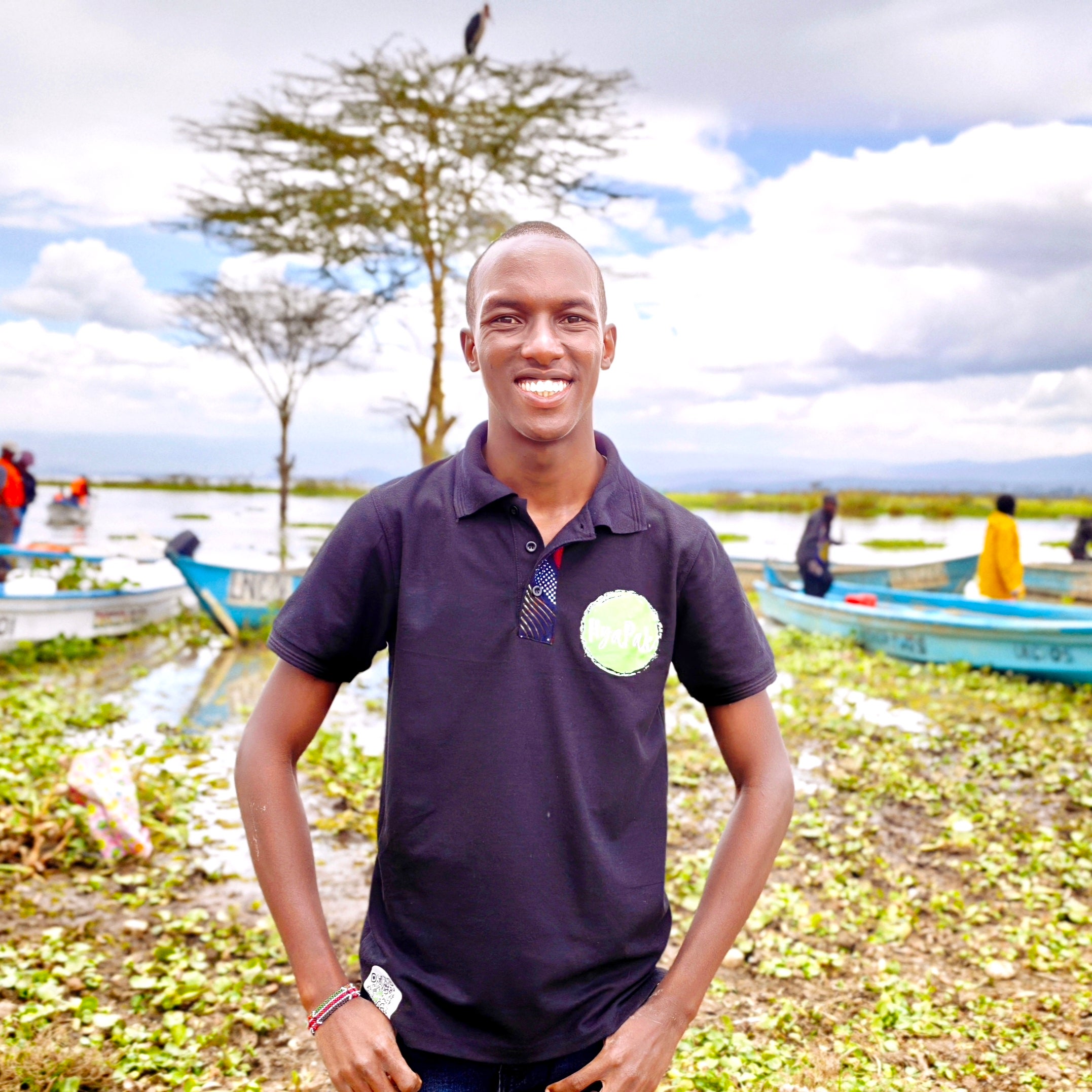
“We work with the fishing community and they collect the water hyacinth for us,” he explains, which both men and women do. For many of the people living here, they’re below the World Bank’s poverty line. By being able to add in an extra source of revenue to the community, Joseph thinks this is “the best way to go about any social social innovation”, plus it gives hope and dignity to people.
Once it’s harvested, the weeds are dried on the side of the lake, then sent to HyaPak’s facility in Nairobi. They’re then crushed into a fine powder, the cellulose is extracted and is used to make different types of packaging materials. These include courier packages where HyaPak is working with one of the world’s largest courier companies to transition their packaging away from plastic, and liners for boxes, which help keep food fresher for 2-3 days longer without the need for cold storage.
But one of the biggest uses is more unexpected, and has come as in 2022 Kenya launched Jaza Miti, a huge tree planting target, set by the president Willaim Ruto, to plant 15 billion trees over 10 years.
“It’s a crazy target,” Joseph says, breaking it down to meaning 4.1 millions trees would need to be planted each day. But it’s a target he admires. “If you’re planting 15-billion trees, you need 15-billion packaging bags for those trees. Overnight, there was huge demand [for bioplastic replacements] that didn’t exist before,” he says. Now HyaPak makes bioplastic alternatives that cover the root system of seedling trees before they’re planted, and then decompose directly into the soil. Of course, HyaPak’s unable to meet such huge targets, but it is scaling up to work towards the demand of the seedling bags.
Joseph’s plan now is to also try to scale the business in other countries suffering from the same invasive species such as El Salvador, India, South Africa and then onto Mexico and Nigeria. It’s largely been made possible to imagine after winning the UN’s Young Champion of the Earth award, which really took HyaPak to the world stage.
As well as HyaPak, Joseph’s also co-founded M-SITU, which uses solar-powered artificial intelligence sensors to detect deforestation, wildfires and illegal charcoal burning. He created a small water bottle size detector,using 3D printing, that scans a radius up to 1km around it looking for illegal loggers or wildfires, so it can alert rangers. A pilot in Kenya’s Ngong Forest cut ranger response times from six hours to 15 minutes.
All from one day getting stuck on a boat in a mass of invasive weeds, Joseph has turned a problem into a resource – and, in doing so, found a way to make the very thing clogging Kenya’s waterways part of the solution, providing value and jobs along the way.
The Independent will be revealing its 2026 Climate 100 List on 20 September