


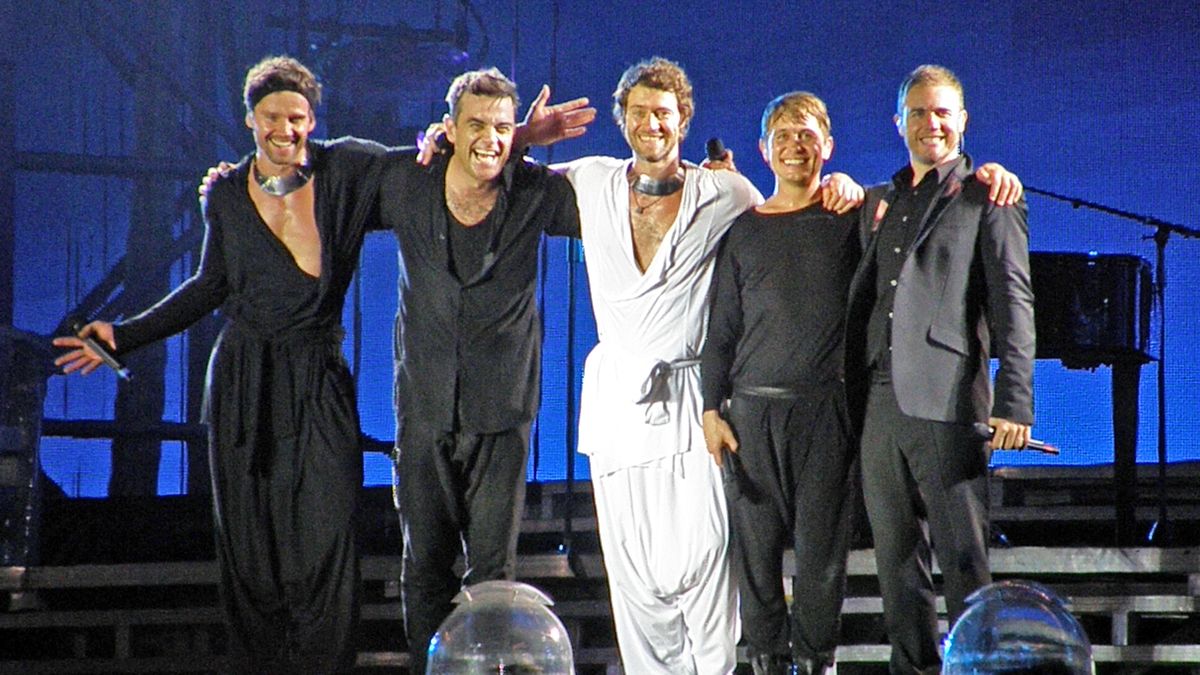
It’s been 36 years since five fresh-faced lads from Manchester burst onto the music scene with their leather cod pieces, impressive dance routines and high-energy pop songs. During that time, Take That have amassed 12 No1 singles and nine No1 albums, and have staged some of the most breath-taking live shows of the 21st Century. They also surprised everyone — including themselves — with the runaway success of their 2006 comeback, a return that will undoubtedly go down as one of the most successful in pop history.
This summer, Gary Barlow, Mark Owen and Howard Donald are bringing their sparkle back to the stage once more for their revived and revamped The Circus Live tour, a 17-date stadium extravaganza that will confirm their status as one of the most adored boybands of all time.
“Take That are the definitive boyband, the classic boyband — they are everything it means to be a boyband,” says music writer Michael Cragg. “But this isn’t some kind of nostalgia loop that we’re all trapped in. They had an incredible comeback and have had consistent hits.”
 View 7 Images
Fans are about to see the Take That boys bring back their show stopping Circus Live tour magic(Image: Getty Images)
He continues, “Musically, they’ve got the iconic ballads, the ‘cheesy pop’ and the big definitive songs, thanks to Gary’s songwriting talent. A song like Back For Good is a classic by any standard, not just in the boyband pop genre.
“They possess all of the attributes that define a great, enduring pop act. You simply can’t consider boybands without immediately thinking of Take That. Yes, they might have originally been created by using the template of others, such as New Kids On The Block, in order to emulate their success, but Take That have done so, so much more than that.”
The “boys” may now all be in their fifties, but the trio don’t plan on holding back when the tour kicks off in Southampton on 29 May. It will be a no-expense-spared spectacle of high-tech and creative artistry, with fire breathers, unicycles, stilt walkers, acrobats and, of course, the return of the 20ft mechanical elephant.
“I’ve experienced a lot of good things in my life but very little comes close to how it felt standing on the back of that elephant as it lifted above the audience,” Gary says. “Watching the faces in the crowd look up at us in awe is something I’ll never forget. This time around, I’ll be living for that moment every night.”
 7View 7 Images
Gary showed off his clown skills on the first run of the Circus Live tour in 2009(Image: Getty Images)
 7View 7 Images
Their stage shows have changed a lot since this 1995 gig at the Manchester Arena(Image: Mirrorpix)
Michael credits Take That’s live shows — including the original Circus Live tour in 2009 and 2011’s Progress Live tour, which saw Robbie Williams briefly rejoin the band — as changing the entire landscape of live performances.
“They don’t generally get the credit they deserve for turning pop into a proper stadium-worthy event, but their incredible staging and performances have influenced a lot of bands and solo artists who have followed,” he says.
“Nowadays, we’re used to artists like Taylor Swift and Beyoncé taking their huge tours around the world and seeing photos of the shows all over social media. But before Take That’s Progress Live tour, we hadn’t ever seen a giant robot rise up and walk across the middle of a stadium. They really did set the bar in terms of a live spectacle.”
 View 7 Images
That That took touring to a whole new level, according to experts and fans(Image: Getty Images)
They have come a long way since their days as a newly formed five-piece, who were put together by Manchester-based music executive Nigel Martin-Smith in 1990. Before the era of streaming and social media, they travelled up and down the country in Nigel’s transit van, performing at every opportunity — predominantly gay clubs and school assembly halls in those very early days — in an effort to build a following.
“Everybody was so nice and so welcoming and it was our start, and I really appreciate that start,” recalls Mark. “We couldn’t afford five radio mics, so we had little £10 microphones with the wires off, and Gary would have a live mic.
“We’d dance away and had all these moves, and at some point try and do a breakdance move, and the end of your mic would fall off, but you’re still up there in your cycling shorts, with your mic hanging off, trying to do your thing, trying to look dignified. And still really believing that it’s real.”
 View 7 Images
Take That travelled up and down the country in their manager’s van in the early nineties, trying to build a fanbase(Image: Redferns)
The budget microphones were long gone by the time they started achieving back-to-back No1s with singles Pray , Relight My Fire and Babe in 1993, followed by Everything Changes in 1994. Much-needed after a few early flops, this run of hit singles set a new bar for Take That, and gave them their first taste of true megastardom.
But the fame was accompanied by egos and disharmony within the group, leading to the eventual departure of Robbie in 1995, followed by the rest of the group announcing their plans to split just six months later.
“It was a gradual process — the growth of the success of the band was gradual and the demise, the falling down, was a gradual thing,” Jason Orange said in 2005, adding, “Things became too chaotic. We were all getting too much money, perhaps. Egos became too inflated and tensions just started to come about among us all.”
A decade later, and prompted by a generous response to their 2005 documentary For The Record , Gary, Jason, Mark and Howard delighted their devoted fanbase by announcing a comeback tour. Running from April to June 2006, the 33-date tour of the UK and Ireland sold 275,000 tickets in under three hours.
 View 7 Images
Their Progress tour in 2011 saw Robbie Williams rejoin the band for the first time since he left the band(Image: Redferns)
“Nobody had ever achieved this scale of comeback before,” says Peter Hart, editor of Top O f T he Pops magazine from 2002 to 2023. “They were no longer a boyband loved only by teen girls, they had matured into a manband and their fans had matured with them.
“The sense of nostalgia meant that people in their twenties and thirties, both male and female, suddenly liked Take That. Their comeback was a risk, and they could have been seen as a joke if it wasn’t a success, but their new look and sound proved they’d grown into a new era.”
Article continues below
With another 20 years of success, 45 million records sold worldwide, and a stadium tour on the horizon, there is nothing left for the band to do other than show up and have fun. Peter adds, “Not many groups would feel confident enough to bring a show back, but Take That are sure they can deliver even more this time around, which means there’s every chance it’s going to be an absolute blockbuster.”
As Mark Owen says, on stage “is where Take That belong”.