



‘Slough is like an experiment’: Europe’s largest datacentre hub leaves town sweltering
Emerging research suggests datacentres create a heat island effect, pushing up temperatures in the immediate vicinity by as much as 9C
The community living next to the largest datacentre park in Europe say the scorching summer heat has grown unbearable.
On days like Wednesday, said Nabeel Nawaz, the store manager of a Chaiiwala franchise in the centre of Slough, the heat is like something “pinching your body and burning your skin”.
What is harder to establish is whether this heat is just the result of the climate emergency, and the growing industrial sprawl across London, or whether the dozens of energy-hungry datacentres that have sprung up are also contributing to the problem.

Ten miles (16km) west of Heathrow, Slough has become one of the largest datacentre hubs in the world, hosting an estimated 30 to 40 huge facilities, many of them on a campus in the centre of town. These – owned and maintained by companies like Equinix and Digital Realty – serve dozens of clients, including the world’s biggest tech companies: Amazon, Google, Oracle and Microsoft.
More are still to be built in a planned development on the edge of the same campus.
Emerging research – including a preprint of a paper led by researchers at Cambridge earlier this year – suggests datacentres create a heat island effect, pushing up temperatures in their immediate vicinity by an average of 2C, and as much as 9C.
This is because of the cooling systems required to keep down the temperature of sensitive electronics, including cutting-edge AI chips. The government has proposed using the waste heat from datacentres to warm thousands of homes.
Andrea Marinoni, an associate professor at Cambridge and one of the authors of the paper, said the work was still nascent. His research – which controls for other factors such as urbanisation and the climate crisis, and was based on decades of satellite data – suggests the increase of 2C was robust worldwide: the paper cites datacentre complexes in Brazil and Spain.
But this may underestimate the effect of a hub like Slough on its surroundings, he said. His work focuses on datacentres built over the past decades, most of which are far smaller than the ones currently under construction – with a typical power consumption of, at most, 100 megawatts.
Sites like Slough, which is widely reported to have roughly a gigawatt of datacentres, are of a different scale, and with potentially far greater effects.
“Slough is almost like an experiment by itself in the sense that the new investments in datacentres are bringing to life a new generation of datacentres,” he said.
“What we measured were what we can call the first generation of datacentres that were the ones that were implemented in the last 20 years. Slough is a different context for the scaling up of datacentres, and is something that is quite unprecedented.”
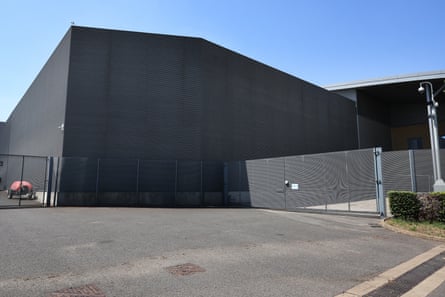
On Wednesday in Slough, datacentres multiple storeys high and surrounded by security fencing emitted a low roar, like the sound of a generator. The closest weather station to the tech park, several blocks away, saw a high temperature of 36.7C that day and 36.5C the day before; other weather stations in Slough and the surrounding area were cooler, at times by several degrees – one in the centre of town, further from the tech park, reached 36.2C on Wednesday and 34.7C the day before. That pattern held through this week.

For the residents of Slough, the datacentres are visible; adjacent to the high street, at times audible through the walls of their offices. There is plenty of debate about how they affect the area.
“We were having a chat about it the other day,” says Didier Kindembe, who is taking his lunch break on the grass in the middle of the industrial park. “I think it’s the concrete too and not just the datacentres. There’s a lot of concrete around, and it absorbs the heat.”
Kindembe’s friend Matt, who asks to not give his surname, says Slough is consistently hotter than the surrounding areas. “In 2022, when there was the heatwave, the temperature in the car park was 45C. But when you drove towards Windsor it dropped to 39C.”
“People are questioning, why is it so hot? It’s getting hotter,” says Naveed Hussein, who has lived in Slough all his life.
“My computer gives off a lot of heat. So does my phone. So I have to imagine that the big datacentres do as well.”
Others are not so sure. Nawaz, the manager of the Chaiiwala, says he discusses the question of the datacentres – and their effect on the area – with many people. A lot of people in Slough are aware of the datacentres, he says, but they have mixed views. The datacentres also create jobs for the community.
“I think it’s only 10% to 15% of why things are hotter. Most of it is climate change.”
Explore more on these topics