


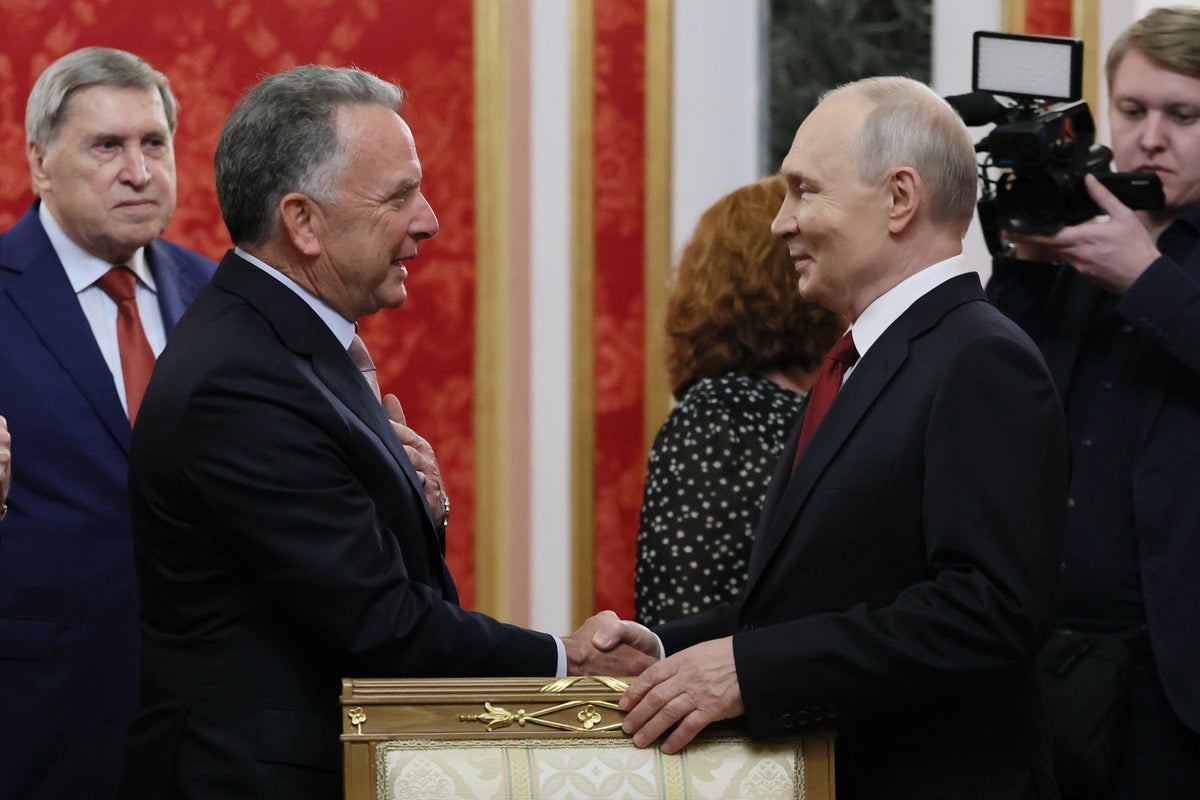
Steve Witkoff is the real estate guy with zero diplomatic experience who Donald Trump appointed last year as his personal “peace emissary”. Jared Kushner is the president’s son-in-law, but did at least play some role in one of President Trump’s few foreign policy achievements – the Abraham Accords process that promised to deliver some stability to the Middle East during the first Trump term. As a team, they have enjoyed little success in securing the “settlement” to the war in Ukraine that Mr Trump so desires. There is little reason to suppose that their latest exercise in shuttle diplomacy will succeed where their previous efforts failed. Indeed, the prospects for an end to the war, let alone one that will prove just and lasting, are as dismal as at any time since Vladimir Putin launched his ill-fated “special military operation” more than four years ago – its duration now longer than the Soviet Union’s “great patoritic war” against Hitler. Just as in that epoch-defining conflict, it is the civilian population of Ukraine that will face some of the harshest consequences as winter approaches.
Before the Witkoff-Kushner double act set out for Moscow and Kyiv, Mr Trump expressed his usual confidence in the pair – he could hardly do otherwise – and declared that “we have an idea for peace”. This idea remains opaque. Yet, for a change, this may be more than the usual self-flattering bluster. After a period when, easily bored, Mr Trump lost interest in the region (the situation in Iran didn’t help), this unexpected flexing of US power comes as a surprise. With the stalemate in the Gulf and some testing mid-term elections coming up, Mr Trump might be looking for some tangible evidence of his success as a peace-maker, and anywhere, no matter how unpromising, will do. Ending the fighting in Ukraine would also deliver some relief for the world economy and the US inflation rate, as grain and energy exports from Ukraine and Russia returned to normal. To be fair to Mr Trump, for all his usual callous attitude to the sanctity of life, he also seems unusually but sincerely distressed at the continuing loss of life – he says 25,000 are lost per month on average in “that stupid war”.
However, somewhat buried in the read-out from the talks with President Putin in Moscow is a more ominous suggestion about the motivations for this latest peace initiative. Mr Putin’s foreign policy adviser, Yuri Ushakov, told reporters that “economic issues and potentially large, mutually beneficial joint projects for Russia and America were discussed in considerable detail”. This echoes the previous US-Ukraine minerals deal, in which Mr Trump connived with the Kremlin to exploit Ukrainian vulnerability to secure sovereign natural resources – and is also not unlike the more recent neo-colonial oil “deal” being presently forced on Venezuela. Once again, Mr Putin may have spied some advantage in encouraging the Americans to exert pressure on Kyiv to accept unjust and humiliating terms just to end the prospect of fighting in what will prove to be an exceptionally cruel winter. But that doesn’t mean he wants to abandon his strategic goal of rebuilding the Russian/Soviet empire across Eastern Europe. Far from it.
If recent experience is anything to go by, Russia may be expected further to intensify its war of attrition on the Ukrainian people. Ukraine is, sadly, accustomed to the indiscriminate bombing of apartment blocks and schools; but now, partly thanks to America’s self-entrapment in the war in Iran and the subsequent shortage of Patriot missiles, Ukraine’s air defences are far too weak to withstand the bombardments. As in the past, railways, power lines and even water supplies will be targeted by Russian missiles and drones this winter, making life unbearable even for the most defiant and brave of Ukrainians. European assistance will probably not make up the shortfall in their defences. As if to prove that they are making up for lack of progress on the battlefield by waging a war of terror, the Russians have also opened an unusual new front to destroy Ukrainian morale – culture. Printing plants producing school textbooks – hardly a military priority – have been hit with incendiaries; and the 11th Century Dormition Cathedral in Kyiv was significantly damaged in what President Zelensky called “one of the biggest Russian crimes against Christian culture today”. Russia, absurdly, denied hitting the Unesco world heritage site.
What this tells the world is that what the Kremlin calls the “useful” talks they had with Mr Trump’s emissaries about future lucrative commercial deals will make no difference to Mr Putin, who is sticking to Plan A – military victory – because he judges he still has a chance of winning a bigger victory than any realistic diplomatic settlement will bring. No concrete proposals have emerged for a ceasefire. His counterpart in Kyiv, has drawn a similar conclusion, boosted by European support and shifts in the US Congress in favour of Ukraine, such as fresh authority to tighten sanctions on Russia, and weariness with the duplicitous pro-Russians within the MAGA movement.
The upshot is that this war will drag on well into 2027 and possibly even longer as a perma-conflict in which neither side can deliver a decisive blow. A change of occupant, and policy, in the White House gives the Ukrainians an additional incentive to resist. It would seem that 25,000 Russian and Ukrainian deaths a month is a price both sides are prepared to pay to avoid defeat, even if victory is elusive. That is the necessary conclusion that Mr Witkoff and Mr Kushner can draw from their discussions with the protagonists.