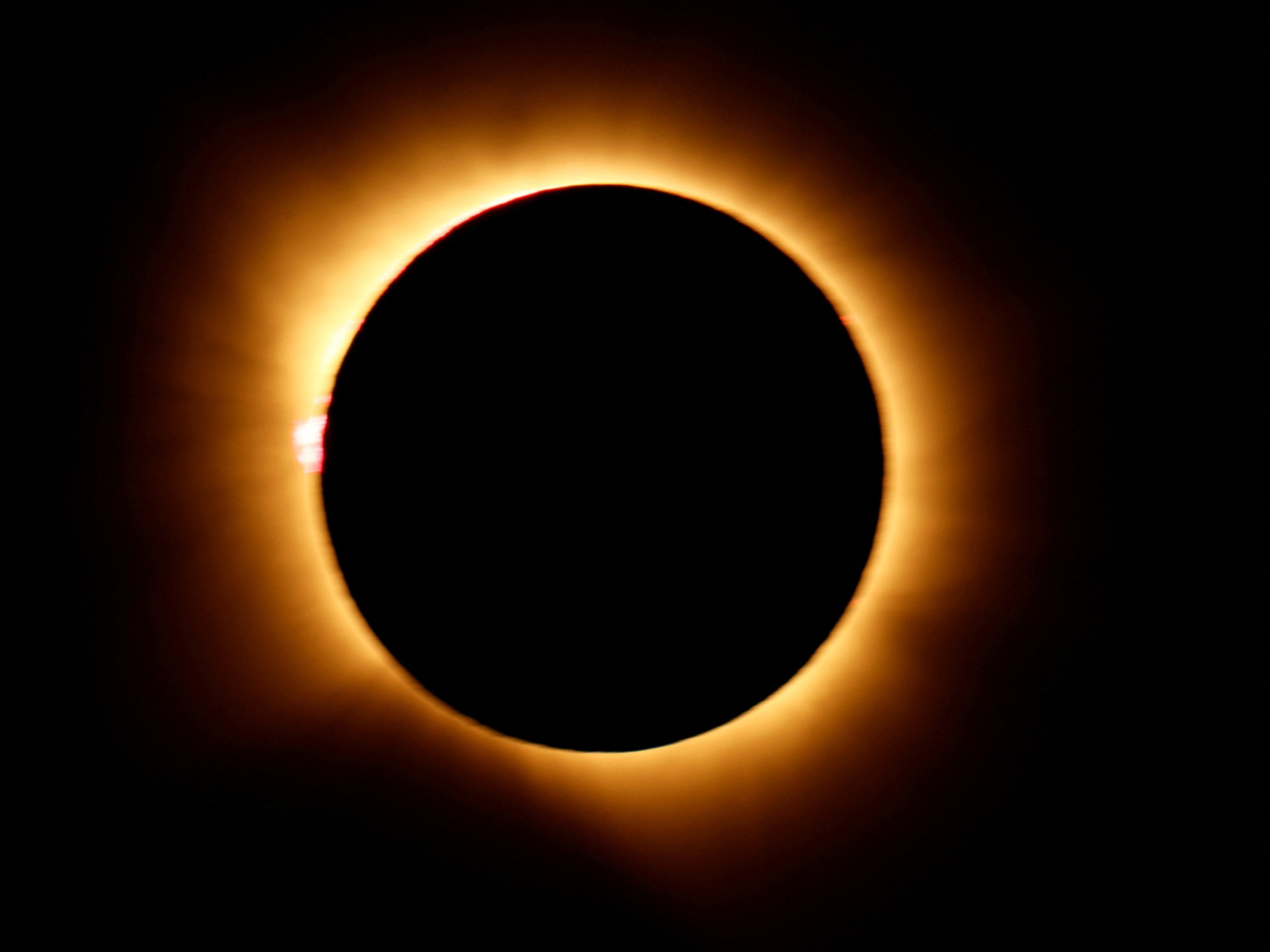
The moon completely covers the sun during a total solar eclipse as seen from Arija, Spain. [Borja Suarez/Reuters]
By News Agencies12 Aug 2026
Millions of people across Europe have experienced their first total solar eclipse in 27 years.
Starting at 15:34 GMT, the brightness of the daylight hours was gradually interrupted as the moon began to block the sun, eventually turning day into sudden night for about two minutes along the path of totality.
That path – where the moon orbits in front of the sun and blocks its entire surface facing Earth – crossed northern Russia, Greenland and Iceland before sweeping across Spain and a small part of Portugal, bringing almost total darkness to about 15 million people.
A partial eclipse was visible across much of Western Europe, parts of Northwest Africa, most of Canada and part of the northern United States.
The silhouette of the Prague Castle stands against the background of a partial solar eclipse in Prague, the Czech Republic. [Martin Divisek/EPA]The eclipse is seen behind the TV Tower in Berlin, Germany. [Hannibal Hanschke/EPA]A farmer holding a scythe stands in a meadow before the solar eclipse in Jacobsdorf, Brandenburg, Germany. [Patrick Pleul/Picture Alliance via Getty Images]A view of the total eclipse as seen from on board the Ambassador cruise ship Ambition, off the coast of Greenland. [Owen Humphreys/PA Images via Getty Images]A view of the solar eclipse in Sarajevo, Bosnia and Herzegovina. [Muhammed Enes Yildirim/Anadolu via Getty Images]The eclipse is observed in Salzburg, Austria. [Cuma Kaan Elbir/Anadolu via Getty Images]A view of the solar eclipse in Belgrade, Serbia. [Filip Stevanovic/Anadolu via Getty Images]People watch the partial solar eclipse from the Sophienalpe recreational area in Vienna, Austria. [Leonhard Foeger/Reuters]The moon completely covers the sun during the total solar eclipse as seen from the Javalambre Astrophysical Observatory in Arcos de las Salinas, near Teruel, Spain. [Christian Hartmann/Reuters]