


As warming seas push native species to cooler waters farther north, once-rare visitors have become more common
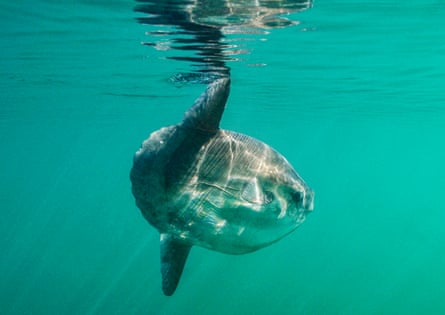
‘It sounds silly but I thought it was a person in the water waving,” says Kurt Lander, skipper of the Yellowfin charter boat, based out of Brighton. But when he grabbed his binoculars, he realised the fluttering movement he had noticed in the middle of the Channel shipping lane was a pair of sunfish.
The huge fish were lying on their sides and flapping their fins. “Apparently, they do it as a visual attraction to birds,” he says. “They’re trying to get the birds to eat the parasites off them.”
Lander has seen the huge fish with their unusual round bodies before. But the difference is that those that he spotted this year are part of a surge in sightings of the species off British shores this summer, probably as a result of a marine heatwave.
Marine heatwaves usually follow long hot spells on land as seas also warm. Last year was labelled “exceptional” by the Met Office, with some parts of British waters seeing heatwave conditions for three-quarters of the year, and 2026 is already showing more of the same.
The extraordinary temperatures are causing shifts in marine life far beyond an increase in sunfish. Some species are moving away from warmer waters, other “invaders” are appearing for the first time around Britain’s coastline, while some marine life is dying off under the rays of the sun.
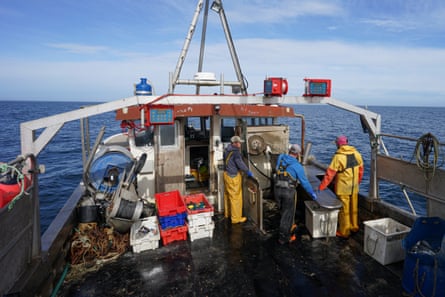
Lander notices the change in the species of fish he now lands. “I used to catch at least a couple of hundred cod a year,” he says. Now, bringing in cod is rare. If he catches any, he adds, “it’s probably about one or two a year in the summer.”
Colder water species are just nowhere to be seen off the southern coastline, says Dr Zoe Jacobs, a senior researcher at the National Oceanography Centre in Southampton. Shifting their range to cooler seas farther north, they are now thriving in Scotland. “Temporarily or permanently, we don’t know,” she says.
Meanwhile, Lander is catching more warm-water fish, such as bass, comber and triggerfish. According to last year’s State of the South-West Seas report, other species found in warmer waters – such as sardines and anchovies – are also doing well.
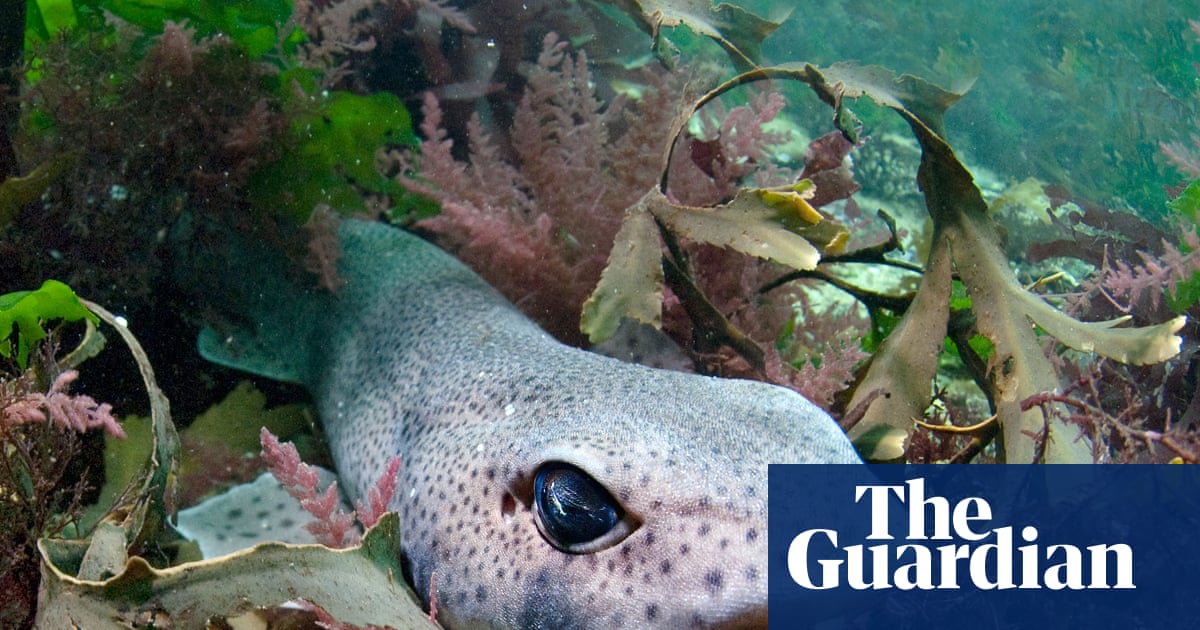
Gio Reale, a diver based in the Cornish port of Falmouth, says: “Small water temperature changes have such big effects on marine life.” It has been weeks since he last saw his favourite shark species: the small spotted catshark (also called the lesser-spotted dogfish). These small sharks – which grow no bigger than a metre and are spattered with delicate freckles – prefer water temperatures of about 16-17C (61-63F).
“This summer, like every day, the water has been about 20C,” he says, adding that he thinks the sharks may have moved into deeper, cooler waters, replicating the way they behave in the Mediterranean.
These sharks may be missing but common octopuses have arrived in force since January last year, when warmer waters in Devon and Cornwall created perfect conditions for them. This species is native to the UK but not usually seen.

The bloom caused issues for some crab and lobster fishers. “Everyone’s complaining, ‘oh, they’re taking all our crabs’,” says Reale. “But obviously, for the octopus, that’s just a really easy meal. You can just get into a trap where the crabs can’t go anywhere and eat them.”
Some boats have switched to targeting the now-abundant octopuses, with catches soaring in 2026. The octopuses also provide food for predators, which could explain an increase in sightings of summer visitors such as Risso’s dolphins.
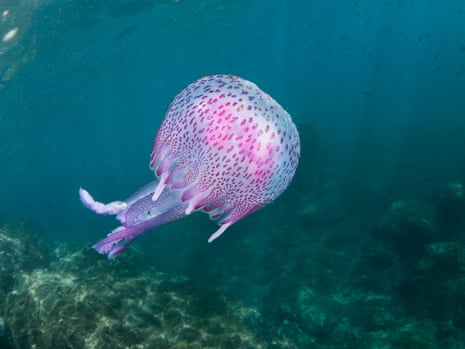
As sea swimmers know, warmer waters also bring jellyfish – another food source. But these blooms “have high and low years”, says Jacobs, and interpreting sightings can be tricky: reports may increase simply because more people are at the beach.
Seeing lots of native moon, compass and barrel jellyfish is normal for summer. However, the arrival of more mauve stingers from the Mediterranean would be “a different story”, she says. “That might well be due to the warming.”
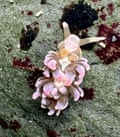
Warmer waters can bring new species altogether. A few smalltooth sand tiger sharks – an “exceptionally rare visitor” in local waters – have washed up on UK beaches in recent years, and hair curler sea slugs , usually found in the Caribbean and Mediterranean, were first recorded in 2025.
Some outsiders can cause problems for native animals. For example, scientists are watching a newly arrived sea squirt, called Didemnum pseudovexillum, closely. It is almost identical to another invader called the carpet sea squirt (Didemnum vexillum) that can smother the seabed, but they do not yet know if this new sea squirt will cause similar damage.
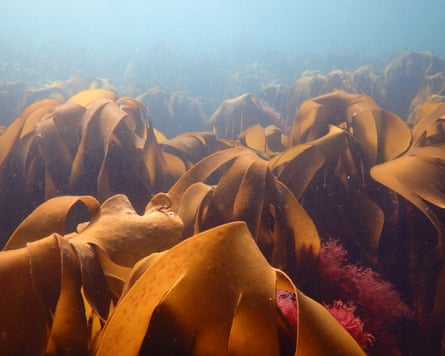
Elsewhere in the world, extreme marine heatwaves have caused extensive loss of seagrass and kelp in countries including Australia and the US. “Huge areas have just been completely wiped out, and they’ve not returned,” says Jacobs.
Chris Williams, founder of the volunteer-run Hastings Kelp Project, is worried. The UK may have lost about 92% of its seagrass meadows since the 1930s. Exactly how much kelp has vanished is unclear but, in Sussex, it could be more than 96%.
And this is hidden under the sea. “You don’t see a degrading kelp forest from the land like you might see a woodland burning down or dying off because of the temperatures,” he says.
Kelp prefers waters of about 8-12C and even Williams’s controlled laboratory is struggling. “Because of the heatwave, our chillers in the lab haven’t been able to keep the tanks below 12C,” he says.
His kelp is growing but he thinks this is because he can control other variables, such as lighting.
Seagrass and kelp provide vital habitats for many animals, protect shorelines from erosion and flooding, and store carbon, which is why Williams hopes to grow kelp that can withstand warmer seas. The Seagrass Ocean Rescue project similarly aims to restore 15% of UK seagrass meadows by 2030.
Warmer waters can also trigger harmful algal blooms, which can harbour nasty pathogens that make animals and people extremely sick. In the Bay of Biscay, the authorities closed beaches to protect swimmers. While the same thing could happen here, our infrastructure is not yet set up for such closures, says Jacobs. “We’re just not ready,” she says.
The impact of repeated heatwaves on fisheries may take a couple of years to become apparent because, even if adults survived the elevated temperatures, eggs and juveniles may have been affected. And experts do not know if the cold-water fishes that moved north will return after the heatwaves end.
“It might be that our cod and mackerel fisheries are done,” says Jacobs. But southern vessels could pivot to catch warmer water species, such as triggerfish, while Scotland benefits from the cod’s shift in its range.
Marine heatwaves are not new but climate breakdown is causing them to hit with increasing frequency and severity. “I’m starting to call it our new normal because we seem to be getting hit by them in successive years,” says Jacobs.
As greenhouse gases emitted from burning fossil fuels push up baseline temperatures, “the extreme is just going to be more extreme”, she says.
Explore more on these topics
- Seascape: the state of our oceans
- Marine life
- Fish (Environment)
- Fish (Food)
- Climate crisis
- Invasive species
- Endangered habitats
- features