


Osun poll: Experts flag tracking hurdles as INEC probes N100bn spending
August 27, 2026 2:06 am

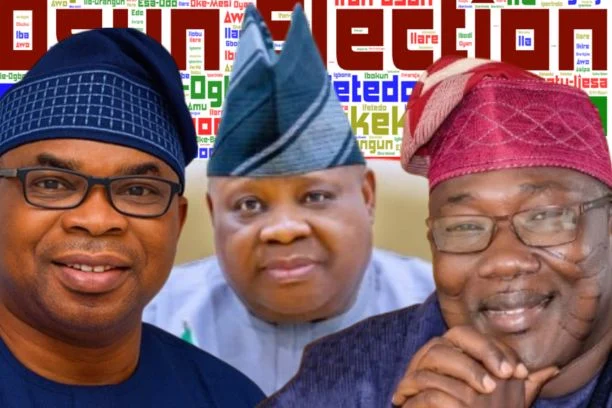
Leading candidates in the #OsunDecides2026, APC’s Oyebamiji, Accord Party’s Adeleke, and ADC’s Salaam | Credit: Adekunle Aliyu
By Deborah Musa
Experts have raised concerns over the difficulty of tracking election expenditure, as the Independent National Electoral Commission moves to independently verify a report alleging that the All Progressives Congress and Accord spent over N100bn on the August 15 Osun State governorship election.
A report published by Saturday PUNCH had unravelled the spending by the two leading parties on vote buying, campaign materials, party agents, canvassers, security personnel and electoral officers during the poll.
The report was based on findings from multiple sources, including party officials and other participants in the electoral process across the state.
The expenditure allegedly included billions of naira spent on vote buying.
Findings indicated that the APC allegedly allocated N40,000 per targeted voter, while Accord reportedly targeted an average of 150 voters in each of the state’s 3,763 polling units at N20,000 per voter.
The APC was estimated to have spent N22.578bn on vote buying, while the corresponding calculation for Accord stood at N11.289bn.
Sources also disclosed payments to party agents, canvassers, security personnel and electoral officers.
The report further found that some voters allegedly received as much as N80,000 for their votes in certain polling units.
Under Section 92(2) of the Electoral Act 2026, “A candidate to the office of governor shall not exceed the sum of N3,000,000,000 (Three billion naira) as election expenses.”
The Osun election was won by the incumbent governor and Accord candidate, Ademola Adeleke, who polled 511,067 votes to defeat the APC candidate, Bola Oyebamiji, who scored 444,815 votes.
Reacting, INEC National Commissioner, Mohammed Haruna, told The PUNCH that the commission could not rely solely on the report’s calculations, stressing that it would conduct its own assessment before determining whether the parties breached the N3bn spending limit prescribed for governorship candidates under the Electoral Act 2026.
Haruna stressed that it must establish the facts through its own findings before applying the provisions of the Electoral Act.
He said, “The rules are quite clear, but INEC has to establish that those are the facts. INEC cannot act on the findings or calculations of another body, so we have to carry out our own calculations and findings and follow the rules from there.
“That is PUNCH; that is their own arithmetic. We haven’t done our own arithmetic, so we have to confirm those are the facts.”
Speaking on the possibility of INEC tracking campaign expenditure and verifying whether parties and candidates exceeded the prescribed spending limits, former and serving Resident Electoral Commissioners said it might be difficult for the commission to establish the exact amounts spent during the election.
They, however, called on INEC and security agencies to enforce the spending limits prescribed by the Electoral Act and prosecute offenders, particularly those involved in vote buying.
A former Zamfara REC, Asmau Maikudi, said INEC had mechanisms for monitoring campaign expenditure by political parties and candidates but added that political parties were in a better position to verify how much they spent.
She noted that monies spent during campaigns, “can only be verified by the political parties that spent the money but we are all aware that the Electoral Act has specified, INEC has specified in its rules and regulations, the maximum amount a candidate seeking political office, whether a House of Representatives member, a state House of Assembly member, a senator, a governor, or the president, the maximum amount that a person should spend, or the political party can spend. That we know.”
Maikudi said INEC’s election monitoring unit was responsible for ensuring compliance with expenditure limits.
“And I think INEC has a machinery. There’s something that is called the election monitoring unit that monitors political parties; it is a department, actually, in INEC. And the staff there are to ensure that political parties do not exceed the amount that INEC has specified,” she said.
She also condemned vote buying, stressing that money or other items used to induce voters could not be treated as legitimate election expenditure.
“Money spent on vote buying cannot be part of the election expenditure, because vote-buying is illegal. Vote-buying is not allowed. Vote-buying is anti-democracy.”
According to her, inducements could come in different forms, including cash, foodstuff or clothing materials.
“Whatever it is, it is illegal. Vote-buying is illegal,” Maikudi stressed.
She urged INEC and security agencies to ensure compliance with electoral laws and called for the prosecution of election offenders.
“So, YIAGA has been consistent on its call for prosecution of election offenders, whatever it is. And we’ve also been advocating that we should have a mobile court on that day whereby people who are caught doing anything that is anti-democracy, anti-party, and political anti-democracy, anti-good elections, if they are caught, they should be prosecuted there and then,” she added.
She said punishment was necessary to deter electoral offenders.
“There’s no deterrence. There’s no punishment. Punishment has to be given so that it can serve as a deterrent against those who would want to do it in the future or those who are thinking of doing it again,” she emphasised.
Maikudi further said democracy could not thrive where elections were reduced to financial inducements.
“Democracy is not a cash-and-carry issue. Democracy cannot survive under such conditions. We want our democracy to thrive,” she added.
Also speaking, a former REC, Prof Sam Egwu, described the verification of alleged election spending as extremely difficult, questioning the methodology that could be used to establish the actual amount spent by political parties and candidates.
“There’s no way of verifying or establishing what was spent. It is a very difficult thing. Is it by looking at the campaign posters? Is it by looking at the money people have spent on vote buying? And how do you track it? You know, is it by tracking the cost of radio adverts? I mean, for me, it’s a wild goose chase, and it’s difficult for you to say you can vouch for, you know, the integrity of the figure that people are bandying around.”
Egwu said although the Electoral Act provided punishments for violations of spending limits, effective enforcement remained a major issue.
“The punishments are there in the Electoral Act, but it’s also about the will to enforce, you know, to enforce those provisions,” he added.
He said while he believed political parties and candidates spent substantial amounts of money during elections, he could not determine the exact figures without evidence and a reliable methodology for tracking expenditure.
“I personally believe they spent money, but I wouldn’t know how much was spent for you to be able to determine whether they have exceeded, you know, the ceiling.
“But honestly, this is something that you need to make a scientific statement about, and you need evidence to be able to make that kind of statement,” Egwu added.
The Oyo State REC, Adeniran Tella, also pointed out that the Electoral Act clearly stipulated spending limits for elections and campaigns.
“What I can say is the Electoral Act has clearly stated the limits on what to spend during the election period,” Tella said.
He, however, said a REC who was not deployed to a particular state could not ascertain the amount spent by political parties during the election.
“So, I may not be in a position to say the actual amount of money that was spent, and if at all the money was spent, it cannot be established on the field that a specific amount of money had been spent so far by the parties,” he added.
On vote buying, the Oyo REC said offenders could face legal consequences.
“So when it comes to the issue of vote buying, it’s an offence punishable under the law. And if a candidate is caught, the culprit will face the court of law,” he noted.
On whether a candidate or political party found to have exceeded the expenditure limit could be punished, including where the candidate had already won an election, Tella said the applicable provisions would have to be determined by the electoral law.
“The only thing that can be done is through the electoral law,” Tella further stated.
Speaking on the development, a lawyer, Augustine Ogechukwu, described the limit set by INEC as a welcome development, but expressed doubts that the electoral body could be holistic in the investigation and prosecution of parties, particularly where it concerned the ruling party.
“The Electoral Act is an Act of the Federal Government and the Federal Republic of Nigeria. So it’s a law, and every politician should abide by it. It’s a good one because it will cut the spending of the politicians.
“If they will be holistic and not be selective in enforcing it, it will be good. But I think this INEC might not enforce it on the APC; they may do so on the opposition, but let’s see.
“If INEC will not do like the EFCC that is selective, I think it would be a good one, but I don’t think INEC can be holistic,” he contended.
A lawyer, who pleaded anonymity, described the allegations of N100bn as “beer parlour gossip” if INEC was unable to establish the fact through an audit of parties’ accounts.
“Number one, it is an allegation. It has to be proven through evidence, and only a court of law can say a party has spent over N100bn; otherwise, it is beer parlour gossip.
“People are putting resources in the elections off the party accounts. It is only if you check the party account that you can actually tell what they have and what they have spent,” he said.
The lawyer also pointed out that some funds used during the election may be impossible to trace, adding that only the Attorney General of the Federation could prosecute the parties after INEC has conducted an audit.
“Some of these monies you see being brandished on election day were not from the banking system, so you can’t trace them.
“To me, INEC can only raise a flag after an audit; then it will now be left for the Attorney General of the Federation to go after the defaulters or the parties, or the NGOs and CSOs should go after parties that have gone overboard.
“But only a court of competent jurisdiction can establish that a party overspent beyond the limit; otherwise, it is beer parlour talk,” he stated.
Deborah Musa is a journalist at Punch Newspapers with five years of experience in journalism, including three years covering the judiciary. She focuses on producing accurate, well-researched reports that provide clarity on legal and justice-related issues. Deborah’s work reflects hands-on newsroom experience and editorial diligence.
All rights reserved. This material, and other digital content on this website, may not be reproduced, published, broadcast, rewritten or redistributed in whole or in part without prior express written permission from PUNCH.
Contact: [email protected]