


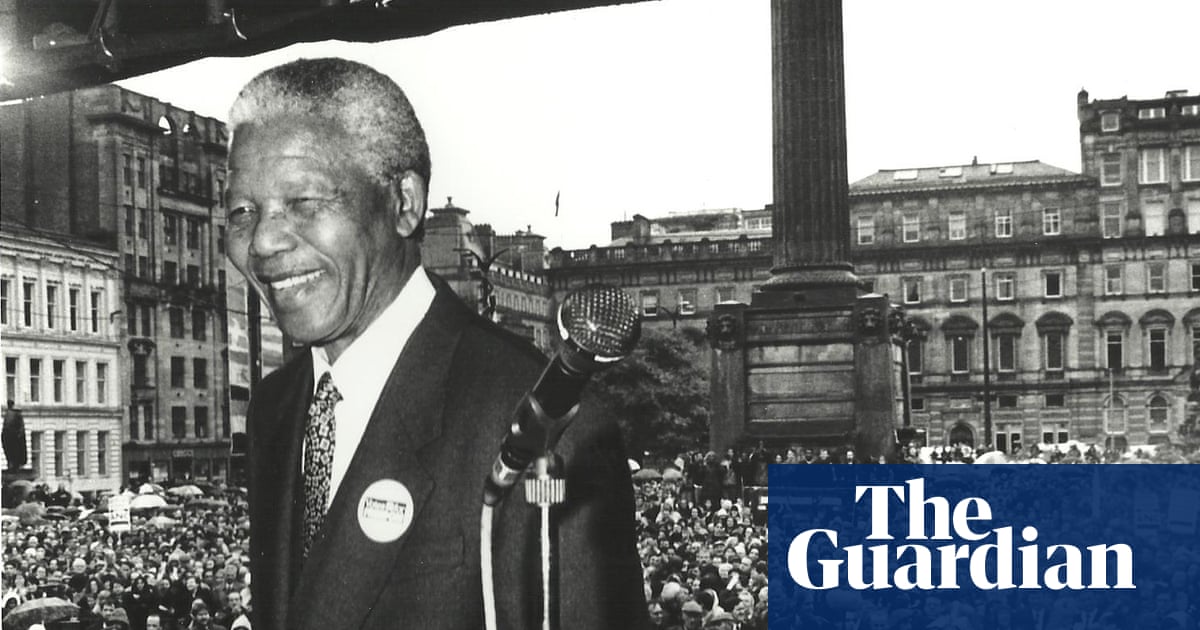
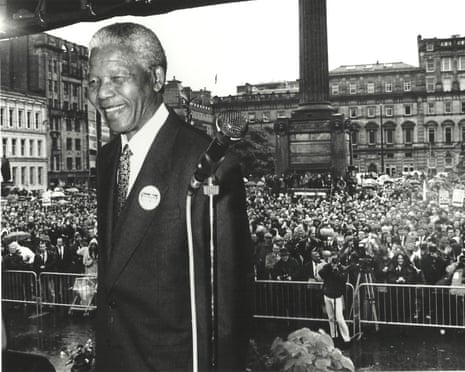
Holding institution: ACTSA Scotland
Holding institution: ACTSA Scotland
‘Once, Mandela was seen as the devil incarnate’: the TV show laying bare the true struggle against apartheid
From the activist who knew him as ‘Uncle Nelson’ to the campaigner who would go on to become a cabinet member, we talk to those involved in the struggle – and who feature in an eye-opening new documentary
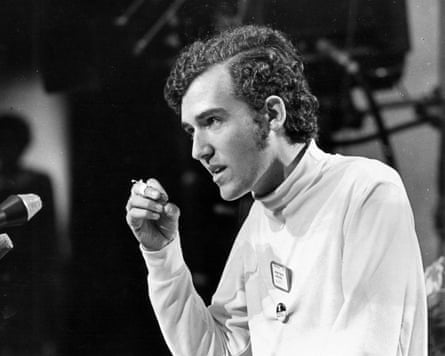
We tend to look back at the campaign to end apartheid in South Africa, says Peter Hain – the activist who would go on to become a senior Labour minister – “as one of the great success stories of protests and Nelson Mandela as a global icon, and rightly so. But Mandela was considered the devil incarnate. He was denounced as a terrorist by Margaret Thatcher only a few years before his release. We were vilified.” It was nothing compared to what Black people in South Africa faced, he stresses, but still he was targeted – a letter bomb was sent to him, and he was framed for a bank theft. It was, he says, “a hard struggle, a bitter struggle.”
A new documentary series, Free Nelson Mandela, covers the three decades of campaigning until Mandela’s release in 1990 and his election as South Africa’s president four years later. What emerges is an inspiring reminder of the power of resistance and resilience – and the sacrifices so many had to make.
Dali Tambo grew up expecting the worst would happen to his father, Oliver Tambo, the ANC president in exile who had brought his family to London in 1960. Other activists who had left South Africa had been assassinated, including Ruth First, known to Tambo as “Auntie Ruth”, and later Dulcie September, who Tambo lived with while studying in Paris. In London, the ANC offices were bombed.
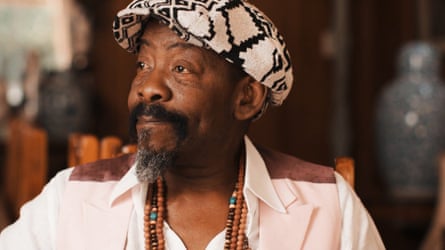
“[My father’s] perspective was that ‘yes, one day the agents of apartheid will kill me but it can’t dissuade me from doing my work. We’re all at threat in this movement’,” remembers Tambo. “He was determined that despite those threats, he would continue the struggle. He and his colleagues just took it as a given that they would not live to see freedom.” (Despite constant threats to his security, Oliver Tambo died in 1993, after a stroke, though he lived to see his lifelong friend Mandela released.)
As a child, Tambo remembers his parents calling in help from the Algerian embassy to sweep their London house for bugs. “Two out of three times they found them.” When he was about 14, he discovered a man hiding in the cellar; trying to escape, the man kicked Tambo through a glass door and jumped the back fence. At his boarding school, he was considered by some to be the son of a terrorist.
Hain had come to the UK with his parents in 1966 when he was a teenager, after a childhood spent living with early morning police raids, telephone taps and his parents’ brief imprisonment. He remembers sailing past Robben Island, looking out to the notorious prison in the bay, and thinking about Mandela – a friend of his parents – in a bleak, freezing cell.
The British anti-apartheid movement was hugely significant, says Hain. “Of course newly independent African countries were expressing solidarity, and the US [movement], particularly the Black community, which itself was suffering from enormous racism. But the British anti-apartheid movement [became] the centre of the international anti-apartheid struggle.” Both Hain and Tambo harnessed sport and culture. Hain led the protests against the 1969 Springbok rugby tour of Britain and Ireland, and succeeded in getting the South African cricket tour cancelled the following year.
“The sports campaign brought to millions of sports fans a sudden awareness: what’s apartheid about?” Hain later became an MP, cabinet minister and now sits in the House of Lords.
The arts would also become hugely influential. A 1983 concert at London’s Alexandra Palace, with a line-up that included the South African musicians Hugh Masekela and Julian Bahula, inspired Jerry Dammers of the Specials – who had, as a teenager, demonstrated against the Springboks rugby tour – to write the song Free Nelson Mandela, which became an anthem of the movement. In 1986, Tambo and Dammers formed Artists Against Apartheid – and were embraced by numerous British artists.
“If George Michael or UB40 or Sting are on your wall, and they say ‘we’re anti-apartheid’, you’ve got to ask yourself, as a young person, ‘what is apartheid, why are they anti-it?’,” says Tambo. “The momentum built, on the cultural side and on the political side.”
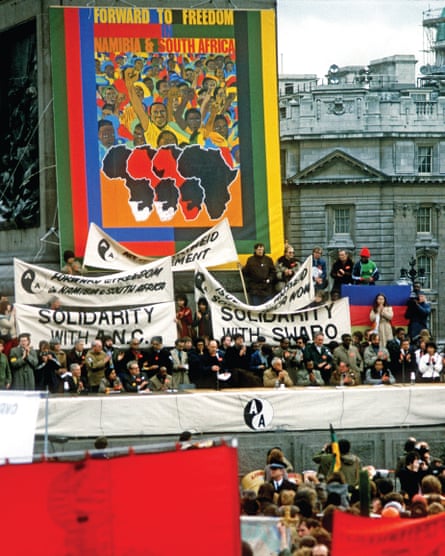
A huge march in June 1986, at that time the world’s biggest anti-apartheid demonstration, led to a free concert in London’s Clapham Common featuring stars including Gil Scott-Heron, Boy George and Sting. A concert at Wembley Stadium two years later, starring Whitney Houston, Stevie Wonder and Dire Straits, and featuring performances from Lenny Henry and Billy Connolly, was broadcast on the BBC and reached an audience of about 600 million people. Oliver Tambo, remembers his son, came up to him after the concert. “He said: ‘I could give 1,000 speeches and it wouldn’t be as powerful as what I’ve seen here today.’”
That concert, says Hain, “was a gamechanger.” The sport boycotts had done the same, “but this concert reached an audience that politicians don’t normally reach. Whether it was grandmothers refusing to buy South African oranges or students driving Barclays Bank [one of the country’s biggest foreign investors] off their campuses by refusing and disrupting their freshers’ week stalls, it was a range of different people.” The concert helped boost the change of mood, he says, even if there had been political pressure on the BBC not to broadcast it. “And then, of course, when Mandela was released, instead of the devil incarnate, we had this saintly grandfather who wowed the world.”
Hain met Mandela after his release, and again later, when his job was to escort the statesman to the 2000 Labour party conference where he was the guest speaker. In the hotel lift, Mandela asked about Hain’s family, and Hain mentioned his mother was in hospital after a fall. Mandela insisted on speaking to her, and while Hain battled to locate the number of her hospital ward, Mandela was shaking the hands of every hotel staff member who had lined up to meet him. “I finally get my mum on the line, and I hand him the phone, and he says, ‘This is Mandela from South Africa. Do you remember me?’” Hain smiles. “The thing that distinguishes him from all the other prominent people I’ve ever met is he was a people’s person.” Throughout everything he had gone through, the brutality and the adulation, that didn’t change.
“He was a very tough-minded, clear leader, but he could always relate to his followers. He managed to go out in the front sometimes, which leaders have to do, but never forgot who his constituents were.”
Throughout Tambo’s childhood, Mandela had taken on a folkloric status. “Your Uncle Nelson’s in prison, and once a year my mother and Aunt Winnie [Mandela’s wife and fellow activist] would find a way to talk, but most of it was through telegrams or letters smuggled out [including] from Robben Island. So he was mysterious.” But he was also family, says Tambo. When they spoke for the first time by phone, “what surprised me is that he seemed to know so much about me, but it was a normal conversation.” They met when his father was recovering after a stroke at a hospital in Sweden. “Uncle Nelson, on one of his first trips abroad, came to Sweden to meet with my father. He had this beautiful manner about him, and I know that they had a very emotional first meeting when they got together again after 30 years. It was wonderful. We spent time together, and he was very much family, guiding me.” Mandela was, adds Tambo, “a revelation. And just Uncle.”
Free Nelson Mandela is on Channel 4 on 14 June at 9pm.