


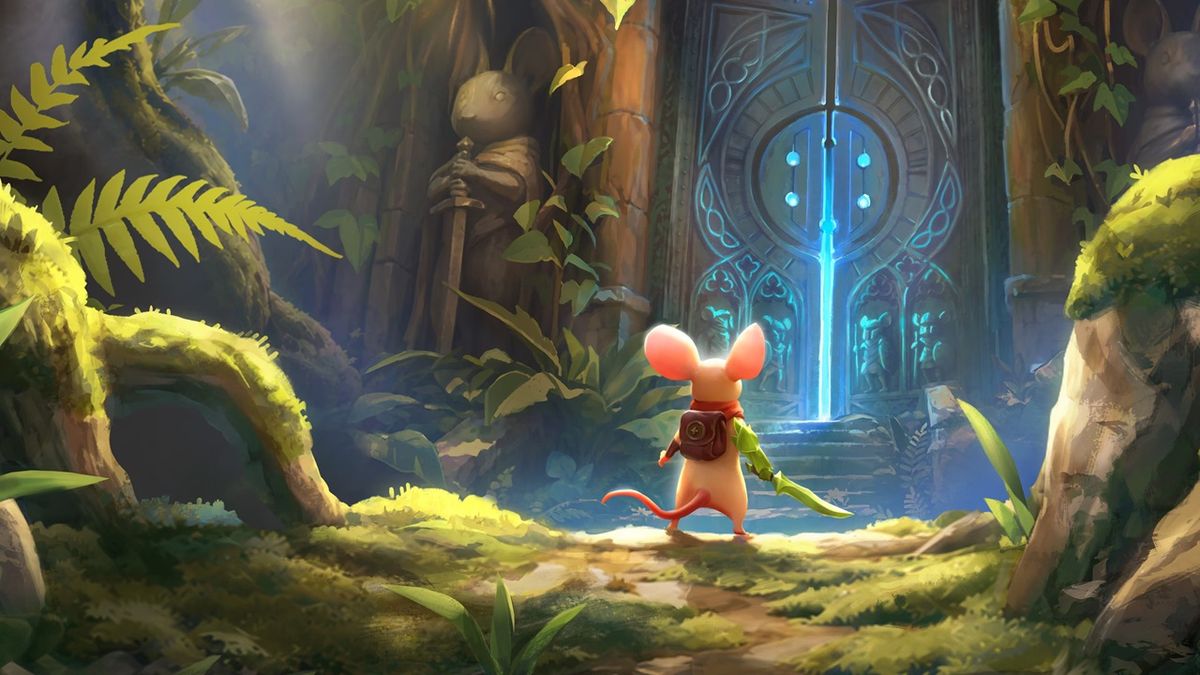
We go hands on with 30 minutes of the upcoming Moss: The Forgotten Relic, which is making the jump from to a more conventional PC and console format.
One of the main themes of this year’s SGF festivities, alongside every AAA title suddenly releasing in September and inconsistent Xbox exclusivity, was definitely previously VR exclusive titles making the jump to a traditional flat screen format. The likes of zombie shooter Arizona Sunshine, chillful puzzler The 7th Guest, and more recently Alien: Rogue Incursion have all been reworked for the more traditional gaming experience in some fashion, all in the hopes of reaching a wider audience.
Is this an industry admission that the VR gaming experiment has failed? Perhaps. But it at least means that more players will have the opportunity to play great games they may have missed out on.
Moss: The Forgotten Relic is yet another upcoming example of this trend, being a storybook platformer whose first game was previously locked on the initial PSVR, but will be coming to standard consoles and PC (alongside its equally as excellent sequel) this July 16, 2026 . This makes me ecstatic since Moss and Moss: Book 2 are some of my favourites from the VR pantheon, both doing a brilliant job of making you feel like an in-universe character able to influence little Quill’s heartfelt adventure by poking, prodding, and grabbing onto the pieces of the environment surrounding her.
Such actions have always combined with Quill’s various combat, puzzle-solving, and platforming antics flawlessly, but I was still surprised to find that the same is very much true for this new, non-VR version that is Moss: The Forgotten Relic.
 View 3 Images
Moss: The Forgotten Relic now plays out from fixed camera angles, which works just as well letting you peer into its world.(Image: Polyarc)
For my 30-minute preview I was jumped into the middle of an early-ish section in Moss Book 2, where Quill is forced to aid her ailing uncle by hunting down a mysterious hammer weapon needed to take on the menacing Cinder Knight boss. The first thing to mention is that Moss: The Forgotten Relic does a pretty decent job at still making you feel like a giant character peering into what is an undeniably alluring fantasy world.
Sure, you no longer have the ability to freely turn the camera since your head movements aren’t tracked anymore, but it always being fixed at a high enough angle does well to let you see every important nook and cranny you’re required to guide Quill through.
From dense, sun-lit forests to dark and dank smithing facilities, Moss might be a series set in fantasy but there’s always a slew of fun locales to fight through and pick away at. Speaking to the former, there’s nothing about Quill’s swordsman abilities that’ll stagger any veteran gamer.
Battling foes is a simple case of pulling off three-hit sword-swipe combos and knowing when to dodge, yet it’s here where the franchise’s origins as a VR title also adds some flavour. At any point you’re able to hold back and stun enemies using your glowing blue touch, at which point they’ll be opened up to receive an attack from Quill.
The later part of the demo also showcases how combat does deepen just a smidge, when Quill receives a hammer ideal for smashing away the tough armour of enemies, as well as solving the suite of shifting environmental puzzles. Also bringing some variety is the way you’re able to separate Quill’s actions from your own which the hammer comes in mightily handy for.
A section later in the machineworks, for example, required me to smash down on a switch while Quill stood on the elevator it activated in order to raise it. Doing so meant activating Quill’s ghost hammer ability, moving her to the correct spot, and then activating it using my in-game character’s touch. As far as skills go, it works wonderfully for both puzzles and combat in this way.
If there’s one major way that Moss: The Forgotten Relic shows its hand as a VR-first game it’s in how levels are segmented. Moving from one area to another always causes the screen to fade in and fade out, which always happens very quickly, but does have the habit of taking me out of the action slightly each time.
 View 3 Images
Quill can equip a magical hammer that comes in handy for solving puzzles but also smashing away enemy armour.(Image: Polyarc)
Obviously, while wearing a VR headset this style of progression could be chalked up to the character blinking or offering a nice rest for the eyes. On a flat screen, however, it’s extremely noticeable whenever levels and stages that Quill moves through don’t neatly lead into one another. True, Moss being presented in the guise of a storybook means you can always think of these moments as the page turning, yet I can’t help thinking there was a better solution to this unique problem.
Article continues below
As far as flat screen adaptations of VR games go, Moss: The Forgotten Relic feels like it’s shaping up to be a mostly neat transition. Sure, the fading in and fading out of level screens isn’t ideal and its combat chops might be as limited as it always was, yet this is still shaping up to be an extremely faithful way to play two of the best VR puzzle-platformers in a whole new, more accessible way.
Moss and Moss Book 2 are both charming adventures that never got the love or attention they deserved, so it’s heartening to see that this might change with the launch of Moss: The Forgotten Relic as soon as next month.
Moss: The Forgotten Relic is set to release on PC, Xbox, and PS5 on July 16, 2026 .