


Morocco migrant death toll hits 67
August 2, 2026 12:41 am

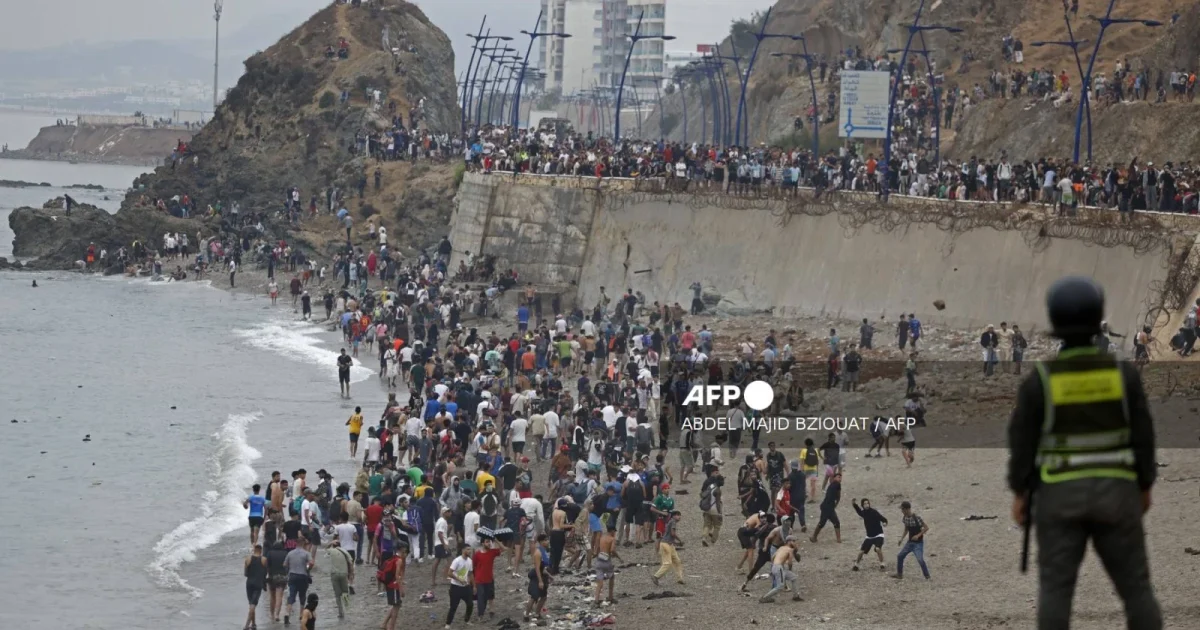
People gather along the fence at the site of clashes near Fnideq, on the Morocco-Spain border, on July 31, 2026. Thousands of migrants crossed overnight from Morocco into Spain’s north Africa’s Ceuta enclave | AFP
Spain’s Prime Minister Pedro Sánchez has denounced the “selfish” response of several EU member states to an influx of migrants crossing into the Spanish exclave of Ceuta from Morocco this week, as the number of people who died rose to 67.
According to CNN, most of those 50,000 to 60,000 people who attempted the crossing had returned to Morocco by Friday evening, quoting Spanish authorities.
Authorities in Ceuta said many of those who lost their lives drowned as crowds streamed over the border by land and sea on Thursday, overwhelming border guards.
In a letter quoted widely by European media, Sánchez condemned the “selfish, polarising and unlawful reaction” from other EU countries, after Italy temporarily placed some border controls on travel from Spain, while France’s Interior Minister Laurent Nunez ordered extra checks along the countries’ shared border. Italian Prime Minister Giorgia Meloni also called for Spain’s membership of the Schengen agreement to be suspended.
Sánchez said in his letter that “such an attitude” was “driven by prejudice, fake news, ignorance or political interest.” “In the current international context, the European Union cannot afford this kind of selfish, polarising and unlawful reaction,” he added.
Later, on Saturday, Ireland, which holds the bloc’s rotating presidency, announced an emergency meeting among national ministers to discuss the crossings. The Irish Justice, Home Affairs and Migration Minister Jim O’Callaghan, posted on X that he remains “in close contact with all EU Member states” and is “continuing to monitor the situation.”
Spanish officials said they would try to expel those who entered irregularly as quickly as possible. The mass crossings come in the wake of a recent ruling by Spain’s Supreme Court that authorities cannot summarily deport migrants who arrive by sea without due process.
However, experts say that legal decision was extremely narrow, with some arguing it was likely misinterpreted by migrants and traffickers.
By Friday, many appeared to have left of their own accord. Reuters reported seeing hundreds of people return to Morocco through border posts and holes in the fence, with some saying they could not find food or shelter in Ceuta.
On Saturday, Spanish officials began installing a floating barrier near the Tarajal breakwater, a key entry point into Ceuta, to “comply with” the Supreme Court ruling in July, the country’s Interior Ministry said in a statement.
Third-country nationals in Ceuta do not have free movement to mainland Spain or the rest of the Schengen area, and identity and visa checks are required for onward travel.
Sánchez previously said the mass crossings constituted a “violation of Spain’s territorial integrity” and blamed the influx on misinformation spread by people traffickers following the Supreme Court ruling.
Reuters spoke to 16-year-old Moroccan Ayoub El Abyad, who said he and his cousin decided to make the 12-hour journey toward Ceuta after watching Instagram videos of other migrants crossing.
“Migration is about improving our lives. We agreed we would try the idea of crossing and trust in God,” El Abyad told the news agency from the Moroccan side of the border.
The videos circulated as reports and misinformation spread on social media about the Spanish Supreme Court ruling, leading many young Moroccans to see an opportunity to cross.
All rights reserved. This material, and other digital content on this website, may not be reproduced, published, broadcast, rewritten or redistributed in whole or in part without prior express written permission from PUNCH.
Contact: [email protected]