Watch: ‘I thought it was important to call out what’s happening’, says Miliband
ByHafsa Khalil
Foreign Secretary Ed Miliband has rejected the chief rabbi’s warning that British Jews are at greater risk after the UK announced sanctions on Israeli settlements in the occupied West Bank.
Miliband said that as a “proud British Jew” he disagreed with UK Chief Rabbi Sir Ephraim Mirvis who described the move as a “truly dark day” that would “succeed only in bolstering the very extremism they seek to target”.
“We all need to do more to tackle antisemitism,” Miliband said, “But I believe we can do that and stand up for British values.”
The sanctions on trade with illegal settlements in the West Bank come against a backdrop of rising antisemitic incidents across the UK.
The Community Security Trust (CST), an organisation that provides security support to the Jewish community, recorded 1,926 incidents of anti-Jewish hate across the UK in the first six months of 2026, a 21% increase on the same period in 2025.
Prime Minister Andy Burnham defended his government’s decision, telling MPs that “Britain has to stand for fairness against injustice. Where people are being bullied out of their homes… we will always stand with the underdog.”
The Palestinian presidency welcomed the UK’s decision, saying it was “an important step towards confronting Israel’s colonial system and its violations against the Palestinian people”.
But there has been mixed reaction within the UK Jewish community on the sanctions and possible implications for security.
The chief rabbi called the government’s announcement “little more than political flag bearing for mendacious anti-Israel rhetoric”.
Sir Ephraim said: “Gesture politics of this kind feeds into an increasingly hostile discourse about Israel, and the cumulative effect of such punitive policies is to further embolden those, at home and abroad, who use hatred as a weapon against Jews.”
Questioned on Mirvis’s comments, Miliband said: “I don’t agree with the chief rabbi, someone whom I have great respect.”
Speaking to BBC Radio 4’s Today programme he said “anyone who holds British Jews – or indeed Jews around the world – responsible for the actions of the Israeli government, is engaging in antisemitism, pure and simple.”
While, the Jewish Leadership Council (JLC) warned the sanctions move “risks becoming a de facto boycott of Israel” and accused Miliband of “yielding to pressure from the most extreme elements of British society”.
And the Board of Deputies of British Jews said the decision to make the announcement before Rosh Hashanah – the Jewish New Year festival – brings “concerns for communal security at their highest levels… felt particularly acutely by British Jews”.
It added the deteriorating relationship between the UK and Israel has the potential to “further inflame community tensions here too”, while also noting it had warned the Israeli government over the “intolerable settler violence” that harms Israel’s reputation.
But Na’amod – which describes itself as a movement of UK Jews seeking to end Israel’s occupation and to support the equality of Palestinians and Israelis – welcomed the decision saying it had waited years for the British government to take action.
“There is no singular Jewish approach to Israel. We reject the contention that [Tuesday’s] UK government measures will contribute to antisemitism.”
The Movement for Progressive Judaism said “while the vulnerability of British Jews must not be ignored” measures directed at Israeli settlements “are not the same as an attack on Jews”.
“We should take care not to collapse the distinction between them,” it said in a statement.
The sanctions have caused a diplomatic row with Israel which has closed the British consulate in East Jerusalem and banned 11 MPs and a campaigner from the country.
On Wednesday the Israel’s Diaspora Minister Amichai Chikli wrote to the head of Israeli border control recommending that several other British linked organisations and individuals should be refused entry to Israel.
The list includes Oxfam, Save the Children, Norwegian Refugee Council, Islamic Relief Worldwide, Medical Aid for Palestinians.
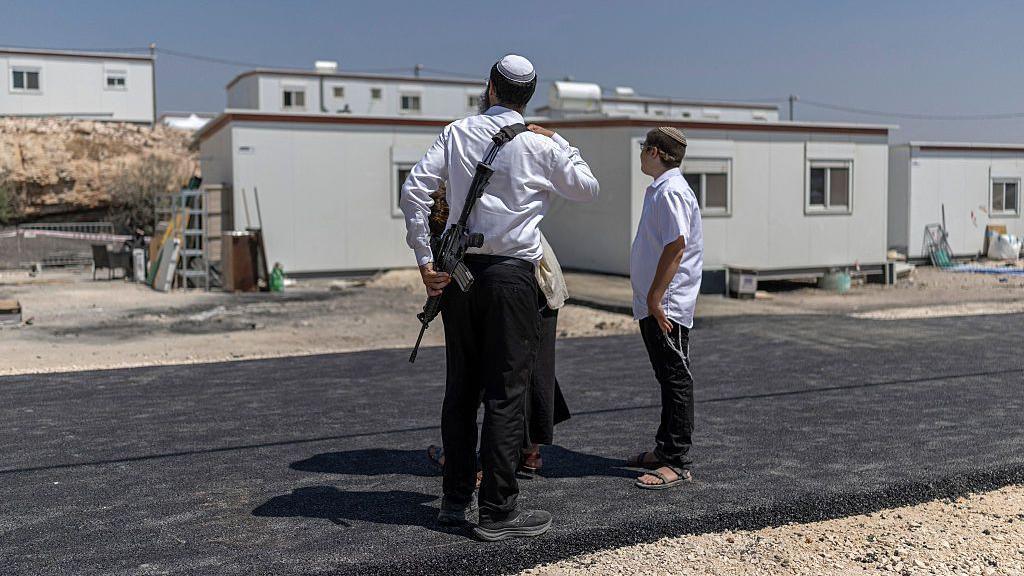
Speaking in the Commons on Tuesday, Miliband said the “new approach” was needed because of the plans for the E1 development – a controversial settlement project that would effectively cut off the occupied West Bank from East Jerusalem and divide the territory in two.
He also told MPs that the UK agreed there was ethnic cleansing in areas of the West Bank – accusing “settler terrorists” of driving Palestinians from their land.
“And all too often, the Israeli government has turned a blind eye to this,” Miliband said.
The sanctions will target companies and people providing services like construction and financing of settlements. There will also be a ban on the advertising illegal settlements in the UK. Miliband said the measures could take up to nine months to put in place.
Canada and France have also banned goods from the settles as part of a co-ordinated action with allies.