


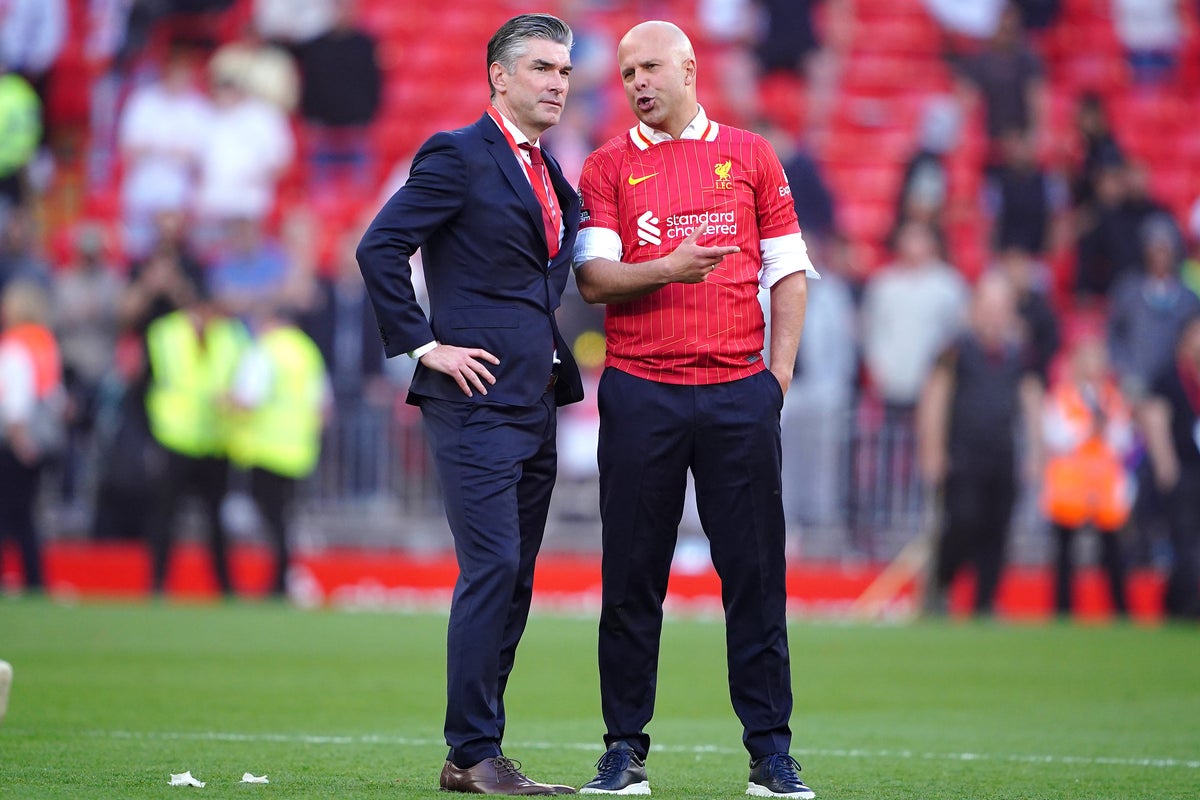
Perhaps, at the last, there was a touch of vindication. In Richard Hughes’ final match as Liverpool’s sporting director, the game was decided after just nine minutes. A devastating burst of two goals in three minutes from Alexander Isak, was probably what Hughes had envisaged rather when he committed a British transfer record of £125m to the striker.
When Isak went off and Bradley Barcola came on at Portman Road, Liverpool became the first club to field three £100m signings in the same game, if not at the same time. Hughes’ reign can be framed in high numbers: more than £650m going on new signings in little over a year with Barcola, Isak and Florian Wirtz each accounting for at least £100m of it. It was initially a time of high achievement, too: Liverpool have only won two Premier League titles and the second came after Hughes headhunted Arne Slot from Feyenoord as Jurgen Klopp’s replacement. That, it seemed, was the Liverpool way: intelligent recruitment, sometimes eschewing the obvious candidates for the leftfield coups.
And yet by the end of Hughes’ reign, Liverpool’s reputation was transformed; perhaps his own, too. Last season’s expensive underachievement mean that Hughes’ departure, while there has long been an expectation he will join Al Hilal, mean it may be celebrated by many a Liverpool fan, and not merely because he spent too much time on the south coast and communicated too little.
Last summer’s spending spree, recently dubbed the worst in history by Jamie Carragher, forms part of Hughes’ legacy. Isak’s brace at Ipswich means he has already equalled his total of Premier League goals from last season; but that was just three. He was the face of a strategy and a spending spree that went wrong, but Hughes was the architect of it.
 open image in gallery
As Liverpool went from taking 84 points to just 60, from finishing first to trailing in fifth, from losing one of Slot’s first 28 games to 20 matches in his second season, the formula the club had developed flaws. The power structure showed cracks. Michael Edwards, who had hired Hughes, informed the club of his intention to stand down as Fenway Sports Group’s director of football. The Scot told the club he wanted to stand down; it may be an indication of the support he retained in the upper echelons that he was asked to stay in charge for the transfer window and, indeed, is credited with completing the signing of Barcola, given the considerable preparatory work he had done on the £106m deal.
It is notable, too, that Hughes had ultimate authority for the managerial change. He backed Slot until, suddenly and perhaps sensing the dissent from stands, he did not, which came as a surprise to the Dutchman. He appointed Andoni Iraola, for the second time, having first taken him to Bournemouth. The Basque may wonder what he has walked into, given the exodus of executives.
The definitive verdict on Hughes’ vast outlay can only come with time. For now, it looks as though the risk is that Liverpool spent two-thirds of a billion to get worse.
Only one of the Hughes buys counts as an unqualified success so far; Hugo Ekitike, now sadly injured. It is, of course, too soon to judge this summer’s four acquisitions, though Jeremy Jacquet looks hugely promising. But the decision to go all-in on the injury-prone Isak backfired last season; it is far from proven that Wirtz suits the Premier League. In seemingly paying over the odds, Hughes’ Liverpool were culpable for raising fees, which in turn cost them when Paris Saint-Germain quoted them £145m for Barcola.
Posterity may look more kindly on Hughes’ dealings. There have been attempts at long-termism. The ages of buys such as Giovanni Leoni, Jacquet, Barcola, Wirtz, Ekitike and Victor Munoz mean he may have shaped Liverpool’s next decade.
Yet it is undeniable that he leaves with a rebuilding job unfinished and the work to do compounded by the continuing failure of Jeremie Frimpong. It is no exaggeration to say Liverpool could be looking for five or six first-team signings next summer.
 open image in gallery
They still have not replaced Mohamed Salah with a specialist right winger. They have key players, Virgil van Dijk and Alisson included, out of contract and Liverpool spent too much time under Hughes risking losing players on free transfers. Hughes seemed to bank a fine fee for one such, Luis Diaz, and yet his sale to Bayern Munich came to look a mistake.
There will be no soft landing for Hughes’ successor, with a host of priorities in the in-tray. As he goes, it is possible to argue that, like Slot, he was first the right man at right time and then suddenly the wrong one at the wrong time. His reign can be presented as a success or a disappointment. He can say that, for only the second time in three-and-a-half decades, Liverpool won the English title when he was in situ. But it is also true that the silverware came before nearly all of his spending.