


Like Eagles, like Falcons: The dwindling fortunes of Africa’s 10-time champions
August 17, 2026 6:12 am

By Peter Akinbo
Nigeria’s storied football institutions are stuttering in tandem, with the Super Falcons following the Super Eagles down the painful road of a World Cup play-off, the parallel has become impossible to ignore, PETER AKINBO writes
There is a peculiar heartbreak that visited Nigerian football twice within the space of a year when the Super Eagles lost automatic qualification and again in the play-offs. The pain has arrived again, from an unlikely source.
Just as the Super Eagles discovered in November 2025 that automatic qualification was no longer a birthright, the Super Falcons were handed the same delivery barely nine months later, and the coincidence has become too glaring for anyone in Nigerian sport to dismiss as bad luck alone.

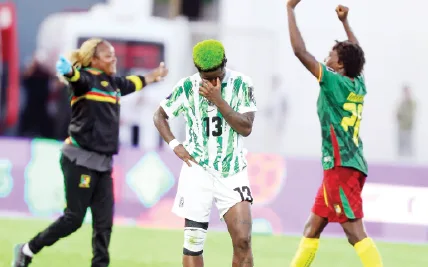
Nigeria’s 10-time African women’s champions crashed out of the 2026 Women’s Africa Cup of Nations at the quarter-final stage on Sunday, beaten 1-0 by Cameroon at the Larbi Zaouli Stadium in Casablanca, a defeat that cost them not only their continental crown but also one of the four automatic tickets to the 2027 FIFA Women’s World Cup in Brazil.
It was Nigeria’s first-ever quarter-final exit at the tournament, and it arrived with an eerie resemblance to the men’s team’s own World Cup nightmare, when the Super Eagles were beaten by DR Congo on penalties in Rabat in the play-off final for the 2026 World Cup, a result later confirmed as final in March 2026 after a Nigeria Football Federation petition over the Congolese squad’s eligibility was rejected by FIFA.
The Falcons, Africa’s most decorated in their respective categories, then found their World Cup destinies hanging on play-off routes that offer no room for error.
Former Super Falcons striker Desire Oparanozie said the defeat left her heartbroken, and admitted her overriding concern was never really about the trophy but about the automatic World Cup ticket that came with it.
“I’m really disappointed and heartbroken. My main priority was the World Cup ticket, and now we have to fight for it through the play-offs,” Oparanozie said.
The 32-year-old stressed that Nigeria have appeared at every edition of the Women’s World Cup since the tournament began in 1991, and that missing out on Brazil 2027 would represent an unprecedented setback for a team that has never before needed the play-off route to reach football’s biggest stage.
She urged the squad to move on quickly and focus on what remains within reach, saying, “It is painful, but we have to move on. The World Cup is still within reach, and everyone has to give everything to make sure Nigeria qualifies.”
The parallel between the two national teams is, in truth, uncomfortably exact.
The Super Eagles missed the 2022 World Cup in Qatar on away goals against Ghana, then failed again for 2026 after losing to DR Congo on penalties in Rabat in November 2025, a defeat that marked the first time in the country’s history that Nigeria would miss back-to-back World Cups.
The Super Falcons now walk a version of the same road, having missed the direct route and been pushed into a play-off against South Africa’s Banyana Banyana and a potential FIFA Women’s World Cup Play-Off Tournament, where three further tickets to Brazil 2027 remain available through the inter-confederation route.
Not everyone in Nigerian sport was willing to treat the defeat as simply one of those things football occasionally produces. Olympic gold medallist Chioma Ajunwa placed the blame squarely on the structures around the team rather than on the players themselves.
“It is getting more competitive, truly, but we cannot kill ourselves. Our country is not doing things right, so what does one expect? By right, with what is happening in Nigeria and in that administrative system, these girls have the heart of lions,” Ajunwa told The PUNCH.
She insisted the squad deserved credit rather than criticism given the circumstances they operate under, saying, “For all that is going on, and seeing how far they went, I praise them. In a country where they are not taking things seriously, this is what will happen. I do not blame them because many of them cannot play with full focus because of all these distractions.”
Ajunwa was particularly scathing about the federation’s scheduling, arguing that Nigerians expect victories without appreciating what genuinely goes into producing them. “It is just that Nigerians want wins all the time, but we do not know what it takes to get these wins. We cannot say because of all the rewards, they will do like last time. The necessary things still have to be done at the right time, and the administration has not, just like the late friendlies, which was what led to this result and this tough position,” she told our correspondent.
Ex-Falcons Patience Avre was equally emphatic in placing the loss to Cameroon at the door of inadequate preparation, telling The PUNCH that the absence of meaningful friendly matches in the buildup directly cost Nigeria their automatic World Cup ticket.
Speaking on Thursday to reaffirm her position after the quarter-final exit, Avre said the federation’s failure to organise sufficient warm-up fixtures left the Super Falcons short of the match sharpness they needed against a well-drilled Cameroonian side.
“The lack of friendlies is what caught up with them in Casablanca. You cannot prepare a title defence with only a handful of matches in the build-up and expect the sharpness to be there when it matters most,” Avre told The PUNCH.
“As Africa’s most successful women’s national team, the Super Falcons have a strong track record, but sharpness is not built in camp alone. That drop in intensity when it mattered against Cameroon traces directly back to how little football this team played together beforehand, but we wish them luck for the play-offs.”
Super Falcons midfielder Christy Ucheibe offered a contrite response, apologising to Nigerians and insisting there could be no excuses for the team’s failure to secure direct qualification.
“We gave everything we had, but unfortunately, it was not enough. There is no excuse. We are very disappointed because we wanted to go further and qualify automatically for the World Cup,” she said.
“We are sorry to Nigerians that we could not advance in the competition. We know how much the country expects from us, and we feel that disappointment as well.”
Goalkeeper Chiamaka Nnadozie echoed the mood in the camp, admitting the team gave everything but simply missed too many of the chances created.
“It was a very difficult game. We played our hearts out, we gave everything, but it was not enough to get the victory today. We missed a lot of chances,” Nnadozie said.
“Everyone is not happy with the performance. We have spoken to ourselves, and I believe that we will go back to the drawing board. We are trying to get it right.”
The Nigeria Football Federation moved swiftly to address the setback, with its president, Alhaji Musa Gusau, issuing a formal apology on behalf of the federation, the Super Falcons and the entire Nigerian football family, extending particular regret to President Bola Ahmed Tinubu for the federation’s failure to repay the confidence and investment the administration had shown the women’s game.
The federation acknowledged that a window of opportunity remained through the CAF play-off pathway and pledged an honest assessment of preparation, technical planning, logistics and overall operations before the Super Falcons’ next assignment.
Head coach Justin Madugu, who guided Nigeria to a historic 10th continental title in Morocco in 2024, drew a direct line between the Super Falcons’ predicament and the men’s team’s own World Cup disappointment, telling reporters the comparison weighed heavily on his players.
“We have a second chance, and we will give it our all. We do not want to disappoint and go the same way as the men. We will do our best to make sure we go through the play-offs,” he said.
Oshoala, one of the most decorated players in African football history, was similarly direct about the significance of the Super Eagles’ shadow hanging over the squad. “We already know the Super Eagles did not qualify, so we know what is at stake, and we know how Nigerians feel about this. We are sorry we lost this one, but the next game we will put in more effort and try to win the game,” she said, before issuing a broader warning about the changing landscape of African women’s football.
“Smaller nations are closing the gap for sure, but it is also a wake-up call for us to put in effort knowing that there are other people who actually want to win this trophy. So we have to work harder now.”
NFF general secretary Dr Mohammed Sanusi took a more philosophical view of the defeat, acknowledging that Nigerians were unhappy but arguing that the Super Falcons’ reputation as ten-time champions means every opponent now treats matches against them as cup finals.
“No Nigerian is happy about Nigeria leaving the WAFCON, but you know that any team coming to play against the Nigerian team, 10-time champions, will play as if they are playing in the World Cup final,” Sanusi said.
“We can all see that the girls have given all their best; they played very well, but the goal did not come,” he said, adding that attention must now turn fully towards the play-off.
“We have to look forward to the play-offs and make sure that we qualify for the World Cup.”
What both institutions now share is not simply misfortune but a widening gap between where Nigerian football believes it stands and where results say it actually stands.
The Super Eagles’ collapse against DR Congo ended a run stretching back to 1994 without back-to-back World Cup absences, while the Super Falcons’ exit in Casablanca has, for the first time in the tournament’s history, denied Nigeria a direct route to the global stage they have never previously had to fight for through a play-off.
Two teams built on the same continental dominance, undone in strikingly similar fashion within the same football year, and one of them now faces knockout fixtures they cannot afford to lose.
The Super Falcons face South Africa on Thursday knowing that the record of nine consecutive World Cup appearances, and the wider standing of Nigerian football itself, rests on getting the result the Super Eagles could not.
Peter, who has been covering sports for PUNCH for close to two years, focuses on combat sports reporting, special features and human angle stories
All rights reserved. This material, and other digital content on this website, may not be reproduced, published, broadcast, rewritten or redistributed in whole or in part without prior express written permission from PUNCH.
Contact: [email protected]