


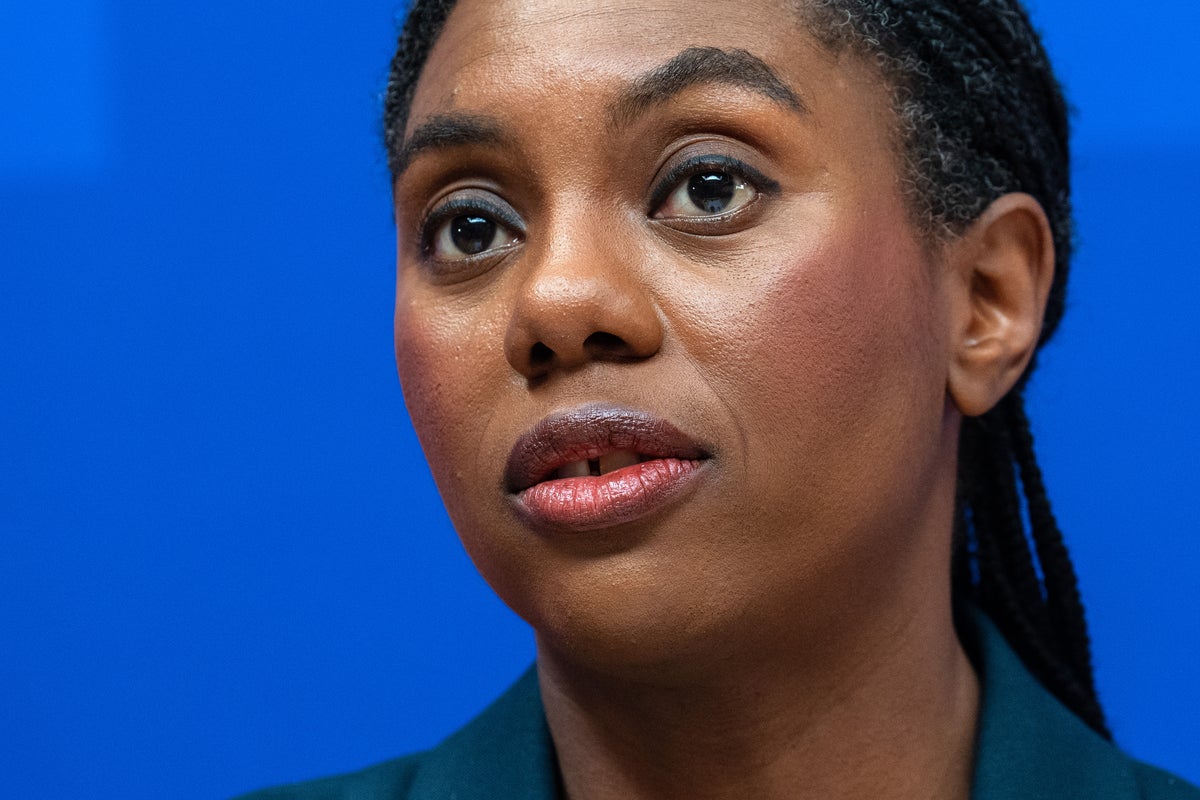
Kemi Badenoch has not yet got the measure of Andy Burnham. She senses weakness on the issues of defence and welfare spending, which is why she delivered a speech today to set out her party’s plan to spend more on defence, paid for by cuts to welfare. But she has not yet made a successful case against the new prime minister.
She is right that Mr Burnham’s policies are not as well defined as they should be. But in their first head-to-head clashes in the House of Commons this week, there was more common ground between them than she admitted.
Mr Burnham agreed that Britain needs to spend more on defence – and quite reasonably pointed out that the last Conservative government, of which Ms Badenoch was a member, had let our armed forces be hollowed out to an unacceptable degree.
Mr Burnham also agreed that we should spend less on welfare, although he phrased it in a more positive way, saying he wanted to give “more support to young people, so that we start investing in their success rather than paying for failure”.
And the prime minister said, “We will stick to the fiscal rules,” so he did not try to escape from being “in hock to the bond markets” – as he once pejoratively described the reality of maintaining sustainable public finances.
At the highest level of spending priorities within the constraints of fiscal responsibility, then, Ms Badenoch and Mr Burnham agree. There remain important differences at the margins, in that the Conservatives want a commitment to spend 3 per cent of national income on defence by 2030. John Healey agreed with that as defence secretary, which is why he resigned in June… but as chancellor he says we must wait until next year to find out if he will agree with himself again.
Mr Burnham muddied the waters at Prime Minister’s Questions by telling Tan Dhesi, the impressive Labour chair of the defence select committee, that he had already “made that commitment” – requiring a spokesperson to “clarify” that he meant a different commitment, to Nato’s 3.5 per cent target by 2035.
However, there remains a broad consensus, encompassing Labour, the Conservatives and Reform UK – but not Diane Abbott, the semi-detached Labour MP, who thinks the Russian threat is a “Nato fiction” – that Britain needs to spend more on defence.
The more difficult part of that consensus is the question of how to pay for it. Hence Ms Badenoch’s speech today, which was backed by a supposedly detailed plan to raise a further £10bn a year from welfare cuts on top of the £23bn a year previously announced.
Given that the £23bn figure was described as “shaky” by the Institute for Government, it is impossible to tell what is genuinely new about the £10bn. All that can be said is that £33bn a year is implausible and would probably involve more hardship for vulnerable people than the cruellest measures of the last Tory government.
If the Conservative figures are shaky, however, Reform UK’s plans, launched at the start of its annual conference in Birmingham by Robert Jenrick, who hopes to be chancellor in a Nigel Farage government, are simply moonshine. Mr Jenrick promises to cut £100bn a year in public spending in a Reform government’s first 100 days. These are Trumpian numbers, made up in some gold-decorated fantasy palace and with no bearing on reality.
Yet Mr Burnham cannot afford to dismiss the strength of public feeling that some welfare spending is unjustified, that the pendulum of tax and spending has swung too far, and that the burden of taxes, especially on wealth-creating and job-creating businesses, cannot be allowed to rise any further. That means that he and Mr Healey will have to come up with a credible plan to restrain the growth of welfare spending at the Budget next month.
If actual spending cuts are too hard – which The Independent does not believe – there are two important areas where the forecast growth of spending can be restrained. One is the disability benefits bill, where Pat McFadden, the work and pensions secretary, and Alan Milburn, his adviser, must succeed in their more compassionate approach where Keir Starmer failed.
The other is the state pension triple lock. The courageous course would be for Mr Burnham to say that it has served its purpose in raising the value of the pension, but that the state pension cannot take an ever-increasing share of national income. Labour’s next manifesto should therefore promise to preserve its value in relation to average disposable incomes.
Ms Badenoch has started to make her case against Mr Burnham by arguing that he is a people-pleaser. Of course, that is what any democratic politician must be, but there are two kinds: those who are weak, who tell people what they want to hear, who tend not to last long; and those who show leadership, telling people what they may initially be reluctant to hear, but what they will recognise is right and necessary.
Mr Burnham has not yet proved that he is the second kind of politician. How he meets the challenge of managing the public finances at the Budget in eight weeks’ time will be the test.