


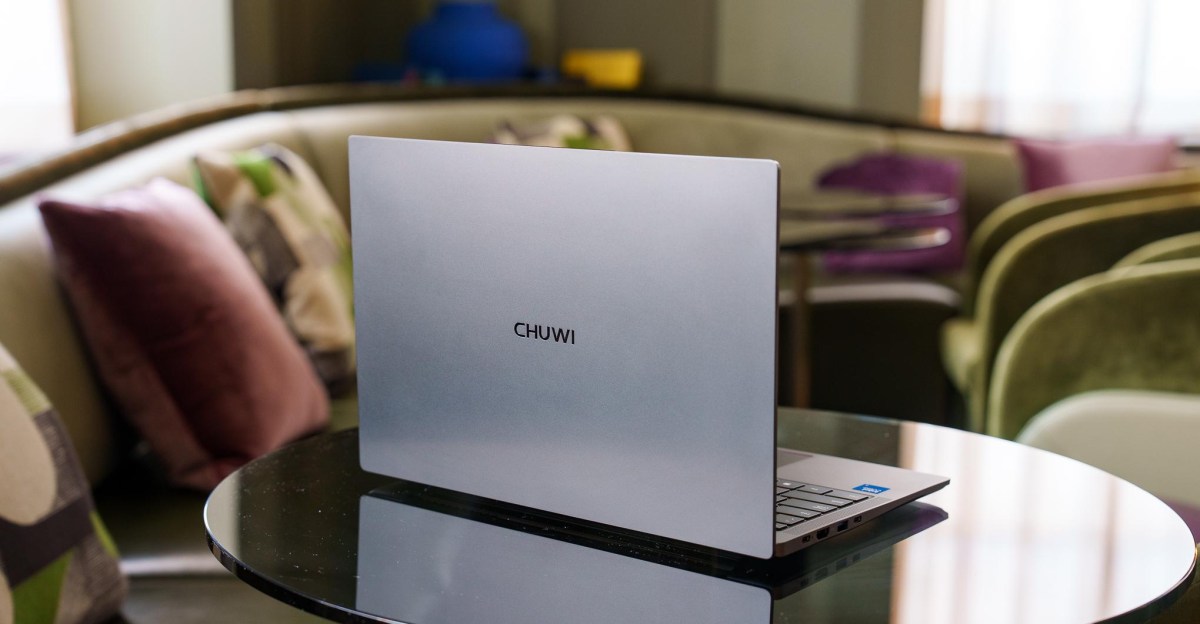
Is this $450 laptop from an unknown brand too good to be true?
The Chuwi Unibook is meant to undercut the MacBook Neo, but you get what you pay for.
If you buy something from a Verge link, Vox Media may earn a commission. See our ethics statement.
by Aug 8, 2026, 12:00 PM UTC
If you buy something from a Verge link, Vox Media may earn a commission. See our ethics statement.


 Antonio G. Di Benedetto is a reviewer covering laptops and the occasional gadget. He spent over 15 years in the photography industry before joining The Verge as a deals writer in 2021.
Finding a good laptop under $500 was hard enough before RAMageddon. They nearly always had cheap hardware and underpowered, often outdated chips. That’s what made the MacBook Neo so disruptive: It offered great build quality and good-enough performance starting at $599. Windows laptops couldn’t touch it. Even though it’s gone up to $699, it’s still the laptop to beat.
So when little-known Chinese brand Chuwi announced a $450 Windows laptop with an aluminum build and a brand-new Intel Wildcat Lake processor, it sounded too good to be true.
It is.


3
Verge Score
Chuwi UniBook
$449$449
The Good
- It’s $450
- Tons of ports for a small laptop (though none are very fast)
- Good battery life
The Bad
- A bad screen and absolutely awful trackpad, speakers, and webcam
- Metal chassis feels cheap, with lots of flex
- Lackluster performance from the Intel chip and limited RAM
- Concerns over long-term customer support
$449 at ChuwiHow we rate and review products
The UniBook comes in one configuration: a 14-inch with an Intel Core 3 304 processor, 8GB of soldered RAM, and a user-swappable 256GB SSD. That’s the lowest-end of Intel’s new Wildcat Lake chips, with just five CPU cores: one performance core, and four low-power efficiency cores. And the integrated graphics? A single GPU core. The MacBook Neo’s A18 Pro is a six-core CPU / five-core GPU ensemble, and it’s a hot rod by comparison.
- Screen: D
- Webcam: D
- Keyboard: C
- Trackpad: F
- Port selection: A
- Speakers: F
- Number of ugly stickers to remove: 1
The UniBook feels sluggish in anything beyond basic web browsing, emails, and messaging. Its benchmark scores confirm how woefully underpowered that chip is. The MacBook Neo trounces it across the board: both single and multicore CPU performance, as well as graphics. Our Adobe Premiere 4K export test took over an hour on the UniBook. (Although at least it didn’t crash out.) I know it isn’t designed for video editing, but neither is the MacBook Neo, and the Neo exports the same video in under 10 minutes. The one edge the UniBook has is a slightly faster SSD.
Chuwi UniBook / Intel Core 3 304 “Wildcat Lake” / 8GB / 256GB
MacBook Neo / Apple A18 Pro / 8GB / 256GB
Microsoft Surface Laptop 13-inch (2026) / Qualcomm Snapdragon X Plus X1P-46-100 / 8GB / 256GB
Acer Aspire 14 AI / Intel Core Ultra 7 256V “Lunar Lake” / 16GB / 1TB
Lenovo IdeaPad Slim 3x / Qualcomm Snapdragon X X1-26-100 / 16GB / 256GB
CPU cores56888GPUIntel Graphics (1 GPU core)A18 Pro (5 GPU cores)Adreno X1-45Intel Arc 140V (8 GPU cores)Adreno X1-26Geekbench 6 CPU Single23853402234827692137Geekbench 6 CPU Multi618785089421109309728Geekbench 6 GPU (OpenCL)6019197989554285569689Premiere 4K Export (lower is better)1 hour, 9 minutes, 29 seconds8 minutes, 30 secondsCrashed7 minutes, 28 seconds12 minutes, 59 secondsSustained SSD reads (MB/s)2394.571735.913804.316391.515738.86Sustained SSD writes (MB/s)2092.661684.053310.945524.222801.02Price as tested$449$699$949.99$1,049.99$749.99
But despite faster storage, the UniBook’s 8GB of RAM is still a hindrance on Windows 11. It didn’t randomly lag like the recent 13-inch Surface Laptop did, but it isn’t hard to overwhelm. As on the 8GB Surface, Windows 11 uses anywhere from 4.6 to over 5GB of memory on the UniBook after a fresh reboot with no additional apps running. Once you open a half dozen Chrome tabs, a couple messaging apps, and a music streaming app, memory usage easily climbs to 7GB.
It’s no surprise Chrome crashed on me a couple times when I pushed it further with over 20 tabs across multiple virtual desktops. This is no problem on Windows laptops with 16GB of RAM, and even the MacBook Neo could handle more before slowing down. And you can count on everything moving like molasses during big file transfers. It couldn’t even load the Start menu or open the calculator app while importing photos into Lightroom Classic until the RAM and SSD bottlenecks eased.

Even if your computing needs are minimal, the Chuwi’s hardware makes every interaction unpleasant. The screen is washed out, covering just 64 percent of the sRGB color space, and at 300 nits it’s pretty dim. But the worst offender is the trackpad. It’s incredibly stiff to click. You have to press it so hard the whole chassis flexes a little under the pressure. You don’t have to click the trackpad; it can detect taps too, but I never like the loosey-goosey feel of tapping — especially when executing right-clicks or click-and-drags. Using this trackpad made me physically and mentally tired. And clicking around on a laptop? Pretty important!
The speakers are an affront to any music you play, as well as anyone else within earshot. They’re a tinny mess. The phone in your pocket has fuller sound. The 720p webcam is only a smidge better, but it’s still offensive to your face (and possibly your self-confidence). It’s almost passable in the best lighting, but it’s low-res, with a green color cast. In dim or backlit lighting you become a dark blur. After a few days, colleagues started greeting me in meetings with, “Oh, you must be on the Chuwi.” It’s like being told “Wow, you look tired.”
“Uhh, yeah. Nice to see you too.”


Amid all these downsides, there are a few bright spots. The UniBook does at least have good battery life. It easily lasts up to 10 hours on battery while doing the lightest of work: writing emails, casually browsing the web, and opening the occasional PDF. And the keyboard isn’t bad. It’s backlit, which is a genuine advantage over the MacBook Neo. It’s fine to type on, but the Neo’s and many other Windows keyboards out there feel less spongy. Also, a lack of function lock means adjusting brightness, volume, or media playback always requires a two-key combo. Not a huge deal, but a strange omission of a usual mainstay.
The one thing about the UniBook that genuinely surprised me, aside from the initial reverse sticker shock, was its amount of ports. This little thing has five total USB ports, HDMI-out, microSD, and even an ethernet jack. You might expect all that on a massive gaming laptop, not a thin-and-light. But sadly, none of the USBs are faster than 5Gbps, and the HDMI is just 1.4b — topping out at a stuttery 30Hz at 4K.
Any money spent on peripherals to offset the Chuwi’s shortcomings would be better spent on a different laptop. I’ve started testing a $500-ish HP OmniBook 3, and coming from the Chuwi, it was a huge relief. Even its cheap-as-they-get Snapdragon X chip offers eight cores, buoyed by twice the RAM and storage of the Chuwi, and that processor already proved it had exceptional battery life when I reviewed it in the Lenovo IdeaPad Slim 3x.


 PreviousNext
1/3
I wasn’t overly impressed with the Acer Aspire 14 AI, which you can often get around $600, when I pitted it and the IdeaPad against the MacBook Neo, but it’s way better than the Chuwi for $155 more. Its Intel Lunar Lake chip gets good battery life and is powerful enough to play indie games and last-gen 3D titles on ultra-low settings. It has twice the RAM and storage as the Chuwi and nearly as many ports, and the Acer’s ports are much faster.
I take no joy in telling you the Chuwi UniBook is bad and frustrating to use. I want to see decent cheap laptops, and I’m all for them coming from lesser-known brands. But Chuwi’s upstart status also brings long-term customer support into question — it doesn’t seem to have US customer service and repair centers like bigger laptop makers. And in early 2026, the company was found to have shipped laptops and mini PCs with older AMD chips disguised as newer, faster ones (even at the BIOS level). Chuwi eventually put out a statement blaming a “production error” and offered refunds for a limited time, but the situation does not inspire confidence.

The UniBook doesn’t leave a great first impression, but I want to remain hopeful that better things are on the horizon — if not for Chuwi, then at least for the Wildcat Lake processor family. Most of the major laptop makers are launching budget laptops with higher-end Wildcat Lake chips to try to compete with the Neo. Microsoft also claims it’s working on improving Windows 11’s performance with 8GB of RAM — which these new laptops desperately need.
With laptop prices skyrocketing due to the RAM and storage crunch, we could all use a win. But the UniBook isn’t it.
- Display: 14-inch 1920 x 1200 60Hz IPS LCD, 300 nits, anti-glare
- CPU: Intel Core 3 304 (Wildcat Lake, 5 cores)
- GPU: Integrated Intel Graphics
- RAM: 8GB LPDDR5 (soldered)
- Storage: 256GB M.2 2280 (user-accessible)
- Webcam: 720p with physical privacy shutter
- Connectivity: Wi-Fi 6, Bluetooth 5.2
- Ports: 2x USB-C 3.2 Gen 1 (5Gbps), 2x USB-A 3.2 Gen 1 (5Gbps), 1x USB-A 2.0 (480Mbps), HDMI 1.4b, RJ-45 gigabit ethernet, microSD card slot, 3.5mm audio jack
- Biometrics: none (lockscreen password only)
- Weight: 2.66 pounds / 1.2kg
- Dimensions: 12.38 x 8.7 x 0.65 inches / 314.5 x 221 x 16.4mm
- Battery: 53.38Wh (65W USB-C charger included)
- Price: $449
Photography by Antonio G. Di Benedetto / The Verge
Follow topics and authors from this story to see more like this in your personalized homepage feed and to receive email updates.