


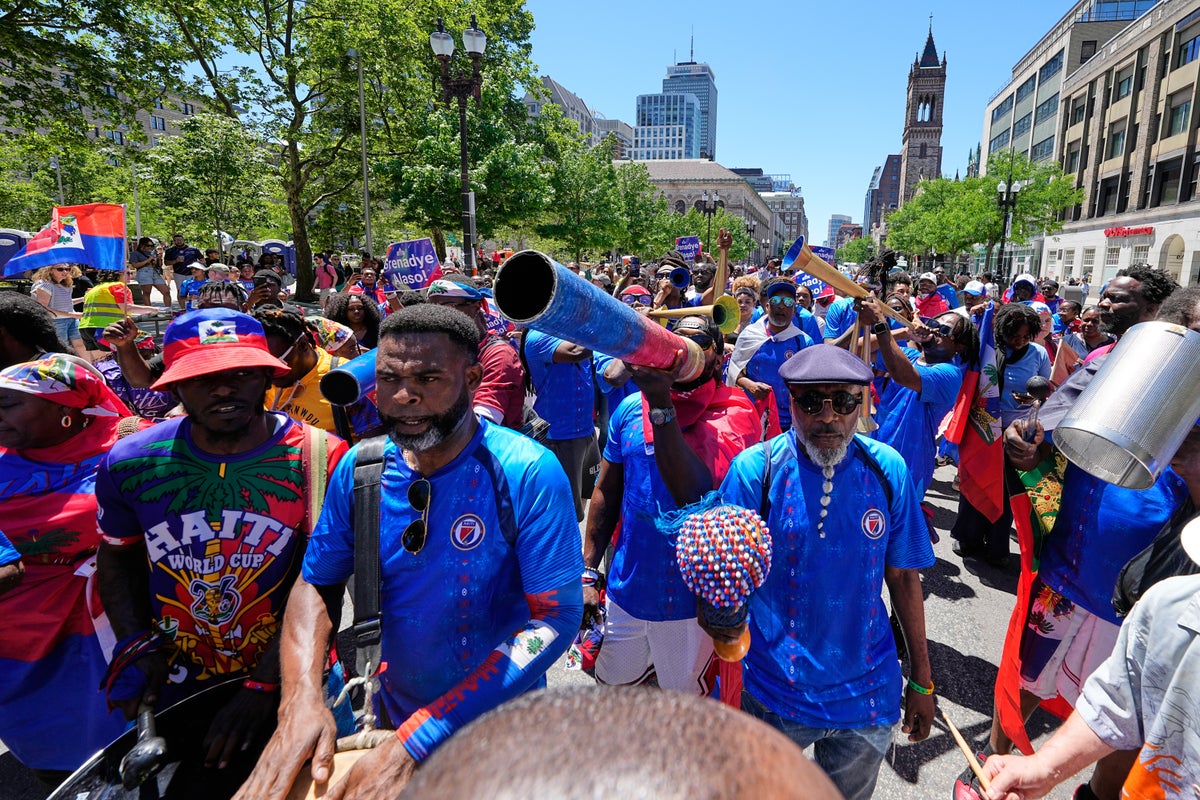
For Boston council member Ruthzee Louijeune, Haiti’s return to the World Cup is a continuation of what’s been a two-month celebration in the city for the Caribbean nation.
Yes, Haiti’s group match against Scotland on Saturday marked its second-ever appearance in the sport’s biggest tournament more than a half-century after its first one in 1974. But it also represented the latest bonding moment for Boston’s Haitian community in light of the ongoing ban on the country’s citizens entering the U.S. and the pending Supreme Court case centered on the American government’s attempt to end the temporary protection status for those that arrived here following 2010 earthquake. A decision in the case is expected soon.
“This moment holds incredible weight, incredible history and incredible pride for the Haitian diaspora,” Louijeune, Boston’s first Haitian-American councilor and former council president, said in an interview with The Associated Press.
According to the U.S. Census Bureau, about 4% of Boston’s approximately 670,000 citizens are Haitians. That gives Massachusetts’ largest city the second largest per capita Haitian population in the country. About 45,000 of Massachusetts’ residents are here under temporary protective status — the third-largest Haitian group in the country.
Political strife in Haiti also affected the national soccer squad’s road to make the 48-team tournament.
For the first time in 52 years, Haiti played none of its qualifying matches on its home soil because of internal political instability. It won its final World Cup qualifying match 2-0 against Nicaragua on Nov. 18. That date coincided with the anniversary of Haiti’s victory over France in the final battle of the Haitian Revolution in 1803.
“It is a story of tremendous depth for the Haitian community, and we’re so proud that they’re playing their first match here in Boston,” Louijeune said.
The team’s opening match in Foxborough also falls just weeks after last month’s 24 Haitian Unity Parade was held in Boston’s Mattapan neighborhood.
Louijeune helped organize a group of about 300 Haitian fans who gathered Saturday morning for a march from Boston’s famed Copley Square to Boston Common.
“In difficult moments, we have a president who has been attacking the Haitian community during (President Donald) Trump 1.0 and now 2.0, where temporary protected status is under attack, a legal status for so many of our Haitian residents,” Louijeune said. “So we are under a lot of pressure, a lot of stress, a lot of heartache. But one thing that, you know, Haitian Flag Day and the Haitian story is important to remember is … Haiti has always punched above its weight. Even these moments of extreme, extreme difficulty, we believe that a better Haiti is possible because of what our ancestors have shown us.”
That spirit and pride was on display in and outside Gillette Stadium prior to the match against Scotland with fans draped in the team’s blue, red and white.
“That was a dream come true,” said Serge Duffaut, who is from Haiti but now lives in Boston and was wearing a blue team jersey and holding a Haitian flag.
Words escaped 48-year-old Fredo Ozil, who was born in Haiti but now lives in in Avon, Massachusetts.
“I can’t even tell, I can’t even express myself,” he said. “It’s the best thing that happened ever.”
Ozil said the uncertainty for some his fellow Haitians hasn’t diminished his excitement to watch them compete on the world stage.
“It’s always the same. Nothing changes for Haitian people. It is what it is,” Ozil said. “Only God can do something for us.”
And should he witness Haiti earn its first-ever World Cup point with a draw or a victory?
“It would be the maximum,” Ozil said. “That’s the best we can get. No matter what happens, it’s going to be a fun day.”
___
AP freelance writer Ken Powtak contributed to this report.
___
AP World Cup: https://apnews.com/hub/fifa-world-cup