


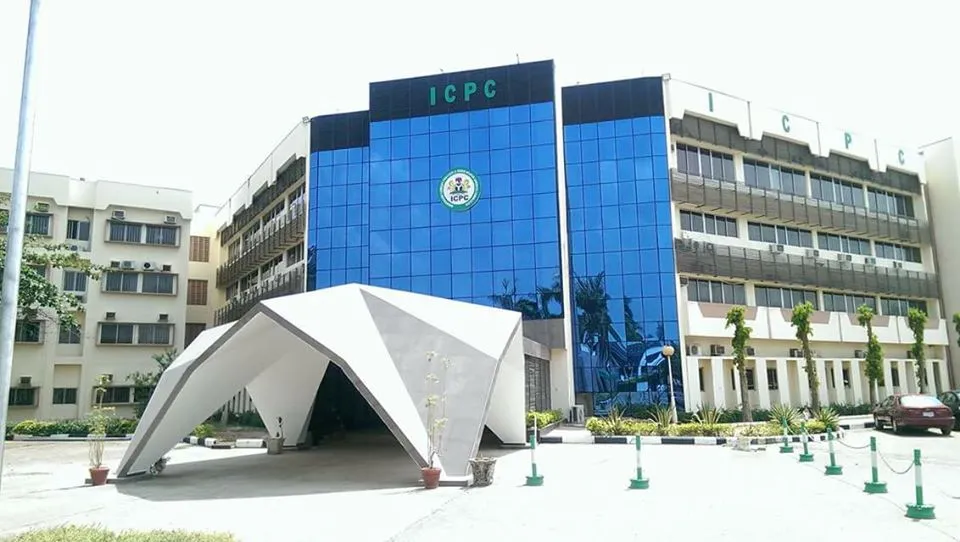
ICPC says no petition on Borno’s N4bn rail controversy
June 25, 2026 12:00 am
By Isah Ojo
The Independent Corrupt Practices and Other Related Offences Commission has said it has yet to receive any official petition or directive to investigate the controversial inclusion of a non-existent N4bn railway project in the Borno State Government’s 2025 budget implementation report, despite mounting calls from opposition parties and residents for a probe.
The commission’s reaction comes days after the Borno State Government admitted that the railway project, listed as 100 per cent completed in the report, was included due to an administrative error.
Speaking with journalists in Maiduguri on Wednesday, the ICPC Resident Anti-Corruption Commissioner overseeing Borno and Yobe states, Linus Gubbi, said the agency had not been formally notified of the matter.
“No official report has come to us,” Gubbi said, adding that he had also not received any directive from the commission’s headquarters to comment or take action.
“I have not received any directive from the headquarters to speak on this subject for now,” he stated.
The controversy followed a June 15 report by civic accountability organisation, Tracka, which questioned the state’s claim that N2bn was spent on rail construction projects in Maiduguri Metropolitan Council and another N2bn in Jere Local Government Area in its 2025 budget implementation report.
Responding to the concerns on Monday, the Borno State Government acknowledged that the rail project entry was erroneous.
In a statement, the Commissioner for Information and Internal Security, Usman Tar, said an internal review involving the Ministries of Budget and Transport and Energy, as well as other relevant agencies, confirmed that no railway project was awarded, funded or executed during the 2025 fiscal year in the affected local government areas.
“The inclusion of the rail project entry in the 2025 Budget Implementation Report, indicating 100 per cent completion, was an administrative error and does not reflect the true position of the matter as the said project was neither executed nor paid for,” the statement read.
The explanation, however, failed to quell public concerns, with opposition parties and residents demanding an independent investigation into the incident.
The Publicity Secretary of the Nigeria Democratic Congress in the state, Aliyu Balarabe, questioned how a project valued at N4bn could mistakenly appear in an official budget implementation report.
“We see it as a lack of accountability and transparency in governance. There is no way that something as serious as a state budget will have such errors. We are not talking about millions but billions of naira. If it is an error, where then are the funds?” he asked.
Balarabe urged both the ICPC and the Economic and Financial Crimes Commission to conduct what he described as a fair and unbiased investigation.
“This just goes to show that the state government may have been doing something like this for a while, but this time it was exposed. We call on the EFCC and ICPC to fear God and investigate this issue without bias,” he said.
Similarly, the spokesperson for the African Democratic Congress in the state, Baba Ahmed Mustapha, described the government’s explanation as unfortunate and insisted that the matter should not be allowed to fade away.
“It is public money, not private money. There should be an investigation, and those responsible must account for it,” he said.
Some residents also expressed scepticism over the government’s claim of an administrative error, arguing that the revelation casts doubt on the credibility of the entire budget implementation report.
A resident of Maiduguri, Hassan Aminu, called for a comprehensive review of the state’s expenditure figures.
“If the government admits that the N4bn railway project was included in error, how do we trust the total expenditure contained in the report when it was calculated using an erroneous figure?” he asked.
Another resident, who declined to be named, queried what had become of the funds associated with the disputed budget entry, saying, “Something is not adding up.”
The controversy has continued to generate debate over transparency and accountability in public finance management, even as anti-graft authorities say they have yet to receive any formal request to investigate the matter.
All rights reserved. This material, and other digital content on this website, may not be reproduced, published, broadcast, rewritten or redistributed in whole or in part without prior express written permission from PUNCH.
Contact: [email protected]