


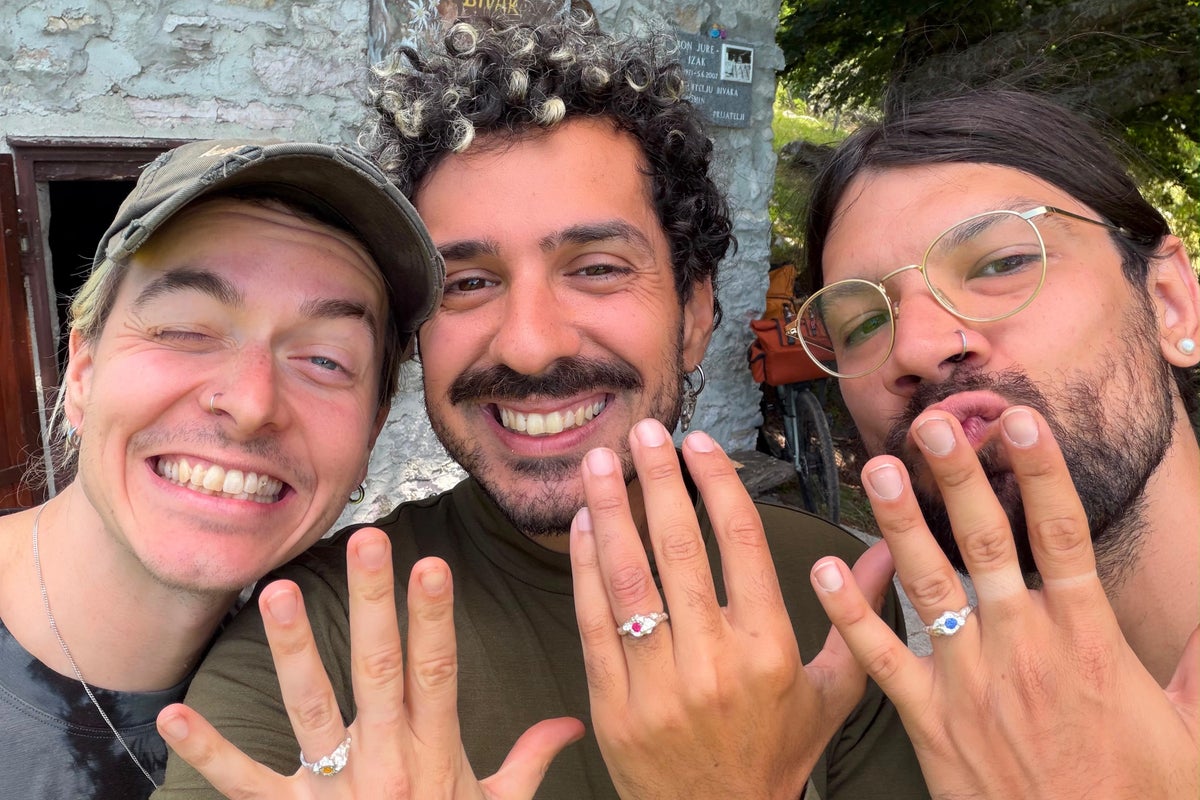
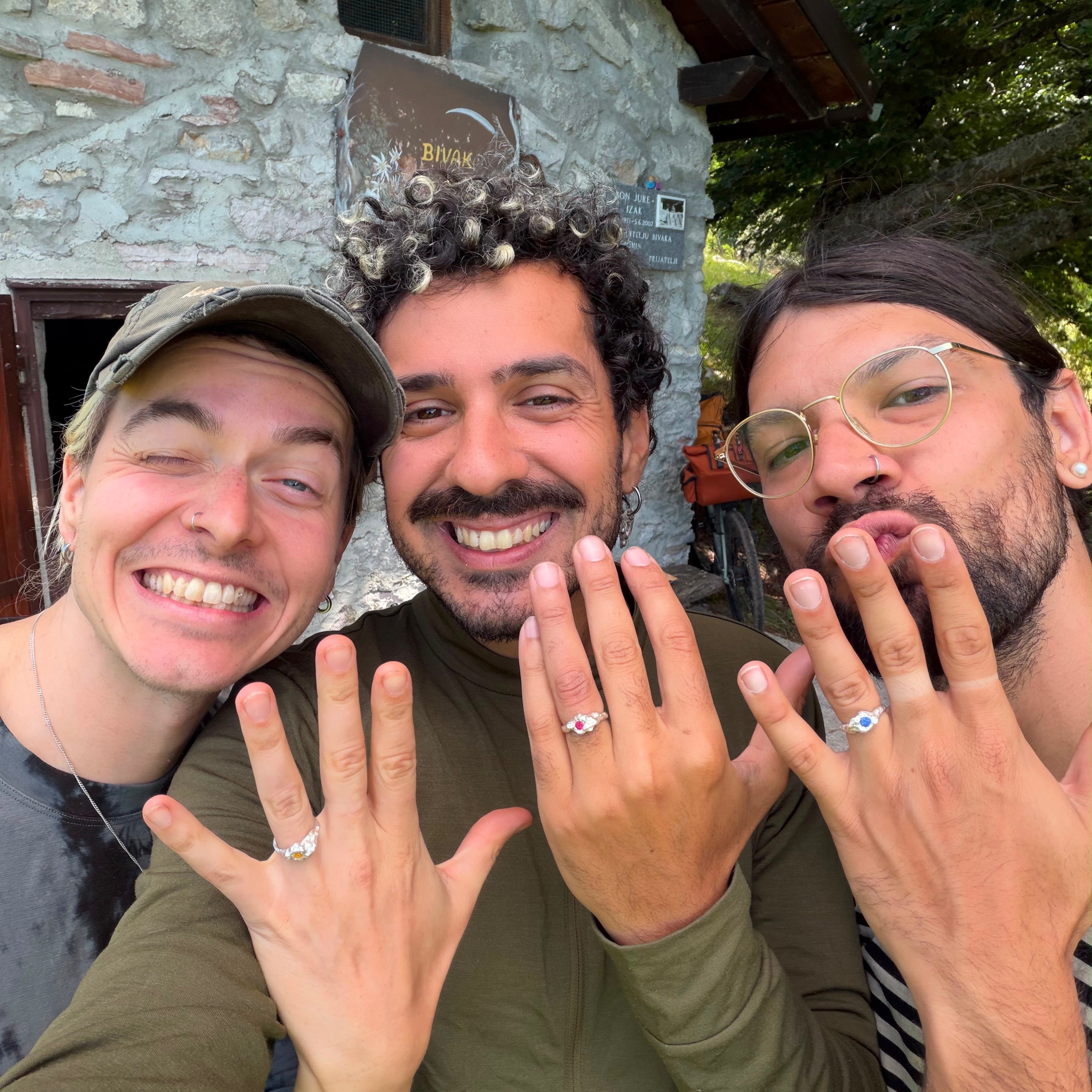
On a picturesque hillside in Slovenia, 32-year-old Karam Nwilati is preparing for the ultimate declaration of love. Nervously, he gets down on one knee and opens an engagement ring box. Inside are three rings.
Nwilati is not proposing to one person, but two: his best friends and platonic life partners, Kristian Naydenov, 29, and Santeri Lehtonen, 36. There’s one ring for each of them.
For Naydenov and Lehtonen, the answer was always going to be yes. The three of them have lived together in Berlin since the Covid-19 lockdown, and they have spent the past four-and-a-half years building a community that exists outside conventional relationship ideals. Their “friendship wedding,” a non-legally binding ceremony celebrating their commitment to each other, is planned for October, when they’ll gather their closest friends on the roof of their Berlin apartment.
Nwilati, a content creator, shared a video of the engagement online, which has now received more than 480,000 likes. The reactions have been mixed – the more negative ones ranging from judgmental to hateful – while others have hailed their unconventional relationship as an antidote to the so-called male loneliness epidemic, marked by a rise in social isolation, shrinking friendship circles, and a lack of emotional support among men.
To Nwilati, Naydenov and Lehtonen, friendships are often treated too casually for the depth they can hold. “We don’t celebrate friendships enough,” says Nwilati. “If there’s a friendship breakup, people just kind of fade away without saying anything. It’s not like a romantic breakup where you actually have to go through the process of doing.”
 open image in gallery
Women are more likely to celebrate their female friendships publicly – that was the moral of Sex and the City, anyway – yet we rarely see men expressing that same affection so openly. “There’s a lot of masculine posturing involved,” says Lehtonen, a sustainability consultant and activist, as he looks back at his male friendships over the years. “There was a lot of ‘Who’s the man’ and basic male behaviors that didn’t always feel awesome.”
For Lehtonen, the engagement symbolizes a promise and accountability in their friendship, which has become his central support system since they started living together. “I feel like I could call them on the rainiest day on the planet, and even if they’re 20 kilometers away, they would be there to help me with something heavy or to be a shoulder to cry on.”
Often, cohabiting with your friends in your twenties and thirties is considered a waiting room until you find a serious romantic partner to settle down with. It’s not something you typically invest in. In his proposal, Nwilati thanked his friends for being his safe space and home. “I love you…We’re such a beautiful unit. We’re building such an intentional life together,” he said.
It’s a far cry from conventional masculine friendships, where fist bumps are generally preferred to hugs. When men do connect, it is often through group activities rather than one-on-one relationships, according to the American Institute for Boys and Men, which makes it harder to have meaningful, deep conversations.
 open image in gallery
 open image in gallery
“I’ve just seen the alternative [types of friendships], and I think, ‘No thank you,’” says Nwilati. “It comes down to the emotional intimacy that we have with each other. Once you see it and once you experience it, like, there is no other option.”
Lehtonen is the only person out of the trio who is in a romantic relationship. Their friendship is strictly platonic (Lehtonen identifies as bi-curious while the other two are heterosexual), but both Nwilati and Naydenov say that their support system makes single life easier. It also helps them reframe their priorities when they’re dating.
“In society, a romantic partner is painted as someone who should be your best friend and your therapist, and everything in between,” says Nwilati. “And so having these relationships takes off a lot of pressure and creates a healthier base to stand on because I’m not looking for someone to fill a hole – you can meet them for who they are and build on that.” He acknowledges, of course, that there are some things the friendship doesn’t fulfill, such as sexual intimacy, “which obviously we’re not exploring in these relationships.”
The unconventional nature of their public declaration of love has not gone unnoticed. Naydenov said his family members have been understanding and supportive, but some will struggle to comprehend it. His mother, he says, understandably had lots of questions. “She was definitely questioning it because she’s, like, ‘So, what kind of obligations are you now tied to? What kind of promise do you have to make to each other, like with the traditional sense of the word, ‘marriage?’ I said, well, we’re celebrating five years of friendship and celebrating that we’re living in this house together.” Lehtonen said he was apprehensive about telling his parents, but they took it surprisingly well; Nwilati hasn’t told his.
 open image in gallery
 open image in gallery
It was a friendship proposal, but the gravity of the moment was still real. “I was super shocked when it happened,” says Naydenov. “It feels like your reality is breaking apart. It feels like something you should only have with a very specific person in your life. It reminded me that I’m living such an unconventional life.”
The long-term goal is for the trio to move to a remote home in the countryside and build a community there. “We would love to eventually live as a six: our romantic partners and us,” says Lehtonen. “In my dream situation, we each have romantic partners. It’s a both/and situation.”
For the upcoming wedding, which they’re currently in the process of planning, they plan to incorporate elements from Arab, Greek and Finnish ceremonies as a homage to their respective heritages. Ultimately, they want to pull from traditional tropes to mark the significance of the occasion.
“I like the idea of keeping some of the traditional ceremony things that you get in weddings in this, just as commentary to be like…. romantic relationships have this…why not also friendship weddings?” says Nwilati. “We twist it and make it our own thing.”
“Maybe we all wear veils?” he asks his friend-fiancées. They all laugh.
“And you can reach back out to us after the divorce.”