


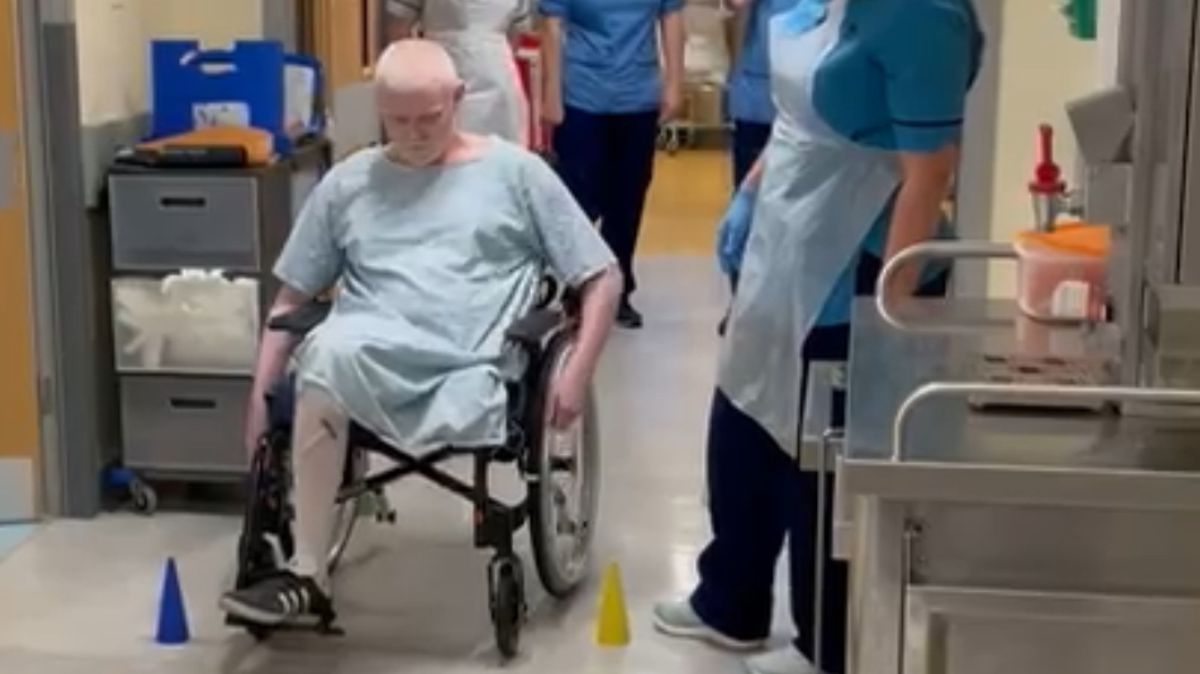
A man who lost his leg to a rare cancer has told how he would be dead if he hadn’t sought private healthcare.
Andrew Scott once led a healthy lifestyle, competing in ultramarathons and playing football every week. However, just one month after getting married, he was diagnosed with one of the rarest forms of sarcoma cancer at the age of 29.
In late 2023, the maths teacher, from Falkirk, noticed a pain in his hip after playing football and visited a physio for a few months but the pain did not go away. An X-ray was inconclusive but the pain was getting worse leaving Andrew struggling to walk in and out of his workplace.
His GP told him he was not a priority for scans because of his relatively young age. Theories as to what was wrong with him included muscular problems and sciatica.
 View 4 Images
Andrew and Lindsay on their wedding day(Image: Sarcoma)
He said: “I knew something was wrong with my hip. Every time I saw a doctor I was given a different painkiller, but nobody was getting to the bottom of what it was.”
Fed up of the delays, Andrew made an appointment with a private orthopaedic surgeon who referred him for a scan. It was then that a tumour was found in his left hip.
“If I had not paid for that appointment, the tumour would have been out of control and I could be dead now,” he said.
A biopsy followed and Andrew was given the shocking news he had a sarcoma cancer in August 2024 – this was just a month after he had got married to Lindsay. Andrew’s subtype was so rare that it was not catalogued but treated as an osteosarcoma.
 View 4 Images
Andrew on the Rare But Real Walk(Image: Sarcoma)
He received chemotherapy starting in October 2024. It was the following March that Andrew was dealt another blow – he was told his left leg would need to be amputated after the tumour had started to grow into his spine.
“I couldn’t believe it at first,” he said.
Andrew’s surgery lasted an incredible 23 hours and he needed to spend a couple of months in hospital to recover as he was so weak. He was only really pain-free in October last year.
He was helped to deal with the emotional trauma of losing a limb when he was put in touch with a patient who had similar surgery and had since become a parent.
Speaking after receiving care from the Beatson West of Scotland Cancer Centre, Andrew said: “He had still managed to live a full life, and I tried to take a positive attitude.”
Andrew was given a prosthetic limb but said he finds it easier to move around on crutches. He is now preparing to return to teaching at the start of the next academic year.
Andrew says Lindsay and the rest of his family were very supportive. Originally from Antrim in Northern Ireland, he has also been able to visit relatives.
He has been supporting the work of charity Sarcoma UK. In June, he took part in a Rare But Real fundraising walk at Bellahouston Park in Glasgow and completed a 10km course with a group of ten friends while on crutches and raised more than £4,000 for Sarcoma UK.
 View 4 Images
Andrew with friends on the charity walk(Image: Sarcoma)
Sarcoma UK’s Director of Fundraising and Communications, Kerry Reeves-Kneip, said: “As we mark Sarcoma Awareness Month, Andrew’s story reminds us of the very best of the human spirit and of why awareness of this disease matters so much. He ran ultramarathons.
“He is now preparing to return to teaching on crutches having lost his leg to a cancer that is notoriously difficult to identify because its symptoms so often resemble far more common conditions. That he has got to this point at all is a testament to his courage and determination and we are immensely proud of everything he has done to support Sarcoma UK, including raising over £4,000 at our Rare But Real Walk in Glasgow.
“His experience underlines why we continue to call for greater awareness of sarcoma among clinicians – the earlier this disease is caught, the better the outcome. We encourage health professionals to keep sarcoma in mind when a patient presents with persistent, worsening pain that isn’t responding to treatment.
“Andrew wants his story to make a difference. So do we.”
Article continues below
Get more Daily Record exclusives by signing up for free to Google’s preferred sources. Click HERE.