


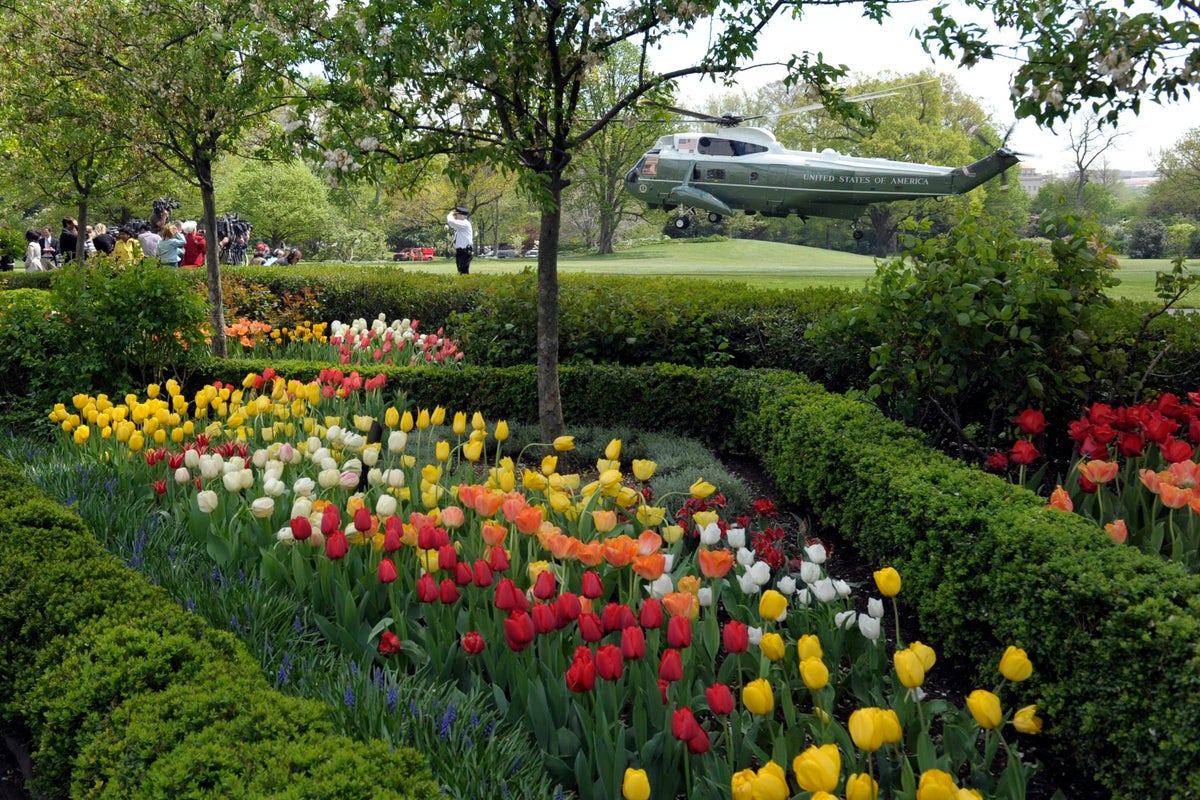
President Donald Trump‘s two makeovers of the White House Rose Garden, including converting its lawn into a patio, have drawn recent attention to one of the nation’s most iconic gardens.
The garden has seen many changes over the years; presidents and first ladies have planted, removed, redesigned and even fully revamped it. Here’s a look at how the Rose Garden and its plantings have evolved.
Ellen Wilson and then Jackie Kennedy make changes
The Rose Garden was established by President Woodrow Wilson’s wife, Ellen Wilson, who worked closely with landscape architect George Burnap, in 1913. It replaced Edith Roosevelt’s Colonial Garden, planted 11 years earlier. Before that, greenhouses occupied the space.
The original Rose Garden remained close to its roots for nearly half a century until 1961, when President John F. Kennedy and first lady Jacqueline Kennedy brought in their friend and Cape Cod, Massachusetts, neighbor, Rachel “Bunny” Mellon, to oversee a redesign.
Mellon, a horticulture expert, worked closely with landscape architect Perry Wheeler and White House Head Gardener Irwin Williams on plans for the new Rose Garden, aiming to create an outdoor room where press conferences, meetings with dignitaries and ceremonies could be held. It was installed the following year.
The space included an expansive central lawn, inspired by the croquet-match passage in Lewis Carroll’s “Alice in Wonderland,” with magnolia trees planted at each corner. Roses, interplanted with culinary herbs, spring-blooming bulbs, seasonal annuals and young Katherine crabapple trees, flanked the lawn in 12-foot-deep borders.
Since then, the space has hosted many historic events and has become known as a place where presidents deliver important speeches to the American people.
The garden evolves with new plants
Mellon’s style favored classic, muted tones, reflected in the roses she selected. But the crabapples turned out to be a misstep. As they matured, they became so large that they shaded the sun-loving roses they were intended to complement.
In 2003, some of those trees were removed to allow sunlight to reach the failing roses. Over the years, various perennials were added and replaced. Dying roses were removed, and the remaining trees continued to grow.
Boxwood shrubs bordering the beds became threatened by boxwood blight disease, and the lawn developed drainage issues that prompted frequent replacements.
The remaining trees’ roots had grown so large that it became difficult to plant annuals in the borders without disturbing them. In addition, as walkway repairs became necessary, portions had been replaced, piecemeal, with various slabs.
A 2020 restoration brings new roses and various upgrades
Then in 2020, first lady Melania Trump commissioned two architectural firms, Perry Guillot, Inc., of Southampton, New York, and Oehme van Sweden & Associates of Washington, D.C., to work with the Committee for the Preservation of the White House and the National Park Service to address those concerns and return the garden to its 1962 aesthetic.
They removed and relocated the remaining crabapple trees, and replaced the dwindling plantings with pastel-colored roses, including the white, tall shrubby “White House Rose,” the cream-colored “JFK Rose,” the white hybrid tea rose “Pope John Paul II,” and the “Peace Rose,” a smaller tea rose with a pale yellow center and light pink edges.
The team also upgraded the garden’s infrastructure, adding electricity for TV appearances and uniform, 36-inch-wide limestone walkways to accommodate wheelchair access and comply with the Americans with Disabilities Act.
The shrubs were replaced with blight-resistant NewGen boxwoods.
Pavers replace the grass
In 2025, President Trump revamped the space again, this time replacing the central lawn with a white limestone patio. He added solar-powered lighting, tables and umbrellas, and bronze statues of George Washington, Benjamin Franklin and Alexander Hamilton.
He has hosted dinners on the patio, and has called the space the Rose Garden Club.
And on the perimeter, the roses continue to bloom.
___
Jessica Damiano writes regular gardening columns for The Associated Press. She publishes the Weekly Dirt Newsletter. Sign up here for weekly gardening tips and advice.
___
For more AP gardening stories, go to https://apnews.com/hub/gardening.