


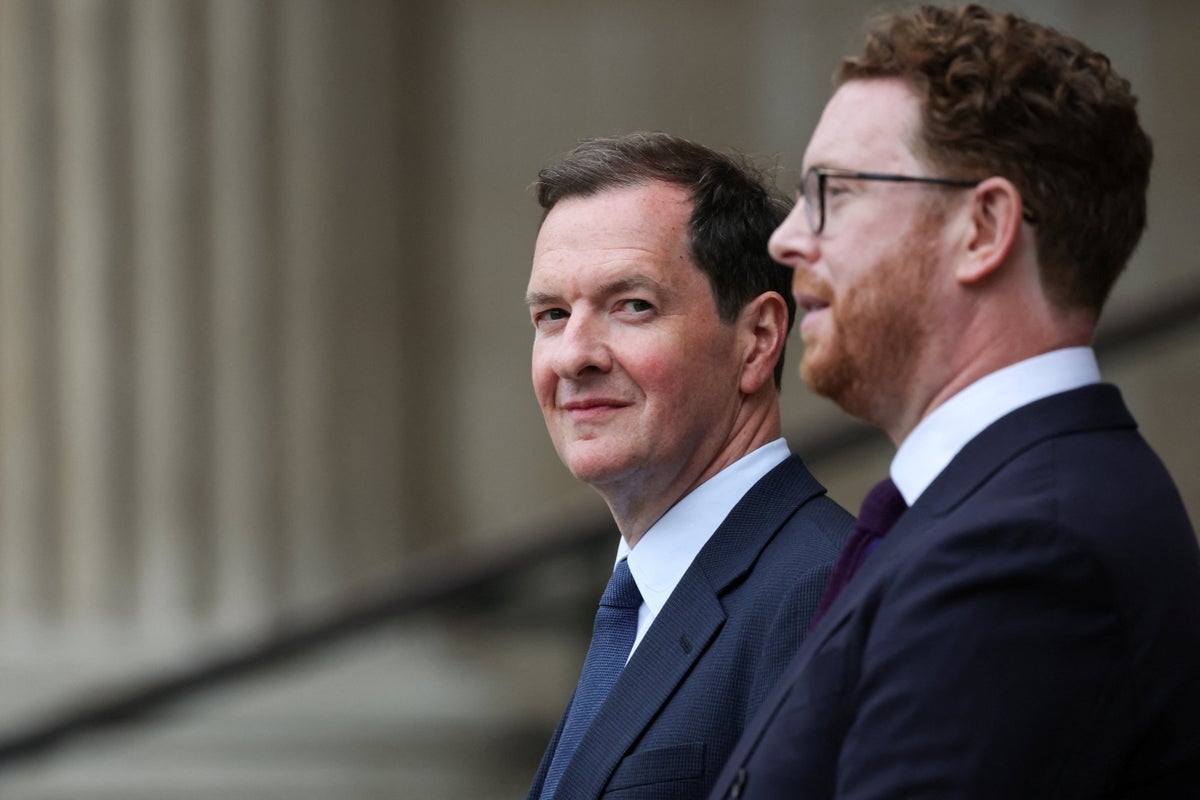
George Osborne suffers from being too clever for his own good, from his superior analysis of the political game to his reputation as the “austerity chancellor” of the first half of the 2010s.
But he is entitled to point out that his partnership with David Cameron in government was a period of relative economic stability that contrasts with the “utter chaos” that followed. And he remains one of the sharpest observers of British politics, even as he devotes himself to the day job of running the British Museum and organising the exhibition in London of the Bayeux Tapestry.
We should listen, therefore, when he supports The Independent’s campaign to move beyond Brexit to rebuild closer ties with the European Union. He is right to repeat what has now become widely accepted: “Brexit has been a mess. Britain has basically gone off a cliff. It has had a huge impact on the British economy. It is clearly poorer than it would otherwise be.”
He is also right to observe that political, business and union leaders are “frightened” to reopen the Brexit controversy. “There’s been a kind of conspiracy of silence about it,” he said, in an exclusive interview with Geordie Greig, editor-in-chief of The Independent.
But, he added, “People now realise you can’t look at Britain’s growth problem without beginning to think, ‘How can we revive trade with the continent, how can we get investment?’”
Rightly, in our view, he wants to push at the softest of Labour’s “red lines” drawn against reversing Brexit. He accepts that rejoining the EU is “hard”, politically, even though that would be most in Britain’s economic interest. He realises that joining the single market, like Norway and Iceland, or large parts of it, like Switzerland, is off the table for the time being because it would mean accepting the free movement of people between Britain and the EU.
But there is one form of economic integration with the EU that would not involve free movement and which would make trade significantly easier. It would therefore have an effect in mitigating the damage done by Brexit to our prosperity. That is a customs union.
“I would rejoin the customs union,” Mr Osborne said. “It’s a quite simple thing to do. That was never part of the Brexit debate. No one knew we were leaving it and it has had a devastating impact on trade.”
It may not be quite as simple as he suggests; Britain could not join “the” EU customs union, as that is an integral part of the single market, but we could negotiate a bespoke customs union that would remove checks on goods flowing between Britain and the EU.
We know that this is possible because such a deal was negotiated by Mr Osborne’s nemesis, Theresa May. Her Brexit deal was essentially a customs union that did not require free movement. It was an excellent deal and many Labour MPs regretted not voting for it and paving the way for Boris Johnson’s harder Brexit.
The argument against a customs union is that it would not allow Britain to negotiate its own trade deals with other countries. “The reason we weren’t supposed to be in the customs union – according to the Brexiteers – was these great trade deals we were going to strike with America,” said Mr Osborne. “That all looks pretty fanciful now.”
He is right again. British trade deals with America, India, South Korea and the Gulf states are together worth a small fraction of the value of a customs deal with the EU.
A customs union is the pinkest of Labour’s red lines. Mr Osborne should be congratulated for breaking the conspiracy of silence about it. Mr Burnham – and indeed any politician who is serious about promoting growth – should listen to him.