


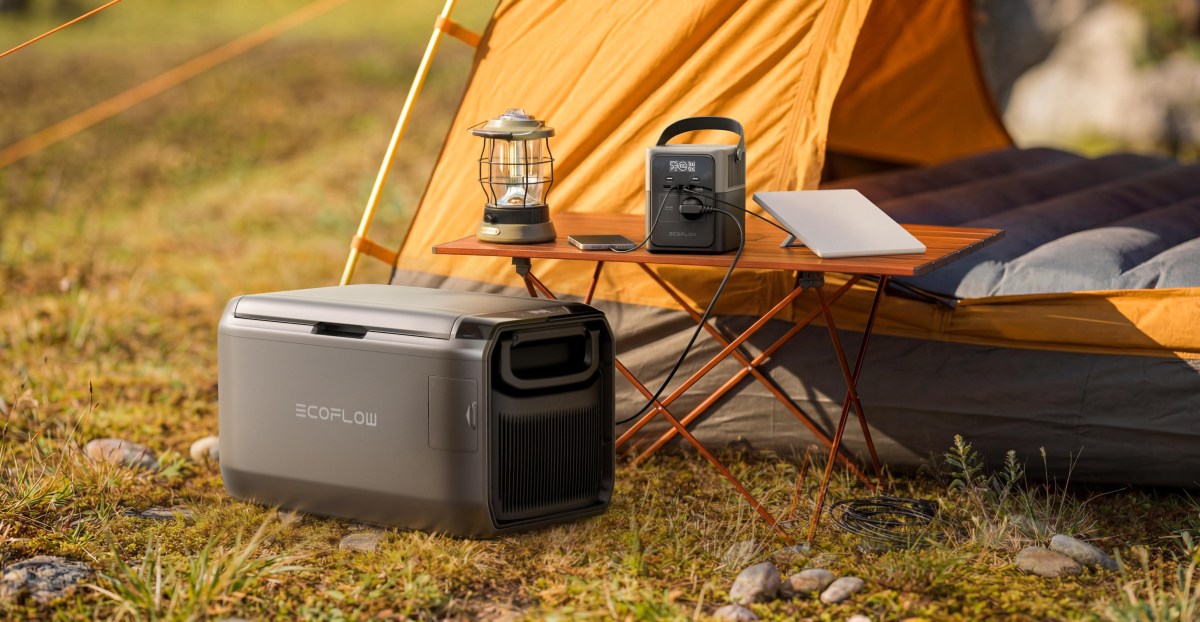
EcoFlow makes the miniature power station even smaller
More energy packed into far less space makes these batteries ideal for day trips or weekend getaways.
More energy packed into far less space makes these batteries ideal for day trips or weekend getaways.
by Sep 7, 2026, 2:59 PM UTC
 Thomas Ricker is a deputy editor and Verge co-founder with a passion for human-centric cities, e-bikes, and life as a digital nomad. He’s been a tech journalist for 20 years.
If you’re in the market for a tiny power station that punches well above its size and weight then have a look at EcoFlow’s new fourth-generation River series.
The River 260 Gen4 features a 256Wh capacity battery while the 520 Gen4 packs in 512Wh — storing about 2.5x and 5x the energy of the largest airline-approved power banks, respectively. Better yet, the batteries are built using longer-lasting LFP chemistry that’s far less volatile. The River 260 Gen4 features four USB ports, and 300W of max continuous output delivered out its lone AC jack. The River 500 Gen4 features the same USB port selection but offers a pair of AC jacks good for 500W of continuous output.
Both of EcoFlow’s Gen4 power stations feature class-leading energy density that cuts both the weight and size, making these power stations lighter and more compact than similarly-specced competition. That makes them ideal for an overnight camping trip or photo shoot in the literal field. The EcoFlow 520 Gen4 is powerful enough to keep a standard US fridge running for about 4 hours during a blackout.


Here’s a quick comparison to show just how much energy these remarkably small power stations are packing, starting with the River 520 Gen4:
Power Station
Capacity (Wh)
Dimensions (W × D × H)
Volume (Liters)
Weight
Volumetric Energy Density (Wh/L)
EcoFlow RIVER 520 Gen4512 Wh13.9 × 17.7 × 22.9 cm5.63 L4.6 kg (10.1 lbs)90.9 Wh/LEcoFlow RIVER 2 Max512 Wh27.0 × 26.0 × 19.6 cm13.76 L6.1 kg (13.4 lbs)37.2 Wh/LAnker 535512 Wh29.2 × 18.8 × 25.1 cm13.78 L7.6 kg (16.8 lbs)37.2 Wh/LBluetti AC50B448 Wh28.0 × 20.0 × 22.0 cm12.32 L6.7 kg (14.8 lbs)36.4 Wh/L
And here’s how the River 260 Gen4 compares to some of the main competition:
Power Station
Capacity (Wh)
Dimensions (W × D × H)
Volume (Liters)
Weight
Volumetric Energy Density (Wh/L)
EcoFlow RIVER 260 Gen4256 Wh13.9 × 17.7 × 17.5 cm4.30 L3.0 kg (6.6 lbs)59.5 Wh/LEcoFlow RIVER 2256 Wh24.5 × 21.4 × 14.2 cm7.44 L3.5 kg (7.7 lbs)34.4 Wh/LAnker Solix C300288 Wh16.4 × 16.1 × 24.0 cm6.34 L4.1 kg (9.1 lbs)45.4 Wh/LBluetti EB3A268.8 Wh25.5 × 18.0 × 18.3 cm8.40 L4.6 kg (10.1 lbs)32.0 Wh/L
Both models can serve as a UPS for your computer, with a cutover time of less than 10ms, and feature one state-of-the-art 140W USB-C PD3.1 port that’s bidirectional. That little trick lets these power stations eschew charging bricks in favor of direct DC charging from a 140W USB-C wall charger you might already own, or a portable USB-C solar panel EcoFlow will happily sell you.
EcoFlow has also addressed a common problem with all power stations that causes them to eventually die if left idling too long. By minimizing the energy spent converting stored DC to AC output, more watt-hours remain to charge your drone, bike computer, and phone, or to power your Starlink Mini and compact fridge.
The River 260 Gen4 will be available in Europe from Q4 2026, while the River 520 Gen4 will follow sometimes in Q1 2027. Pricing for both will be announced as we get closer to their global release dates.
Follow topics and authors from this story to see more like this in your personalized homepage feed and to receive email updates.