


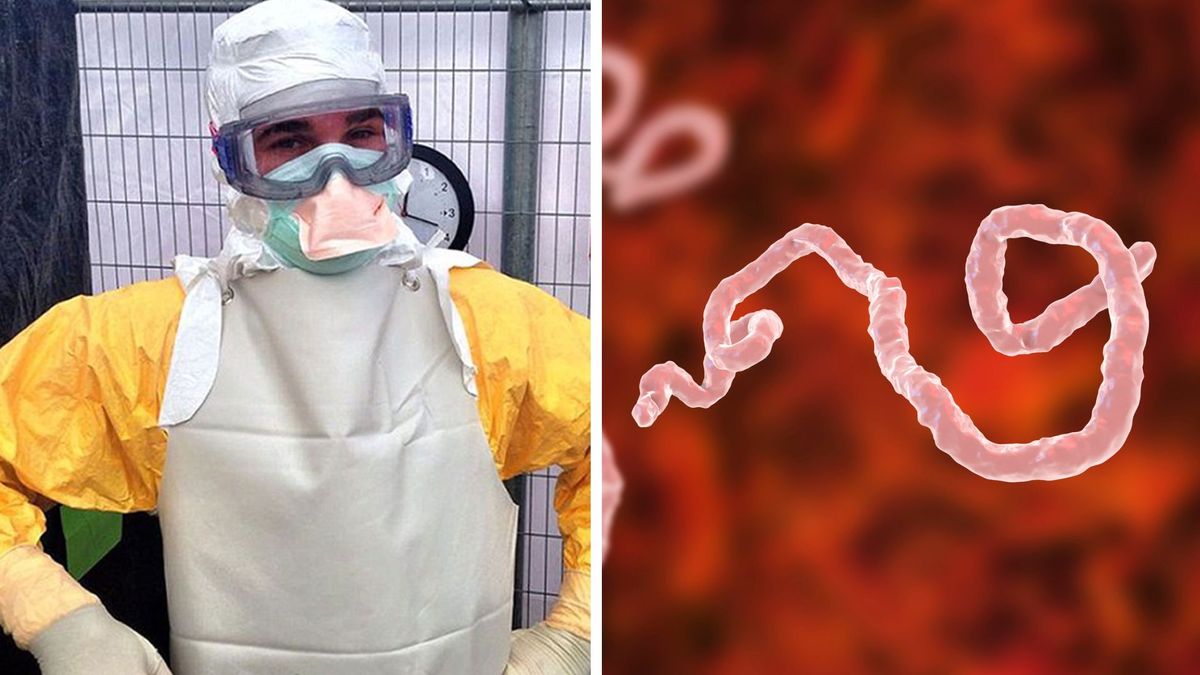
Health officials are on high alert in the wake of a fresh Ebola virus outbreak in Africa that has already made its way abroad.
Ebola, which causes fever, vomiting, and catastrophic bleeding, can kill those infected within just 24 hours.
More than 130 people are believed to have died and there have been more than 500 suspected cases in the Ebola outbreak in eastern Congo, the country’s health ministry has said in a shocking update.
An American has also been a confirmed case, with the US citizen exposed to the virus while working in the DR Congo. That person has tested positive and has been flown to Germany for treatment, according to the Centres for Disease Control and Prevention (CDC). The Ebola-infected American is currently in a special isolation ward at Charité hospital in Berlin.
 View 5 Images
A staff member of the CBCA Virunga Hospital checks a visitor’s temperature using a a contactless infrared thermometer, before allowing her access to the hospital in Goma, where the first case of a 2026 Ebola virus outbreak was reported.(Image: AFP via Getty Images)
Six other people have also been identified as high-risk contacts, and are expected to be relocated to Europe to be placed under a strict quarantine.
But, as the world scrambles to wrap its head around another major health crisis, an American doctor has spoken out after he became infected with Ebola when treating patients in an outbreak in 2014.
Dr Craig Spencer has told American outlet ABC News he is “certain” the current virus outbreak is “much bigger” than what current numbers show.
 View 5 Images
Dr Craig Spencer, who was diagnosed with Ebola in New York City last month, is viewed at a news conference at New York’s Bellevue Hospital after being declared free of the disease on November 11, 2014 in New York City.(Image: Getty Images)
“My biggest concern about this outbreak is that we learned way too much way too quickly for this to be anything but really bad,” Dr Spencer said.
Dr Spencer tested positive for the killer virus after treating patients in Guinea in 2014 while working for Médecins Sans Frontières, also known as Doctors Without Borders. When he returned to the states, he spent 19 days being treated at New York’s Bellevue Hospital in Manhattan.
“I was lucky enough to survive. And then a few months later, I went back to Guinea. As an epidemiologist helping run the national response for Doctors Without Borders in early 2015,” Dr Spencer said.
When asked if he would ever consider lending a hand to help with the current Ebola outbreak, he said: “I’ve already put my family through quite a bit. We’ll see what comes out of this, but I’m happy to help.”
 View 5 Images
A visitor washes his hands before entering Kyeshero Hospital at a checkpoint for hand washing and temperature screening for all visitors and patients entering Kyeshero Hospital, as part of Ebola prevention measures in Goma on May 18, 2026.(Image: AFP via Getty Images)
Dr Spencer added to ABC News that the American doctor who has recently contracted the disease is at the forefront of his mind.
“I unfortunately know exactly what it feels like to be in that situation, to be incredibly fearful, to have a disease that maybe you’ve seen the impact of and know that there’s not a treatment for,” Dr Spencer said, adding: “I’m thinking of him and his family.”
Dr Spencer still works in emergency medicine as a doctor at A&E, and now is also a professor of public health at Brown University. He added that US president Donald Trump’s decision to withdraw the US from the World Health Organisation (WHO) has left America flat-footed in responding to the latest Ebola outbreak. It was one of Trump’s first acts on returning to office last year.
 View 5 Images
Trump withdrew US support for the WHO, a year prior to the 2206 Ebola crisis in which six Americans are reported to have been exposed(Image: AP Photo/Mark Schiefelbein)
Dr Spencer’s comments come shortly after US Secretary of State Marco Rubio criticised the WHO on Tuesday (May 19), telling reporters the international health watchdog was “a little late” in identifying the deadly Ebola outbreak in Africa.
“The lead is obviously going to be CDC and the World Health Organisation, which was a little late to identify this thing unfortunately,” he said, via the Guardian.
Rubio added that the United States – which committed about £9.7 million (USD$13 million) in assistance despite sweeping aid cuts last year – was hoping to open about 50 clinics to treat Ebola in the DR Congo.
Article continues below
The US departure from the WHO also saw the international health watchdog lose nearly a quarter of its workforce – about 2,000 jobs – from a total staff of about 9,400.
Trump’s withdrawal of the US from the WHO is a move that has been described by experts – namely Georgetown University professor of global health Lawrence Gostin – as “sowing the seeds of the next pandemic”.